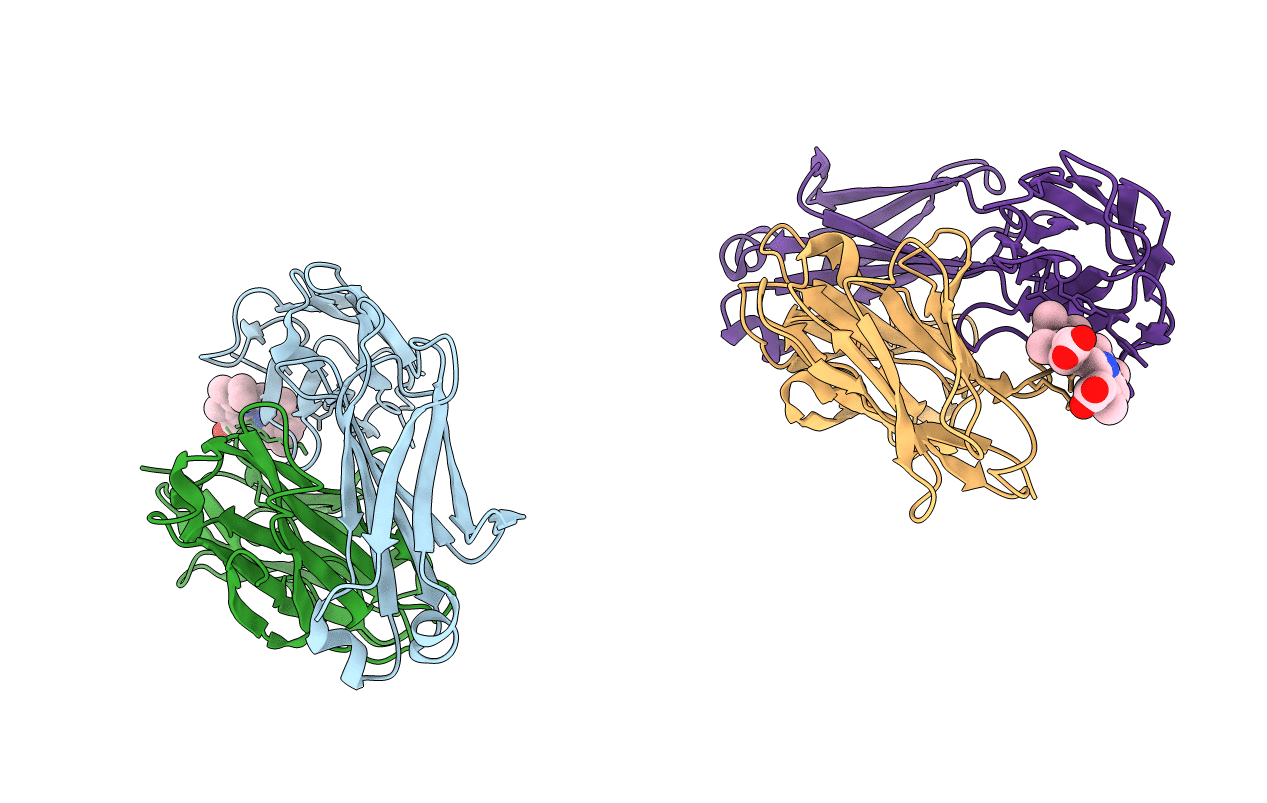
1NGW image
Deposition Date 2002-12-18
Release Date 2003-02-04
Last Version Date 2024-10-30
Entry Detail
PDB ID:
1NGW
Keywords:
Title:
Chimeric Affinity Matured Fab 7g12 complexed with mesoporphyrin
Biological Source:
Source Organism:
Host Organism:
Method Details:
Experimental Method:
Resolution:
2.60 Å
R-Value Free:
0.31
R-Value Work:
0.27
Space Group:
P 21 21 2
Macromolecular Entities
Structures with similar UniProt ID
Protein Blast
Polymer Type:polypeptide(L)
Molecule:Mature Metal Chelatase Catalytic Antibody, Heavy chain
Gene (Uniprot):Ighv1-72
Chain IDs:B (auth: H), D (auth: B)
Chain Length:216
Number of Molecules:2
Biological Source:Mus musculus, Homo sapiens
Polymer Type:polypeptide(L)
Molecule:Mature Metal Chelatase Catalytic Antibody, Light chain
Chain IDs:A (auth: L), C (auth: A)
Chain Length:213
Number of Molecules:2
Biological Source:Mus musculus, Homo sapiens
Ligand Molecules
Primary Citation
Structural evidence for substrate strain in antibody catalysis
Proc.Natl.Acad.Sci.USA 100 856 861 (2003)
PMID: 12552112 DOI: 10.1073/pnas.0235873100

Abstact

The crystal structure of the Michaelis complex between the Fab fragment of ferrochelatase antibody 7G12 and its substrate mesoporphyrin has been solved to 2.6-A resolution. The antibody-bound mesoporphyrin clearly adopts a nonplanar conformation and reveals that the antibody catalyzes the porphyrin metallation reaction by straining/distorting the bound substrate toward the transition-state configuration. The crystal structures of the Fab fragment of the germ-line precursor antibody to 7G12 and its complex with the hapten N-methylmesoporphyrin have also been solved. A comparison of these structures with the corresponding structures of the affinity-matured antibody 7G12 reveals the molecular mechanism by which the immune system evolves binding energy to catalyze this reaction.

Legend

Protein

Chemical

Disease

Primary Citation of related structures
Feedback Form
Name
Email
Institute
Feedback