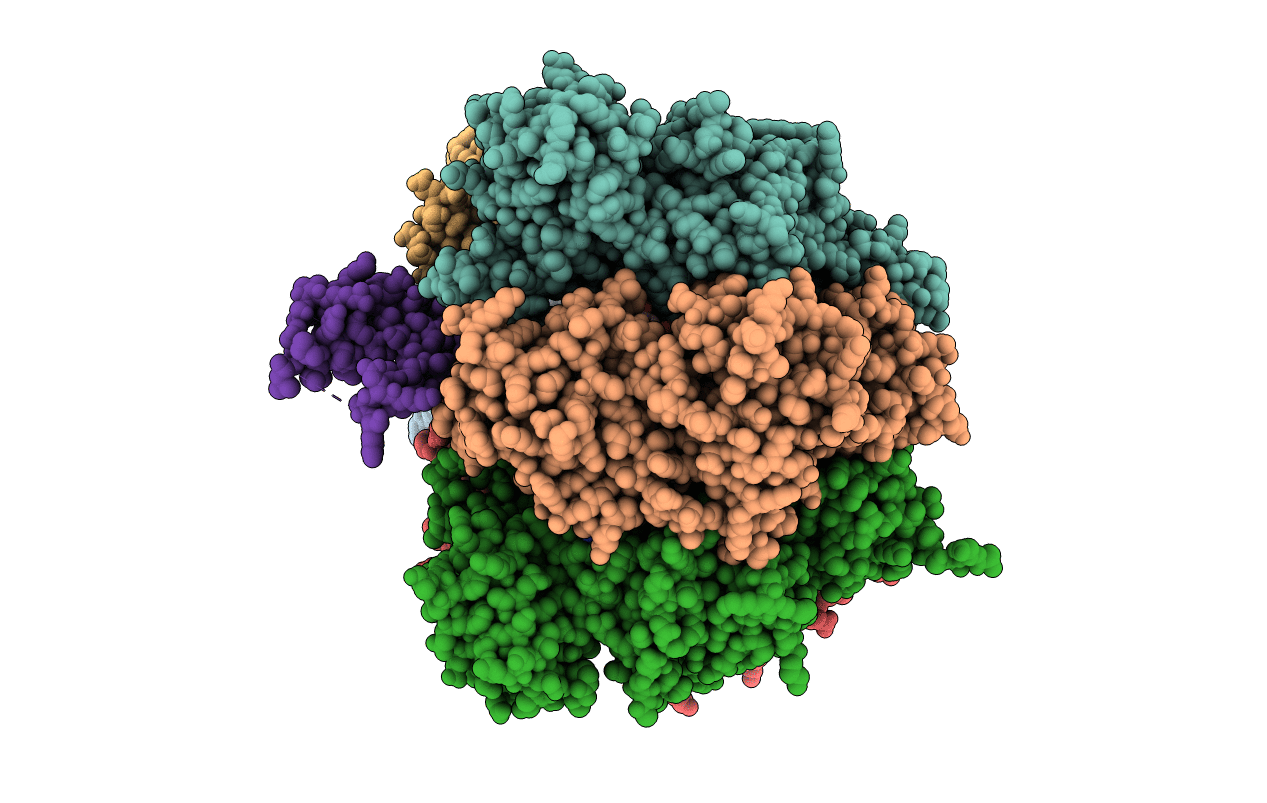
1NBM image
Deposition Date 1998-04-30
Release Date 1998-08-26
Last Version Date 2024-04-03
Entry Detail
PDB ID:
1NBM
Keywords:
Title:
THE STRUCTURE OF BOVINE F1-ATPASE COVALENTLY INHIBITED WITH 4-CHLORO-7-NITROBENZOFURAZAN
Biological Source:
Source Organism:
Bos taurus (Taxon ID: 9913)
Method Details:
Experimental Method:
Resolution:
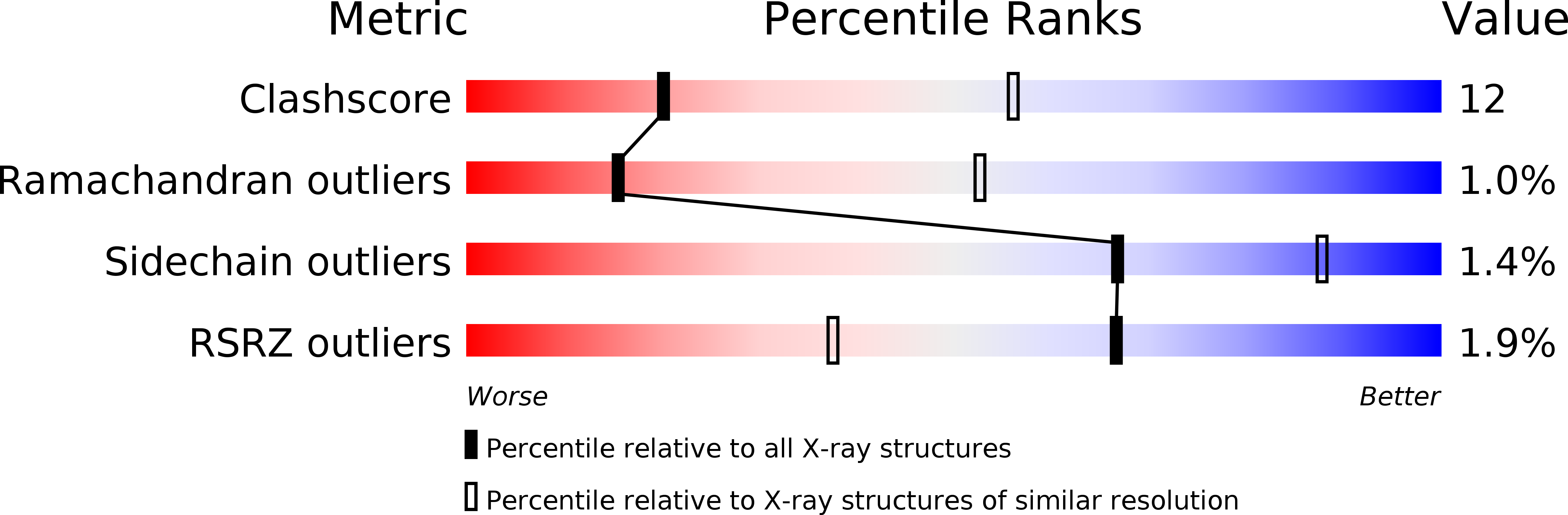
3.00 Å
R-Value Free:
0.29
R-Value Work:
0.20
R-Value Observed:
0.20
Space Group:
P 21 21 21
Macromolecular Entities
Structures with similar UniProt ID
Protein Blast
Polymer Type:polypeptide(L)
Molecule:F1-ATPASE
Gene (Uniprot):ATP5F1A
Chain IDs:A, B, C
Chain Length:510
Number of Molecules:3
Biological Source:Bos taurus
Structures with similar UniProt ID
Protein Blast
Polymer Type:polypeptide(L)
Molecule:F1-ATPASE
Gene (Uniprot):ATP5F1B
Chain IDs:D, F
Chain Length:480
Number of Molecules:2
Biological Source:Bos taurus
Structures with similar UniProt ID
Protein Blast
Polymer Type:polypeptide(L)
Molecule:F1-ATPASE
Gene (Uniprot):ATP5F1B
Chain IDs:E
Chain Length:480
Number of Molecules:1
Biological Source:Bos taurus
Structures with similar UniProt ID
Protein Blast
Polymer Type:polypeptide(L)
Molecule:F1-ATPASE
Gene (Uniprot):ATP5F1C
Chain IDs:G
Chain Length:272
Number of Molecules:1
Biological Source:Bos taurus
Modified Residue
Compound ID Chain ID Parent Comp ID Details 2D Image
TYN E TYR AMINOBENZOFURAZAN-O-TYROSINE
Primary Citation
Bovine F1-ATPase covalently inhibited with 4-chloro-7-nitrobenzofurazan: the structure provides further support for a rotary catalytic mechanism.
Structure 6 831 837 (1998)
PMID: 9687365 DOI: 10.1016/S0969-2126(98)00085-9

Abstact

BACKGROUND F1-ATPase is the globular domain of F1F0-ATP synthase that catalyses the hydrolysis of ATP to ADP and phosphate. The crystal structure of bovine F1-ATPase has been determined previously to 2.8 A resolution. The enzyme comprises five different subunits in the stoichiometry alpha 3 beta 3 gamma delta epsilon; the three catalytic beta subunits alternate with the three alpha subunits around the centrally located single gamma subunit. To understand more about the catalytic mechanisms, F1-ATPase was inhibited by reaction with 4-chloro-7-nitrobenzofurazan (NBD-Cl) and the structure of the inhibited complex (F1-NBD) determined by X-ray crystallography. RESULTS In the structure the three beta subunits adopt a different conformation with different nucleotide occupancy. NBD-Cl reacts with the phenolic oxygen of Tyr311 of the beta E subunit, which contains no bound nucleotide. The two other catalytic subunits beta TP and beta DP contain bound adenylyl-imidodiphosphate (AMP-PNP) and ADP, respectively. The binding site of the NBD moiety does not overlap with the regions of beta E that form the nucleotide-binding pocket in subunits beta TP and beta DP nor does it occlude the nucleotide-binding site. Catalysis appears to be inhibited because neither beta TP nor beta DP can accommodate a Tyr311 residue bearing an NBD group. CONCLUSIONS The results presented here are consistent with a rotary catalytic mechanism of ATP synthesis and hydrolysis, which requires the sequential and concerted participation of all three catalytic sites. NBD-Cl inhibits the enzyme by preventing the modified subunit from adopting a conformation that is essential for catalysis to proceed.

Legend

Protein

Chemical

Disease

Primary Citation of related structures
Feedback Form
Name
Email
Institute
Feedback