1NAA image
Deposition Date 2002-11-27
Release Date 2003-01-14
Last Version Date 2024-11-20
Entry Detail
PDB ID:
1NAA
Keywords:
Title:
Cellobiose Dehydrogenase Flavoprotein Fragment in Complex with Cellobionolactam
Biological Source:
Source Organism:
Method Details:
Experimental Method:
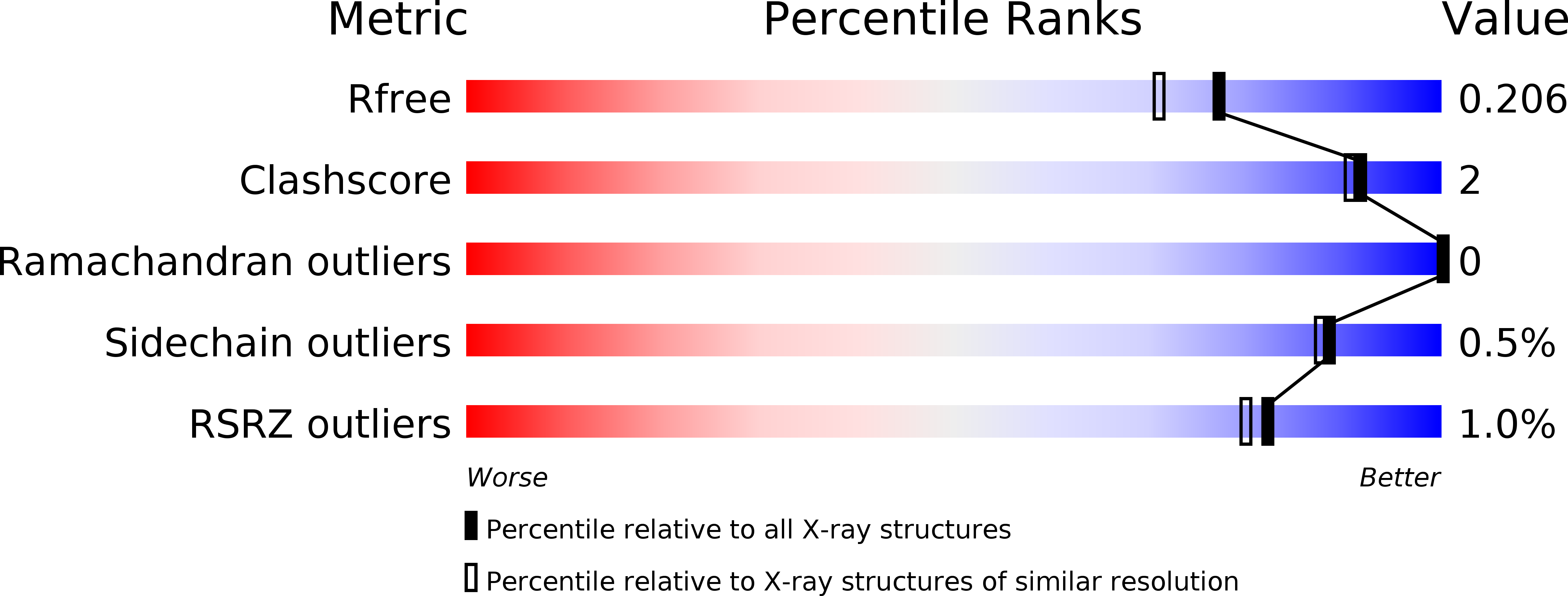
Resolution:
1.80 Å
R-Value Free:
0.18
R-Value Work:
0.14
R-Value Observed:
0.14
Space Group:
H 3
Macromolecular Entities
Structures with similar UniProt ID
Protein Blast
Polymer Type:polypeptide(L)
Molecule:Cellobiose dehydrogenase
Gene (Uniprot):CDH-1, CDH-2
Chain IDs:A, B
Chain Length:541
Number of Molecules:2
Biological Source:Phanerochaete chrysosporium
Modified Residue
Compound ID Chain ID Parent Comp ID Details 2D Image
ASN A ASN GLYCOSYLATION SITE
Primary Citation
Mechanism of the reductive half-reaction in cellobiose dehydrogenase
J.BIOL.CHEM. 278 7160 7166 (2003)
PMID: 12493734 DOI: 10.1074/jbc.M210961200

Abstact

The extracellular flavocytochrome cellobiose dehydrogenase (CDH; EC ) participates in lignocellulose degradation by white-rot fungi with a proposed role in the early events of wood degradation. The complete hemoflavoenzyme consists of a catalytically active dehydrogenase fragment (DH(cdh)) connected to a b-type cytochrome domain via a linker peptide. In the reductive half-reaction, DH(cdh) catalyzes the oxidation of cellobiose to yield cellobiono-1,5-lactone. The active site of DH(cdh) is structurally similar to that of glucose oxidase and cholesterol oxidase, with a conserved histidine residue positioned at the re face of the flavin ring close to the N5 atom. The mechanisms of oxidation in glucose oxidase and cholesterol oxidase are still poorly understood, partly because of lack of experimental structure data or difficulties in interpreting existing data for enzyme-ligand complexes. Here we report the crystal structure of the Phanerochaete chrysosporium DH(cdh) with a bound inhibitor, cellobiono-1,5-lactam, at 1.8-A resolution. The distance between the lactam C1 and the flavin N5 is only 2.9 A, implying that in an approximately planar transition state, the maximum distance for the axial 1-hydrogen to travel for covalent addition to N5 is 0.8-0.9 A. The lactam O1 interacts intimately with the side chains of His-689 and Asn-732. Our data lend substantial structural support to a reaction mechanism where His-689 acts as a general base by abstracting the O1 hydroxyl proton in concert with transfer of the C1 hydrogen as hydride to the re face of the flavin N5.

Legend

Protein

Chemical

Disease

Primary Citation of related structures
Feedback Form
Name
Email
Institute
Feedback