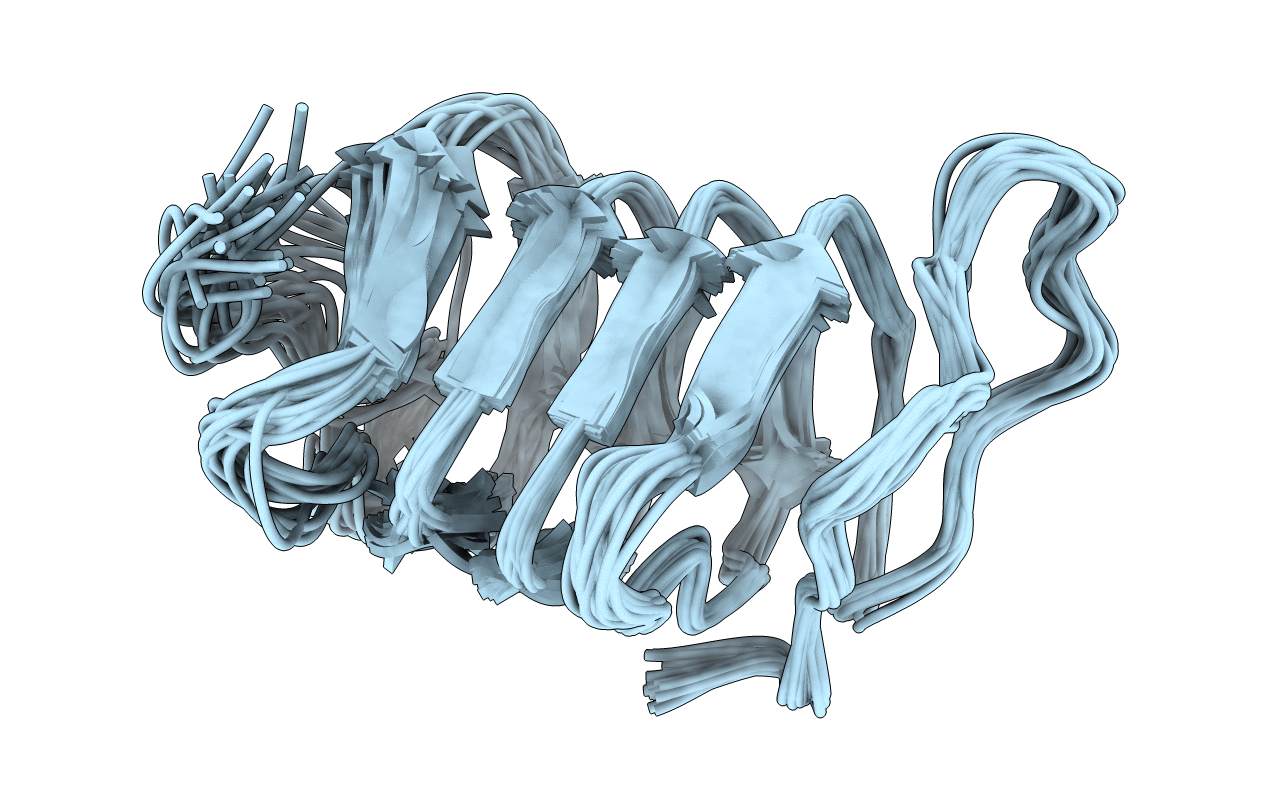
1N4I image
Deposition Date 2002-10-31
Release Date 2003-04-08
Last Version Date 2024-10-30
Entry Detail
PDB ID:
1N4I
Title:
Solution structure of spruce budworm antifreeze protein at 5 degrees celsius
Biological Source:
Source Organism:
Host Organism:
Method Details:
Experimental Method:
Conformers Calculated:
50
Conformers Submitted:
25
Selection Criteria:
structures with the lowest energy

Macromolecular Entities
Structures with similar UniProt ID
Protein Blast
Polymer Type:polypeptide(L)
Molecule:thermal hysteresis protein
Chain IDs:A
Chain Length:90
Number of Molecules:1
Biological Source:Choristoneura fumiferana
Ligand Molecules
Primary Citation
Spruce Budworm Antifreeze Protein: Changes in Structure and Dynamics at Low Temperature
J.Mol.Biol. 327 1155 1168 (2003)
PMID: 12662938 DOI: 10.1016/S0022-2836(03)00235-3

Abstact

Antifreeze proteins (AFPs) prevent the growth of ice, and are used by some organisms that live in sub-zero environments for protection against freezing. All AFPs are thought to function by an adsorption inhibition process. In order to elucidate the ice-binding mechanism, the structures of several AFPs have been determined, and have been shown to consist of different folds. Recently, the first structures of the highly active insect AFPs have been characterized. These proteins have a beta-helix structure, which adds yet another fold to the AFP family. The 90-residue spruce budworm (Choristoneura fumiferana) AFP consists of a beta-helix with 15 residues per coil. The structure contains two ranks of aligned threonine residues (known as the TXT motif), which were shown by mutagenesis experiments to be located in the ice-binding face. In our previous NMR study of this AFP at 30 degrees C, we found that the TXT face was not optimally defined because of the broadening of NMR resonances potentially due to weak oligomerization. We present here a structure of spruce budworm AFP determined at 5 degrees C, where this broadening is reduced. In addition, the 1H-15N NMR dynamics of the protein were examined at 30 degrees C and 5 degrees C. The results show that the spruce budworm AFP is more structured at 5 degrees C, and support the general observation that AFPs become more rigid as the temperature is lowered.

Legend

Protein

Chemical

Disease

Primary Citation of related structures
Feedback Form
Name
Email
Institute
Feedback