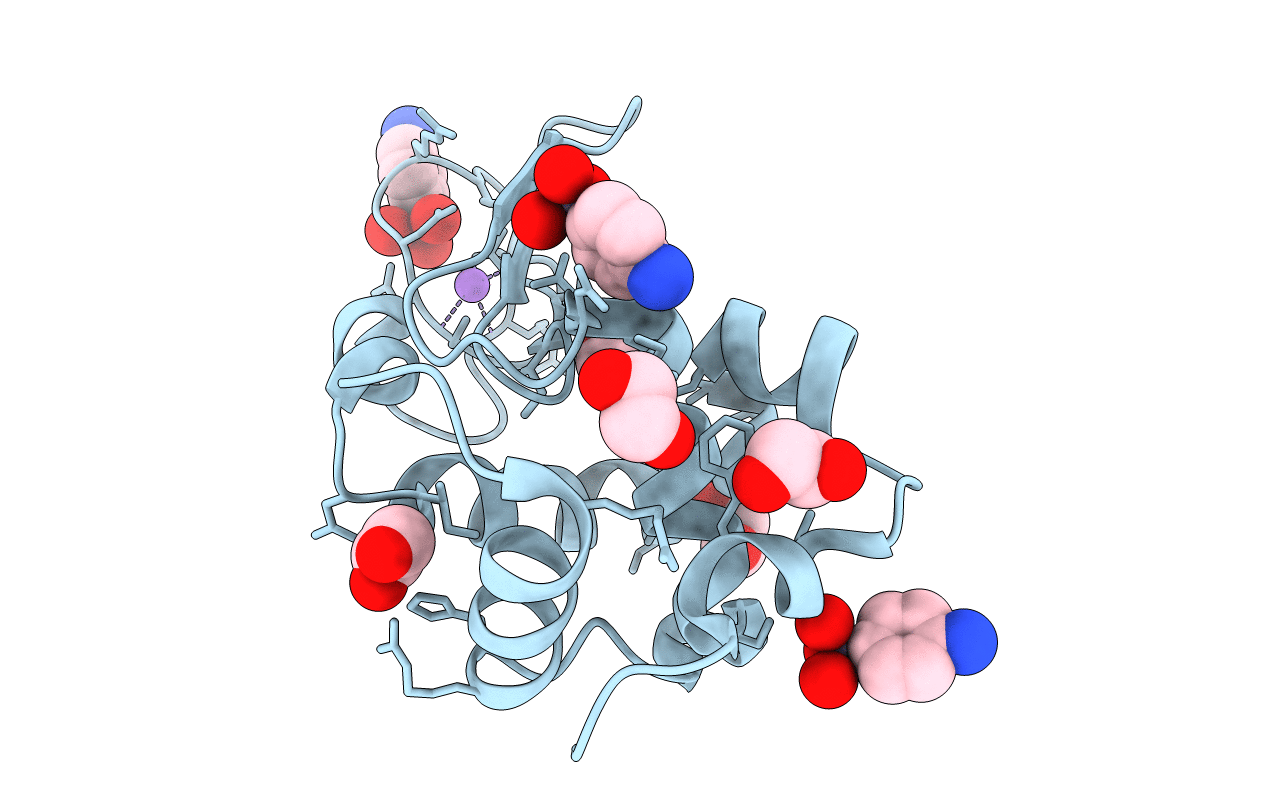
1N4F image
Deposition Date 2002-10-31
Release Date 2003-05-06
Last Version Date 2024-10-09
Entry Detail
PDB ID:
1N4F
Keywords:
Title:
Para-Arsanilate Derivative of Hen Egg-White Lysozyme
Biological Source:
Source Organism:
Gallus gallus (Taxon ID: 9031)
Method Details:
Experimental Method:
Resolution:
1.78 Å
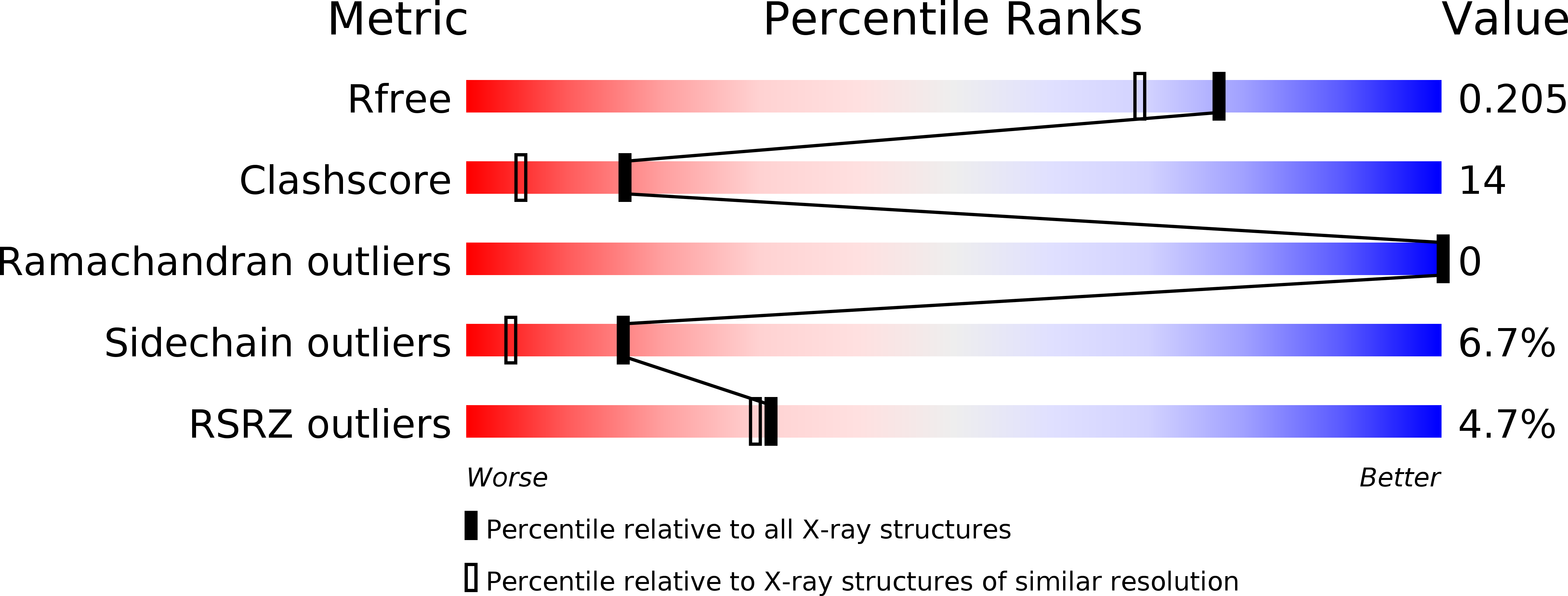
R-Value Free:
0.21
R-Value Work:
0.16
Space Group:
P 43 21 2
Macromolecular Entities
Structures with similar UniProt ID
Protein Blast
Polymer Type:polypeptide(L)
Molecule:Lysozyme C
Gene (Uniprot):LYZ
Chain IDs:A
Chain Length:129
Number of Molecules:1
Biological Source:Gallus gallus
Primary Citation
Phasing power at the K absorption edge of organic arsenic.
Acta Crystallogr.,Sect.D 59 887 896 (2003)
PMID: 12777806 DOI: 10.1107/S0907444903003512

Abstact

Single/multiple-wavelength anomalous dispersion (SAD/MAD) experiments were performed on a crystal of an organic arsenic derivative of hen egg-white lysozyme. A para-arsanilate compound used as a crystallizing reagent was incorporated into the ordered solvent region of the lysozyme molecule. Diffraction data were collected to high resolution (</=2.0 A) at three wavelengths around the K edge (1.04 A) of arsenic at beamline BM30A, ESRF synchrotron. Anomalous Patterson maps clearly showed the main arsanilate site to be between three symmetry-related lysozyme molecules, at a location previously occupied by a para-toluenesulfonate anion. MAD phases at 2 A derived using the program SHARP led to an electron-density map of sufficient quality to start manual building of the protein model. Amplitudes from a second crystal measured to a resolution of 1.8 A at the peak wavelength revealed two additional heavy-atom sites, which reinforced the anomalous subset model and therefore dramatically improved the phasing power of the arsenic derivative. The subsequent solvent-flattened map was of such high accuracy that the program ARP/wARP was able to build a nearly complete model automatically. This work emphasizes the great potential of arsenic for de novo structure determination using anomalous dispersion methods.

Legend

Protein

Chemical

Disease

Primary Citation of related structures
Feedback Form
Name
Email
Institute
Feedback