1N45 image
Deposition Date 2002-10-30
Release Date 2002-11-13
Last Version Date 2024-02-14
Entry Detail
PDB ID:
1N45
Keywords:
Title:
X-RAY CRYSTAL STRUCTURE OF HUMAN HEME OXYGENASE-1 (HO-1) IN COMPLEX WITH ITS SUBSTRATE HEME
Biological Source:
Source Organism(s):
Homo sapiens (Taxon ID: 9606)
Expression System(s):
Method Details:
Experimental Method:
Resolution:
1.50 Å
R-Value Free:
0.21
R-Value Work:
0.15
Space Group:
P 1 21 1
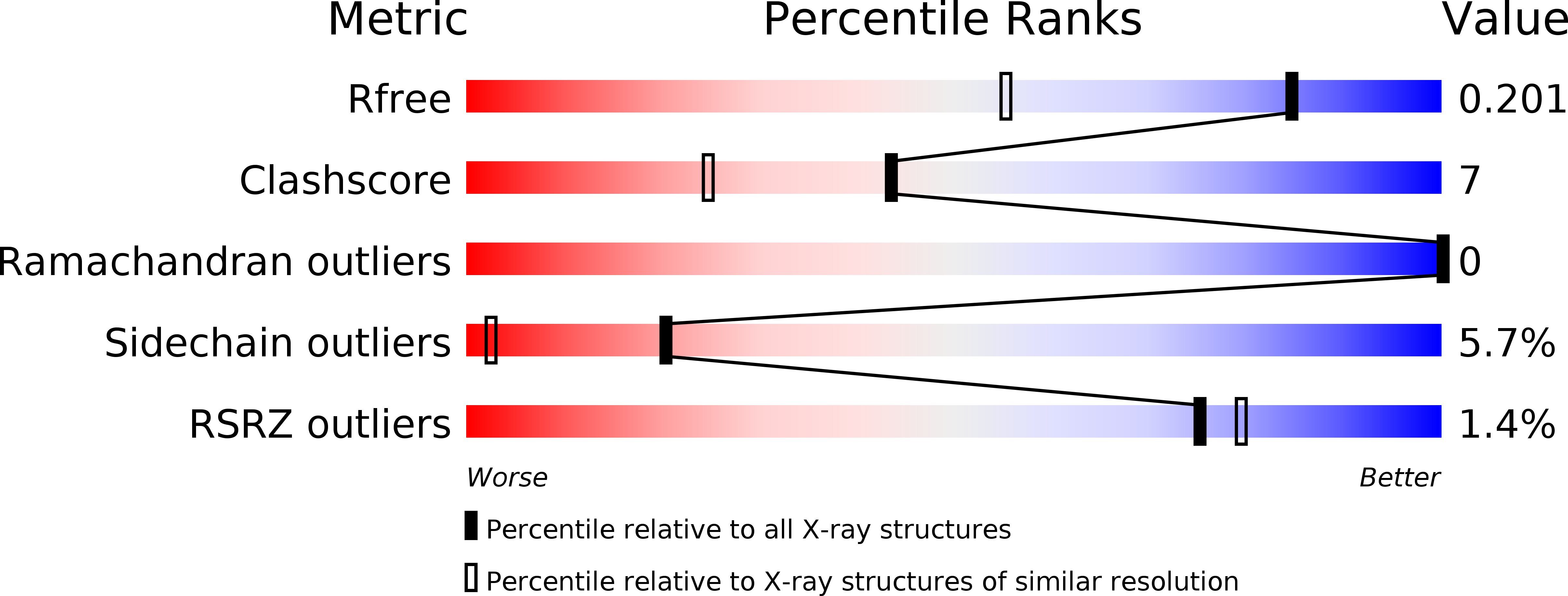
Macromolecular Entities
Structures with similar UniProt ID
Protein Blast
Polymer Type:polypeptide(L)
Molecule:heme oxygenase 1
Gene (Uniprot):HMOX1
Chain IDs:A, B
Chain Length:233
Number of Molecules:2
Biological Source:Homo sapiens
Primary Citation
Comparison of the heme-free and -bound crystal structures of human heme oxygenase-1.
J. Biol. Chem. 278 7834 7843 (2003)
PMID: 12500973 DOI: 10.1074/jbc.M211450200

Abstact

Heme oxygenase (HO) catalyzes the degradation of heme to biliverdin. The crystal structure of human HO-1 in complex with heme reveals a novel helical structure with conserved glycines in the distal helix, providing flexibility to accommodate substrate binding and product release (Schuller, D. J., Wilks, A., Ortiz de Montellano, P. R., and Poulos, T. L. (1999) Nat. Struct. Biol. 6, 860-867). To structurally understand the HO catalytic pathway in more detail, we have determined the crystal structure of human apo-HO-1 at 2.1 A and a higher resolution structure of human HO-1 in complex with heme at 1.5 A. Although the 1.5-A heme.HO-1 model confirms our initial analysis based on the 2.08-A model, the higher resolution structure has revealed important new details such as a solvent H-bonded network in the active site that may be important for catalysis. Because of the absence of the heme, the distal and proximal helices that bracket the heme plane in the holo structure move farther apart in the apo structure, thus increasing the size of the active-site pocket. Nevertheless, the relative positioning and conformation of critical catalytic residues remain unchanged in the apo structure compared with the holo structure, but an important solvent H-bonded network is missing in the apoenzyme. It thus appears that the binding of heme and a tightening of the structure around the heme stabilize the solvent H-bonded network required for proper catalysis.

Legend

Protein

Chemical

Disease

Primary Citation of related structures
Feedback Form
Name
Email
Institute
Feedback