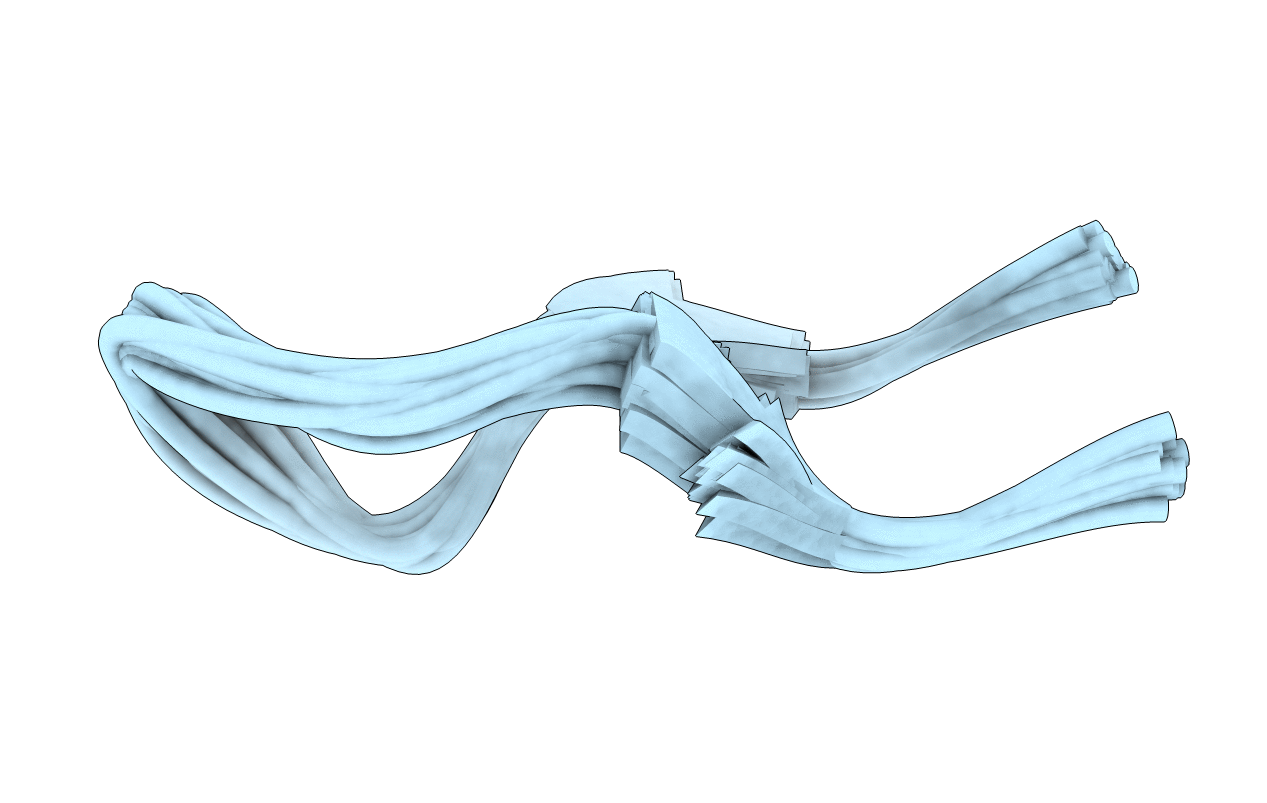
1N0D image
Deposition Date 2002-10-11
Release Date 2003-02-04
Last Version Date 2024-10-30
Entry Detail
PDB ID:
1N0D
Keywords:
Title:
Stability of cyclic beta-hairpins: Asymmetric contibutions from side chains of hydrogen bonded cross-strand residue pair
Biological Source:
Source Organism:
Method Details:
Experimental Method:
Conformers Calculated:
80
Conformers Submitted:
20
Selection Criteria:
structures with the least restraint violations
Macromolecular Entities
Polymer Type:polypeptide(L)
Molecule:bhp_VWLH, disulfide cyclized beta-hairpin peptide
Chain IDs:A
Chain Length:12
Number of Molecules:1
Biological Source:
Ligand Molecules
Primary Citation
Stability of Cyclic Beta-Hairpins: Asymmetric Contributions From Side Chains of Hydrogen Bonded Cross-Strand Residue Pair
J.Am.Chem.Soc. 125 388 395 (2003)
PMID: 12517150 DOI: 10.1021/ja028075l

Abstact

Amino acid structural propensities measured in "host-guest" model studies are often used in protein structure prediction or to choose appropriate residues in de novo protein design. While this concept has proven useful for helical structures, it is more difficult to apply successfully to beta-sheets. We have developed a cyclic beta-hairpin scaffold as a host for measurement of individual residue contributions to hairpin structural stability. Previously, we have characterized substitutions in non-backbone-hydrogen-bonded strand sites; relative stability differences measured in the cyclic host are highly predictive of changes in folding free energy for linear beta-hairpin peptides. Here, we examine the hydrogen-bonded strand positions of our host. Surprisingly, we find a large favorable contribution to stability from a valine (or isoleucine) substitution immediately preceding the C-terminal cysteine of the host peptide, but not at the cross-strand position of the host or in either strand of a folded linear beta-hairpin (trpzip peptide). Further substitutions in the peptides and NMR structural analysis indicate that the stabilizing effect of valine is general for CX(8)C cyclic hairpins and cannot be explained by particular side-chain-side-chain interactions. Instead, a localized decrease in twist of the peptide backbone on the N-terminal side of the cysteine allows the valine side chain to adopt a unique conformation that decreases the solvent accessibility of the peptide backbone. The conformation differs from the highly twisted (coiled) conformation of the trpzip hairpins and is more typical of conformations present in multistranded beta-sheets. This unexpected structural fine-tuning may explain why cyclic hairpins selected from phage-displayed libraries often have valine in the same position, preceding the C-terminal cysteine. It also emphasizes the diversity of structures accessible to beta-strands and the importance of considering not only "beta-propensity", but also hydrogen-bonding pattern and strand twist, when designing beta structures. Finally, we observe correlated, cooperative stabilization from side-chain substitutions on opposite faces of the hairpin. This suggests that cooperative folding in beta-hairpins and other small beta-structures is driven by cooperative strand-strand association.

Legend

Protein

Chemical

Disease

Primary Citation of related structures
Feedback Form
Name
Email
Institute
Feedback