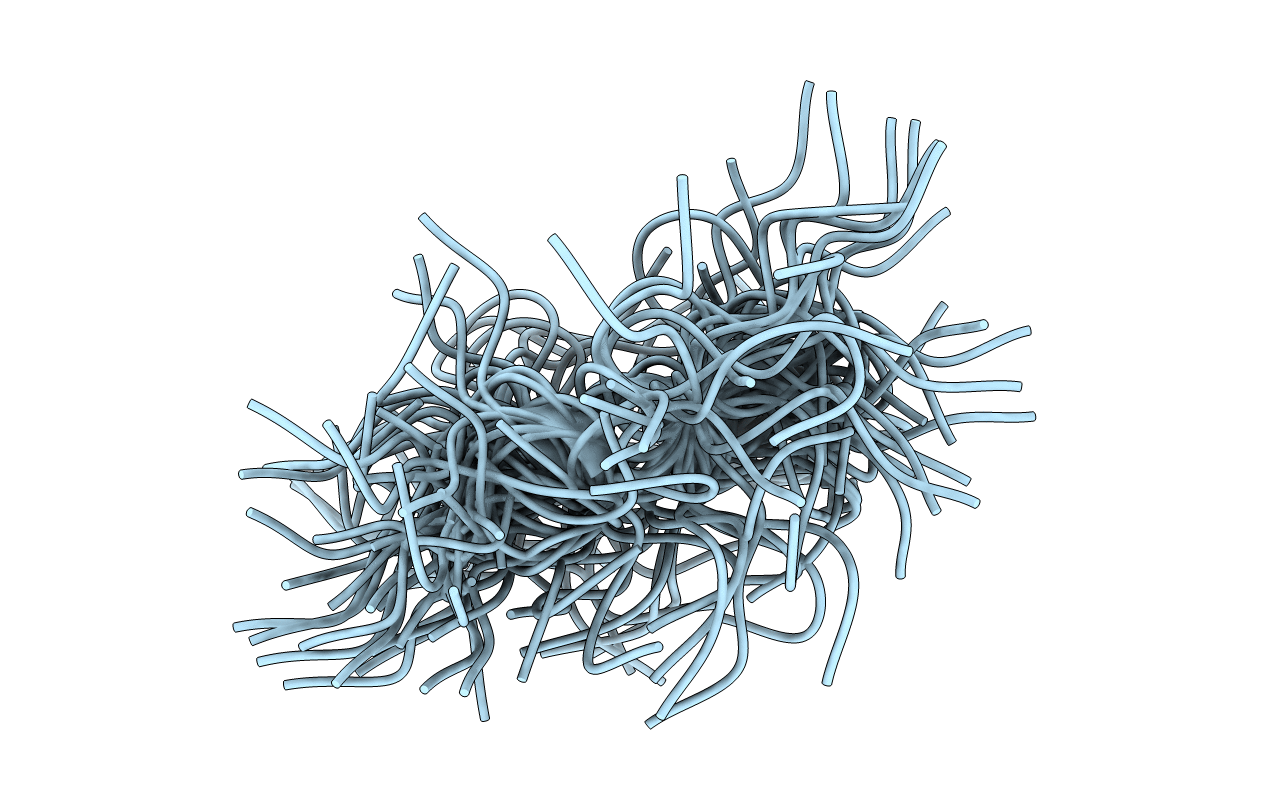
1MZI image
Deposition Date 2002-10-08
Release Date 2003-09-02
Last Version Date 2024-05-29
Entry Detail
PDB ID:
1MZI
Keywords:
Title:
Solution ensemble structures of HIV-1 gp41 2F5 mAb epitope
Biological Source:
Source Organism:
Method Details:
Experimental Method:
Conformers Calculated:
6400
Conformers Submitted:
81
Selection Criteria:
Base set ensemble representative of the conformational space experimentally allowed

Macromolecular Entities
Structures with similar UniProt ID
Protein Blast
Polymer Type:polypeptide(L)
Molecule:2F5 epitope of HIV-1 gp41 fusion protein
Gene (Uniprot):env
Chain IDs:A
Chain Length:13
Number of Molecules:1
Biological Source:
Ligand Molecules
Primary Citation
Structural analysis of the epitope of the anti-HIV antibody 2F5 sheds light into its mechanism of neutralization and HIV fusion.
J.Mol.Biol. 330 1101 1115 (2003)
PMID: 12860131 DOI: 10.1016/S0022-2836(03)00611-9

Abstact

Inhibition of human immunodeficiency virus (HIV) fusion with the host cell has emerged as a viable therapeutic strategy, and rational design of inhibitors and vaccines, interfering with this process, is a prime target for antiviral research. To advance our knowledge of the structural biology of HIV fusion, we have studied the membrane-proximal region of the fusogenic envelope subunit gp41, which includes the epitope ELDKWA of the broadly neutralizing human antibody 2F5. The structural evidence available for this region is contradictory, with some studies suggesting an overall helical conformation, while the X-ray structure of the ELDKWAS peptide bound to the antibody shows it folded in a type I beta turn. We used a two-step strategy: Firstly, by a competition binding assay, we identified the proper boundaries of the domain recognized by 2F5, which we found considerably larger than the ELDKWAS hexapeptide. Secondly, we studied the structure of the resulting 13 amino acid residue peptide by collecting NMR data and analyzing them by our previously developed statistical method (NAMFIS). Our study revealed that the increase in binding affinity goes in parallel with stabilization of specific local and global conformational propensities, absent from the shorter epitope. When compounded with the available biological evidence, our structural analysis allows us to propose a specific role for the membrane-proximal region during HIV fusion, in terms of a conformational transition between the turn and the helical structure. At the same time, our hypothesis offers a structural explanation for the mechanism of neutralization of mAb 2F5.

Legend

Protein

Chemical

Disease

Primary Citation of related structures
Feedback Form
Name
Email
Institute
Feedback