1MUT image
Deposition Date 1995-09-14
Release Date 1996-04-03
Last Version Date 2024-05-22
Entry Detail
PDB ID:
1MUT
Keywords:
Title:
NMR STUDY OF MUTT ENZYME, A NUCLEOSIDE TRIPHOSPHATE PYROPHOSPHOHYDROLASE
Biological Source:
Source Organism:
Escherichia coli (Taxon ID: 562)
Host Organism:
Method Details:
Experimental Method:
Conformers Submitted:
15
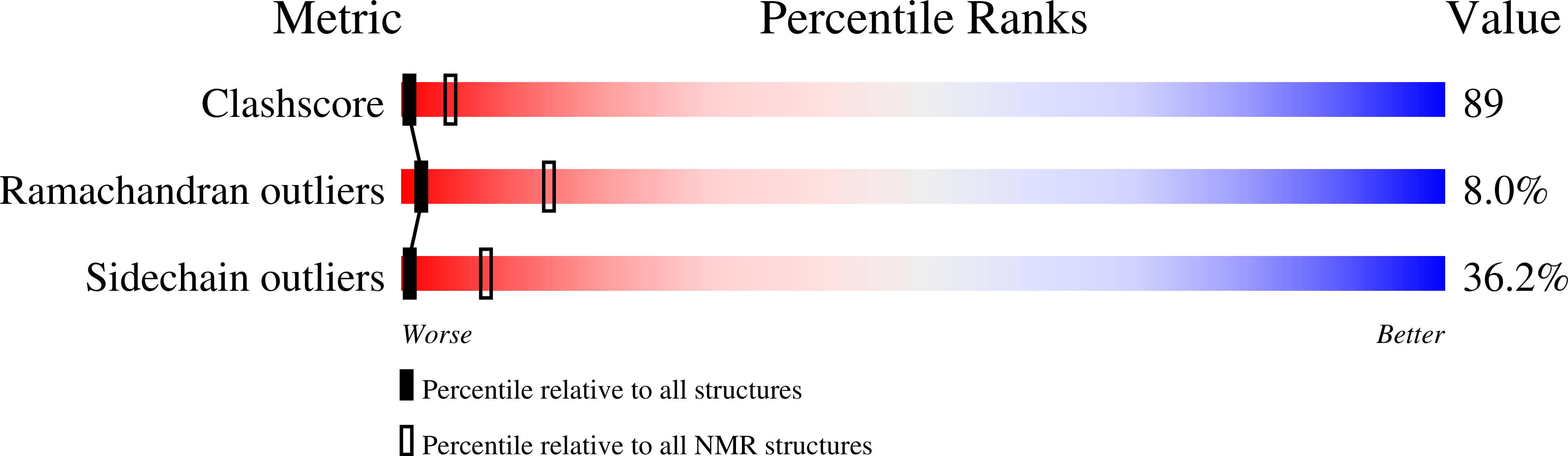
Macromolecular Entities
Structures with similar UniProt ID
Protein Blast
Polymer Type:polypeptide(L)
Molecule:NUCLEOSIDE TRIPHOSPHATE PYROPHOSPHOHYDROLASE
Gene (Uniprot):mutT
Chain IDs:A
Chain Length:129
Number of Molecules:1
Biological Source:Escherichia coli
Ligand Molecules
Primary Citation
Solution structure of the MutT enzyme, a nucleoside triphosphate pyrophosphohydrolase.
Biochemistry 34 14997 15005 (1995)
PMID: 7578113 DOI: 10.1021/bi00046a006

Abstact

The MutT enzyme (129 residues) catalyzes the hydrolysis of normal and mutagenic nucleoside triphosphates, such as 8-oxo-dGTP, by substitution at the rarely attacked beta-P, to yield NMP and pyrophosphate. Previous heteronuclear NMR studies of MutT have shown the secondary structure to consist of a five-stranded mixed beta-sheet connected by the loop I-alpha-helix I--loop II motif, by two tight turns, and by loop III, and terminated by loop IV--alpha-helix II [Abeygunawardana et al. (1993) Biochemistry 32, 13071-13080; Weber et al. (1993) Biochemistry 32, 13081-13087). Complete side-chain assignments of 1H and 13C resonances have now been made by 3D C(CO)NH and HCCH-TOCSY experiments. A total of 1461 interproton proximities (11 per residue), obtained by 3D 15N-resolved NOESY-HSQC and 3D 13C-resolved NOESY-HSQC spectra, including 372 long-range NOEs, as well as 65 dihedral angle (phi) restraints and 34 backbone hydrogen bond restraints were used to determine the tertiary structure of MutT by distance geometry, simulated annealing, and energy minimization with the program X-PLOR. The structure is globular and compact with the parallel portion of the beta-sheet sandwiched between the two alpha-helices, forming an alpha+beta fold. The essential divalent cation has previously been shown to bind near residues Gly-37, Gly-38, Lys-39, and Glu-57, and nucleotides have been shown to bind near residues Leu-54 and Val-58 by NMR relaxation methods [Frick et al. (1995) Biochemistry 34, 5577-5586].(ABSTRACT TRUNCATED AT 250 WORDS)

Legend

Protein

Chemical

Disease

Primary Citation of related structures
Feedback Form
Name
Email
Institute
Feedback