1ML4 image
Deposition Date 2002-08-30
Release Date 2003-02-25
Last Version Date 2023-10-25
Entry Detail
PDB ID:
1ML4
Keywords:
Title:
The PALA-liganded Aspartate transcarbamoylase catalytic subunit from Pyrococcus abyssi
Biological Source:
Source Organism:
Host Organism:
Method Details:
Experimental Method:
Resolution:
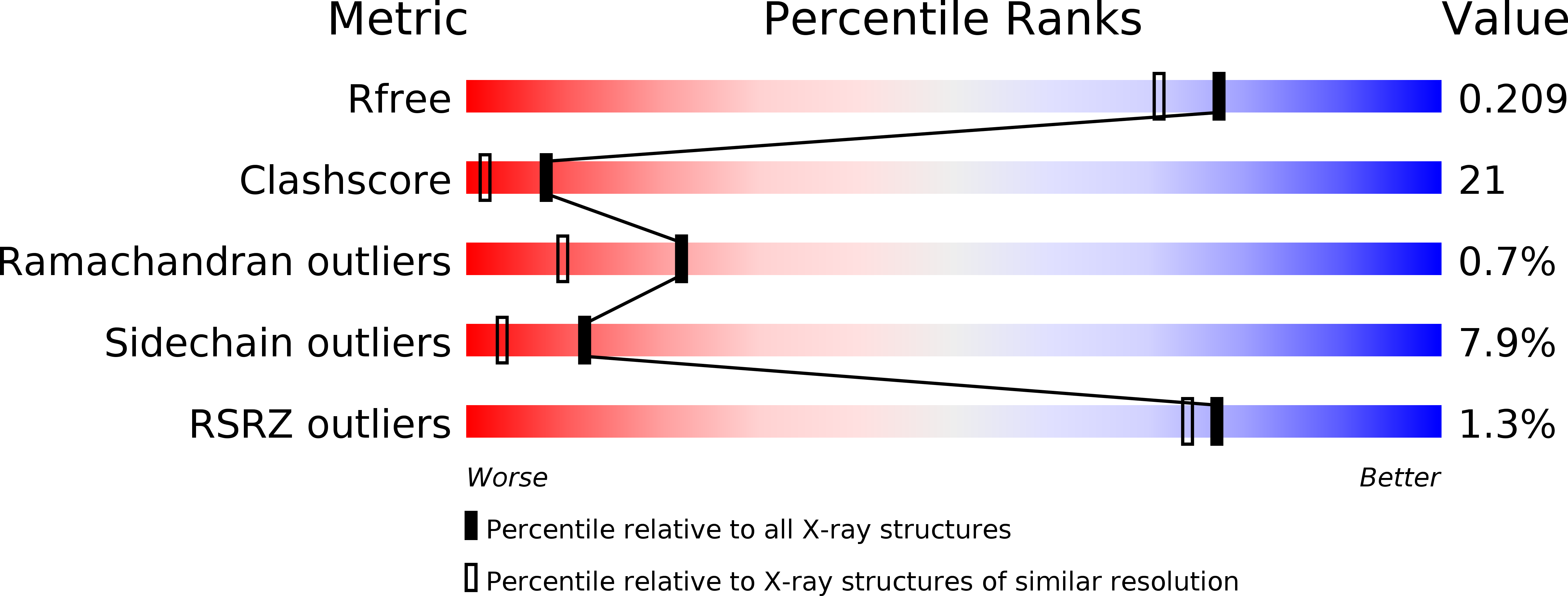
1.80 Å
R-Value Free:
0.21
R-Value Work:
0.17
R-Value Observed:
0.17
Space Group:
H 3
Macromolecular Entities
Structures with similar UniProt ID
Protein Blast
Polymer Type:polypeptide(L)
Molecule:Aspartate Transcarbamoylase
Gene (Uniprot):pyrB
Chain IDs:A
Chain Length:308
Number of Molecules:1
Biological Source:Pyrococcus abyssi
Ligand Molecules
Primary Citation
Aspartate Transcarbamylase from the Hyperthermophilic Archaeon Pyrococcus abyssi: Thermostability and 1.8A Resolution Crystal Structure of the Catalytic Subunit Complexed With the Bisubstrate Analogue N-Phosphonacetyl-L-aspartate.
J.Mol.Biol. 326 203 216 (2003)
PMID: 12547202 DOI: 10.1016/S0022-2836(02)01228-7

Abstact

The Pyrococcus abyssi aspartate transcarbamylase (ATCase) shows a high degree of structural conservation with respect to the well-studied mesophilic Escherichia coli ATCase, including the association of catalytic and regulatory subunits. The adaptation of its catalytic function to high temperature was investigated, using enzyme purified from recombinant E.coli cells. At 90 degrees C, the activity of the trimeric catalytic subunit was shown to be intrinsically thermostable. Significant extrinsic stabilization by phosphate, a product of the reaction, was observed when the temperature was raised to 98 degrees C. Comparison with the holoenzyme showed that association with regulatory subunits further increases thermostability. To provide further insight into the mechanisms of its adaptation to high temperature, the crystal structure of the catalytic subunit liganded with the analogue N-phosphonacetyl-L-aspartate (PALA) was solved to 1.8A resolution and compared to that of the PALA-liganded catalytic subunit from E.coli. Interactions with PALA are strictly conserved. This, together with the similar activation energies calculated for the two proteins, suggests that the reaction mechanism of the P.abyssi catalytic subunit is similar to that of the E.coli subunit. Several structural elements potentially contributing to thermostability were identified: (i) a marked decrease in the number of thermolabile residues; (ii) an increased number of charged residues and a concomitant increase of salt links at the interface between the monomers, as well as the formation of an ion-pair network at the protein surface; (iii) the shortening of three loops and the shortening of the N and C termini. Other known thermostabilizing devices such as increased packing density or reduction of cavity volumes do not appear to contribute to the high thermostability of the P.abyssi enzyme.

Legend

Protein

Chemical

Disease

Primary Citation of related structures
Feedback Form
Name
Email
Institute
Feedback