Abstact
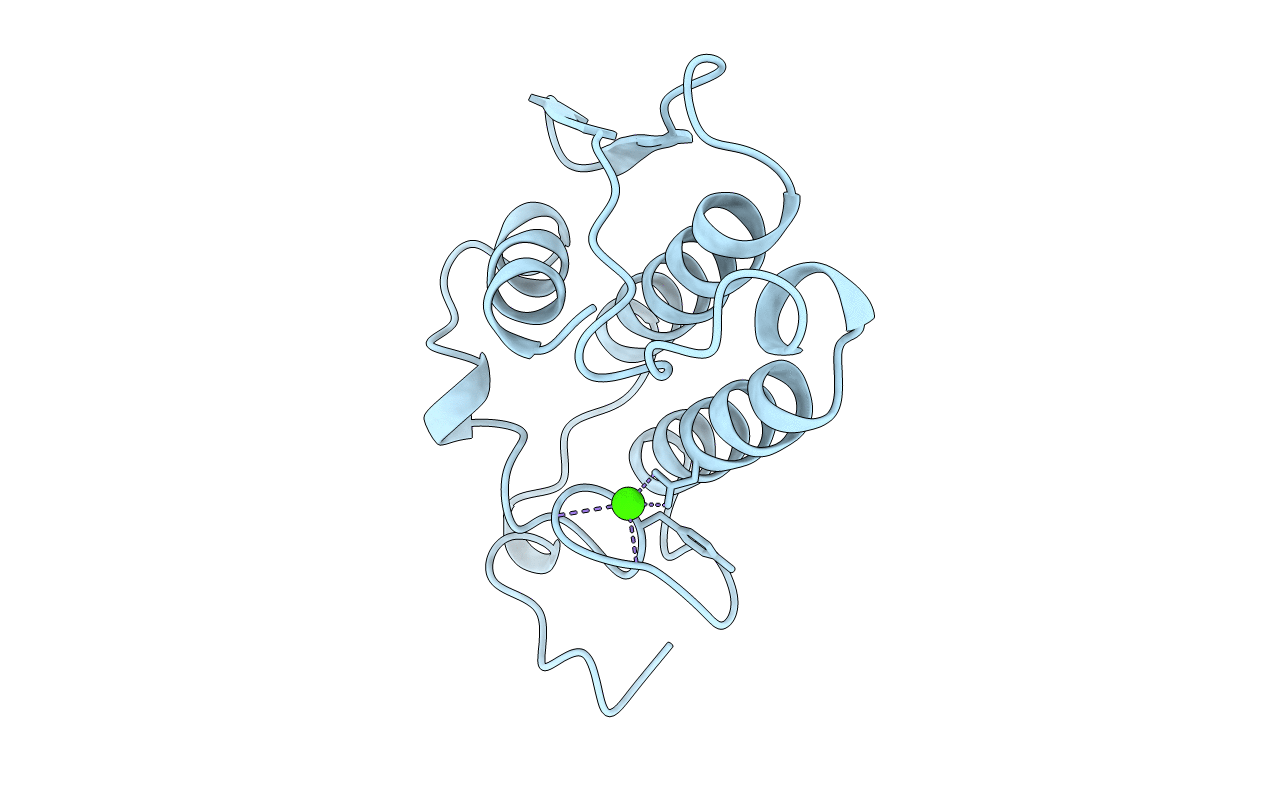
The aspartate-99 of secreted phospholipase A2 (PLA2) has been proposed to be critical for the catalytic mechanism and interfacial activation of PLA2. Aspartate-99 connects the catalytic machinery (including the catalytic diad, the putative catalytic waters W5 and W6, and the calcium cofactor) to the hydrogen-bonding network. The latter involves Y52, Y73, the structural water, and the N-terminal region putatively required for the interfacial activation. A triple mutant of bovine pancreatic PLA2 with substitutions aspartate plus adjacent tyrosine residues (Y52,73F/D99N) was constructed, its X-ray structure was determined, and kinetic characteristics were analyzed. The kinetic properties of the D99N mutant constructed previously were also further analyzed. The X-ray structure of the Y52,73F/D99N mutant indicated a substantial disruption of the hydrogen-bonding network including the loss of the structural water similar to that seen in the structure of the D99N mutant published previously [Kumar, A., Sekharudu, Y. C., Ramakrishnan, B., Dupureur, C. M., Zhu, H., Tsai, M.-D., & Sundaralingam, M. (1994) Protein Sci. 3, 2082-2088]. Kinetic analysis demonstrated that these mutants possessed considerable catalytic activity with a k(cat) value of about 5% compared to WT. The values of the interfacial Michaelis constant were also little perturbed (ca. 4-fold lower for D99N and marginally higher for Y52,73F/D99N). The results taken together suggest that the hydrogen-bonding network is not critically important for interfacial activation. Instead, it is the chemical step that is perturbed, though only modestly, in the mutants.