1MKM image
Deposition Date 2002-08-29
Release Date 2002-09-11
Last Version Date 2024-02-14
Entry Detail
PDB ID:
1MKM
Keywords:
Title:
CRYSTAL STRUCTURE OF THE THERMOTOGA MARITIMA ICLR
Biological Source:
Source Organism:
Host Organism:
Method Details:
Experimental Method:
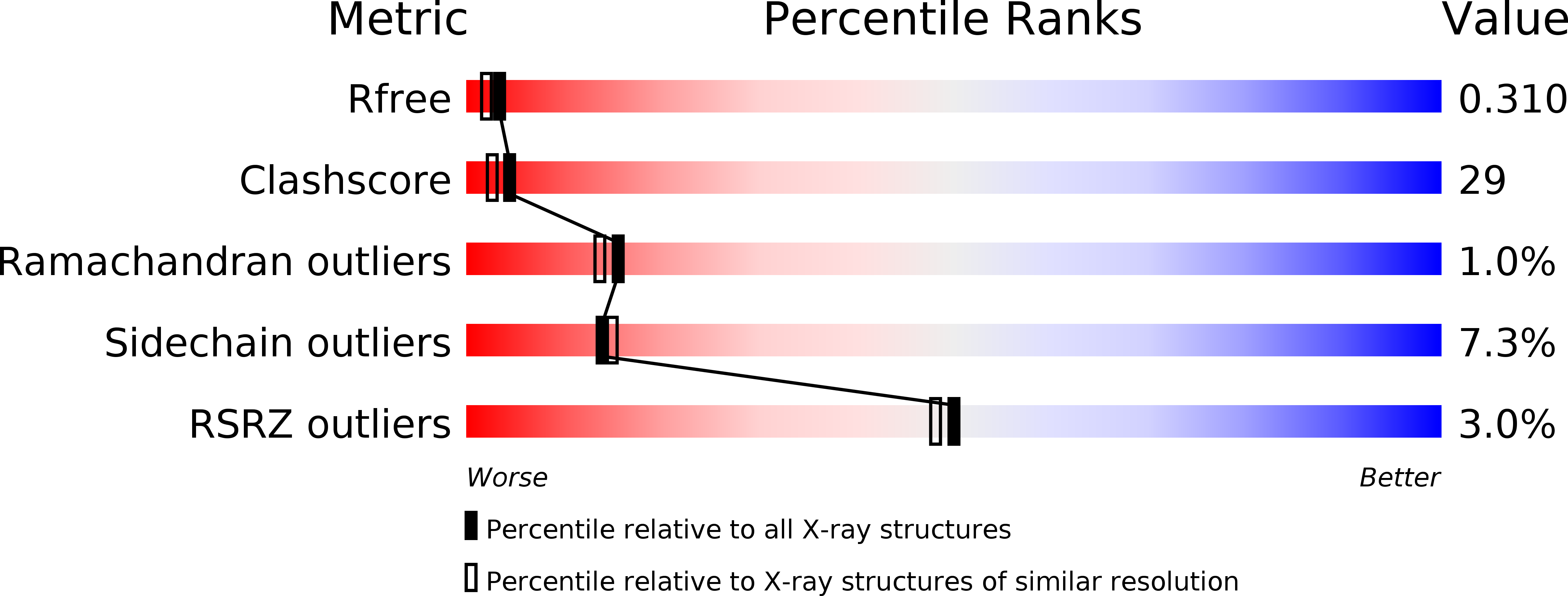
Resolution:
2.20 Å
R-Value Free:
0.3
R-Value Work:
0.23
R-Value Observed:
0.25
Space Group:
C 1 2 1
Macromolecular Entities
Structures with similar UniProt ID
Protein Blast
Polymer Type:polypeptide(L)
Molecule:IclR transcriptional regulator
Gene (Uniprot):TM_0065
Chain IDs:A, B
Chain Length:249
Number of Molecules:2
Biological Source:Thermotoga maritima
Primary Citation
Crystal structure of Thermotoga maritima 0065, a member of the IclR transcriptional factor family.
J.Biol.Chem. 277 19183 19190 (2002)
PMID: 11877432 DOI: 10.1074/jbc.M112171200

Abstact

Members of the IclR family of transcription regulators modulate signal-dependent expression of genes involved in carbon metabolism in bacteria and archaea. The Thermotoga maritima TM0065 gene codes for a protein (TM-IclR) that is homologous to the IclR family. We have determined the crystal structure of TM-IclR at 2.2 A resolution using MAD phasing and synchrotron radiation. The protein is composed of two domains: the N-terminal DNA-binding domain contains the winged helix-turn-helix motif, and the C-terminal presumed regulatory domain is involved in binding signal molecule. In a proposed signal-binding site, a bound Zn(2+) ion was found. In the crystal, TM-IclR forms a dimer through interactions between DNA-binding domains. In the dimer, the DNA-binding domains are 2-fold related, but the dimer is asymmetric with respect to the orientation of signal-binding domains. Crystal packing analysis showed that TM-IclR dimers form a tetramer through interactions exclusively by signal-binding domains. A model is proposed for binding of IclR-like factors to DNA, and it suggests that signal-dependent transcription regulation is accomplished by affecting an oligomerization state of IclR and therefore its affinity for DNA target.

Legend

Protein

Chemical

Disease

Primary Citation of related structures
Feedback Form
Name
Email
Institute
Feedback