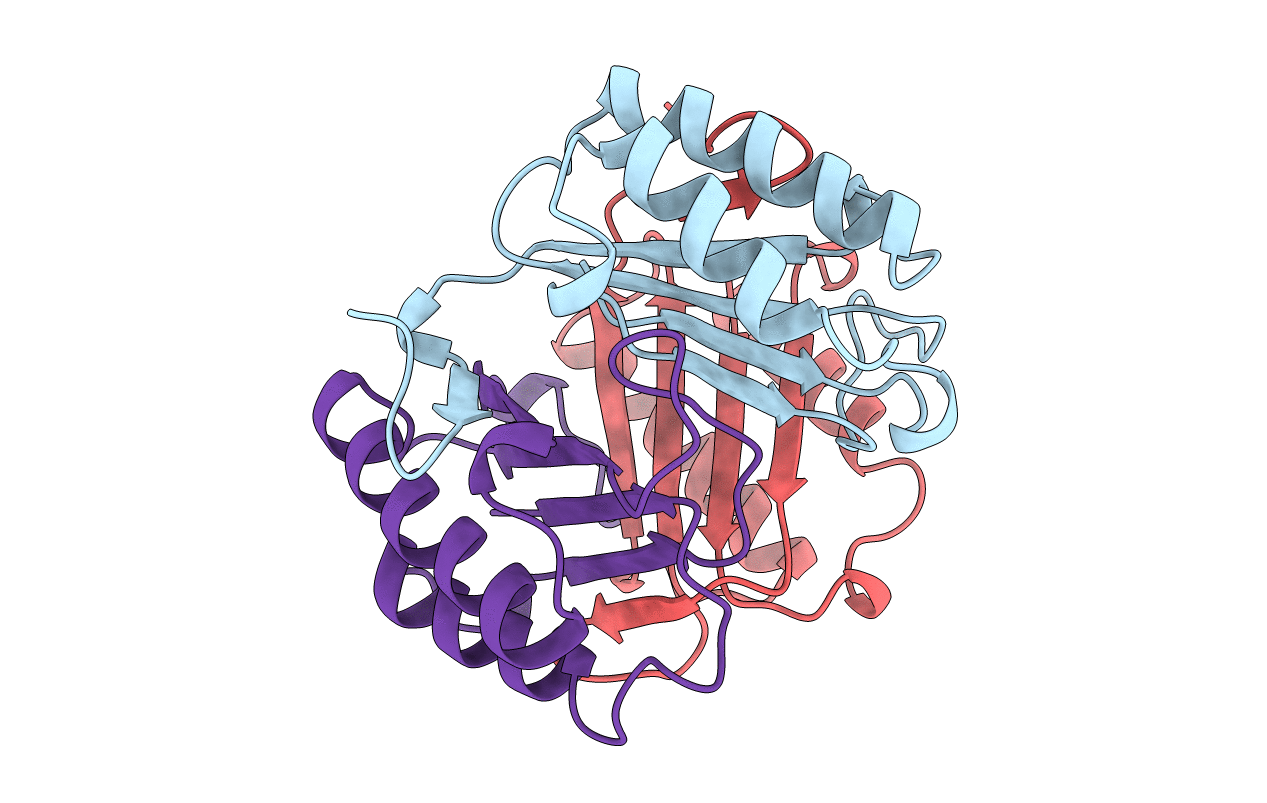
1MIF image
Deposition Date 1996-01-26
Release Date 1996-12-07
Last Version Date 2024-02-14
Entry Detail
PDB ID:
1MIF
Keywords:
Title:
MACROPHAGE MIGRATION INHIBITORY FACTOR (MIF)
Biological Source:
Source Organism:
Homo sapiens (Taxon ID: 9606)
Method Details:
Experimental Method:
Resolution:
2.60 Å
R-Value Work:
0.20
R-Value Observed:
0.20
Space Group:
P 31 2 1

Macromolecular Entities
Structures with similar UniProt ID
Protein Blast
Polymer Type:polypeptide(L)
Molecule:MACROPHAGE MIGRATION INHIBITORY FACTOR
Gene (Uniprot):MIF
Chain IDs:A, B, C
Chain Length:115
Number of Molecules:3
Biological Source:Homo sapiens
Primary Citation
Crystal structure at 2.6-A resolution of human macrophage migration inhibitory factor.
Proc.Natl.Acad.Sci.USA 93 5191 5196 (1996)
PMID: 8643551 DOI: 10.1073/pnas.93.11.5191

Abstact

Macrophage migration inhibitory factor (MIF) was the first cytokine to be described, but for 30 years its role in the immune response remained enigmatic. In recent studies, MIF has been found to be a novel pituitary hormone and the first protein identified to be released from immune cells on glucocorticoid stimulation. Once secreted, MIF counterregulates the immunosuppressive effects of steroids and thus acts as a critical component of the immune system to control both local and systemic immune responses. We report herein the x-ray crystal structure of human MIF to 2.6 angstrom resolution. The protein is a trimer of identical subunits. Each monomer contains two antiparallel alpha-helices that pack against a four-stranded beta-sheet. The monomer has an additional two beta-strands that interact with the beta-sheets of adjacent subunits to form the interface between monomers. The three beta-sheets are arranged to form a barrel containing a solvent-accessible channel that runs through the center of the protein along a molecular 3-fold axis. Electrostatic potential maps reveal that the channel has a positive potential, suggesting that it binds negatively charged molecules. The elucidated structure for MIF is unique among cytokines or hormonal mediators, and suggests that this counterregulator of glucocorticoid action participates in novel ligand-receptor interactions.

Legend

Protein

Chemical

Disease

Primary Citation of related structures
Feedback Form
Name
Email
Institute
Feedback