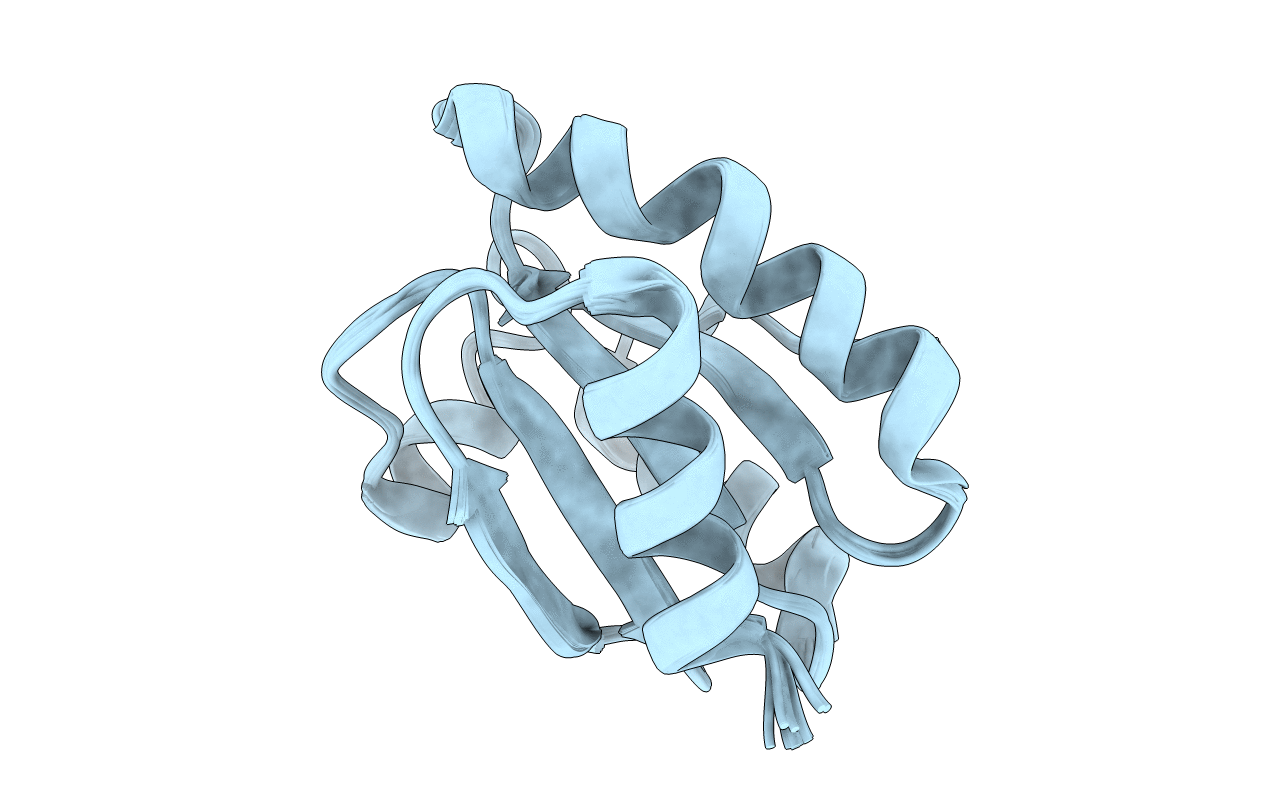
1M7T image
Deposition Date 2002-07-22
Release Date 2002-09-25
Last Version Date 2024-10-09
Entry Detail
PDB ID:
1M7T
Title:
Solution Structure and Dynamics of the Human-Escherichia coli Thioredoxin Chimera: Insights into Thermodynamic Stability
Biological Source:
Source Organism:
Host Organism:
Method Details:
Experimental Method:
Conformers Calculated:
100
Conformers Submitted:
21
Selection Criteria:
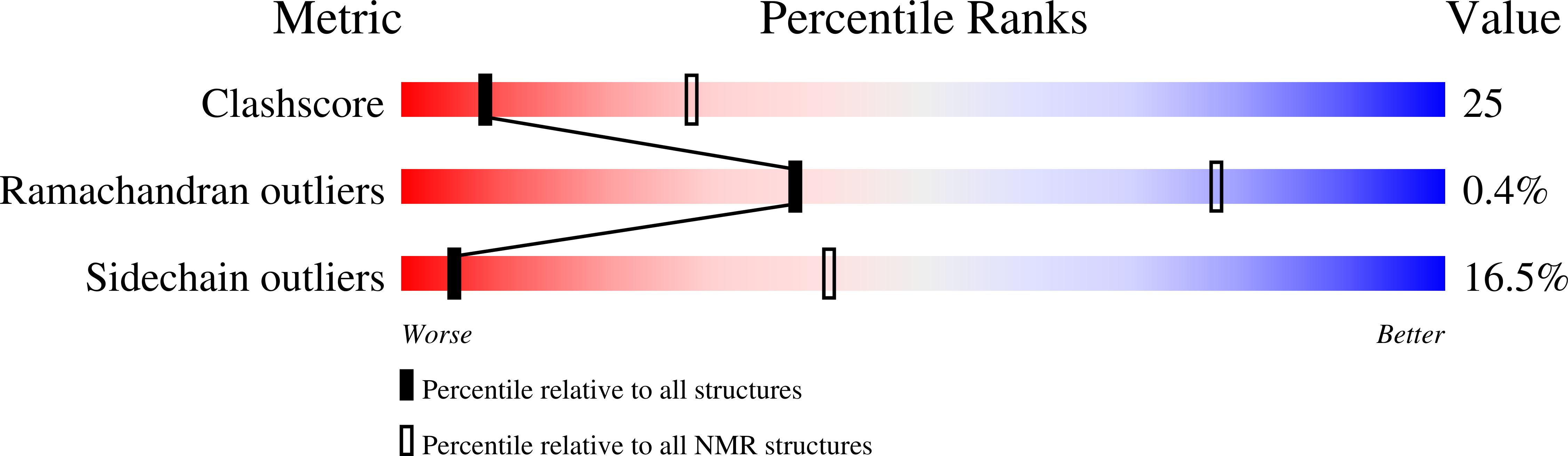
Back calculated data agree with experimental NOESY spectrum,structures with acceptable covalent geometry,structures with favorable non-bond energy,structures with the least restraint violations,structures with the lowest energy,target function
Macromolecular Entities
Protein Blast
Polymer Type:polypeptide(L)
Molecule:Chimera of Human and E. coli thioredoxin
Gene (Uniprot):TXN
Chain IDs:A
Chain Length:107
Number of Molecules:1
Biological Source:Homo sapiens, Escherichia coli
Ligand Molecules
Primary Citation
Solution Structure and Dynamics of the Human-Escherichia coli Thioredoxin Chimera: Insights into Thermodynamic Stability
Biochemistry 41 9376 9388 (2002)
PMID: 12135359 DOI: 10.1021/bi0258501

Abstact

We have determined the high-resolution solution structure of the oxidized form of a chimeric human and Escherichia coli thioredoxin (TRX(HE)) by NMR. The overall structure is well-defined with a rms difference for the backbone atoms of 0.27 +/- 0.06 A. The topology of the protein is identical to those of the human and E. coli parent proteins, consisting of a central five-stranded beta-sheet surrounded by four alpha-helices. Analysis of the interfaces between the two domains derived from the human and E. coli sequences reveals that the general hydrophobic packing is unaltered and only subtle changes in the details of side chain interactions are observed. The packing of helix alpha(4) with helix alpha(2) across the hybrid interface is less optimal than in the parent molecules, and electrostatic interactions between polar side chains are missing. In particular, lysine-glutamate salt bridges between residues on helices alpha(2) and alpha(4), which were observed in both human and E. coli proteins, are not present in the chimeric protein. The origin of the known reduced thermodynamic stability of TRX(HE) was probed by mutagenesis on the basis of these structural findings. Two mutants of TRX(HE), S44D and S44E, were created, and their thermal and chemical stabilities were examined. Improved stability toward chaotropic agents was observed for both mutants, but no increase in the denaturation temperature was seen compared to that of TRX(HE). In addition to the structural analysis, the backbone dynamics of TRX(HE) were investigated by (15)N NMR relaxation measurements. Analysis using the model free approach reveals that the protein is fairly rigid with an average S(2) of 0.88. Increased mobility is primarily present in two external loop regions comprising residues 72-74 and 92-94 that contain glycine and proline residues.

Legend

Protein

Chemical

Disease

Primary Citation of related structures
Feedback Form
Name
Email
Institute
Feedback