1LNI image
Deposition Date 2002-05-03
Release Date 2002-07-31
Last Version Date 2024-11-13
Entry Detail
PDB ID:
1LNI
Keywords:
Title:
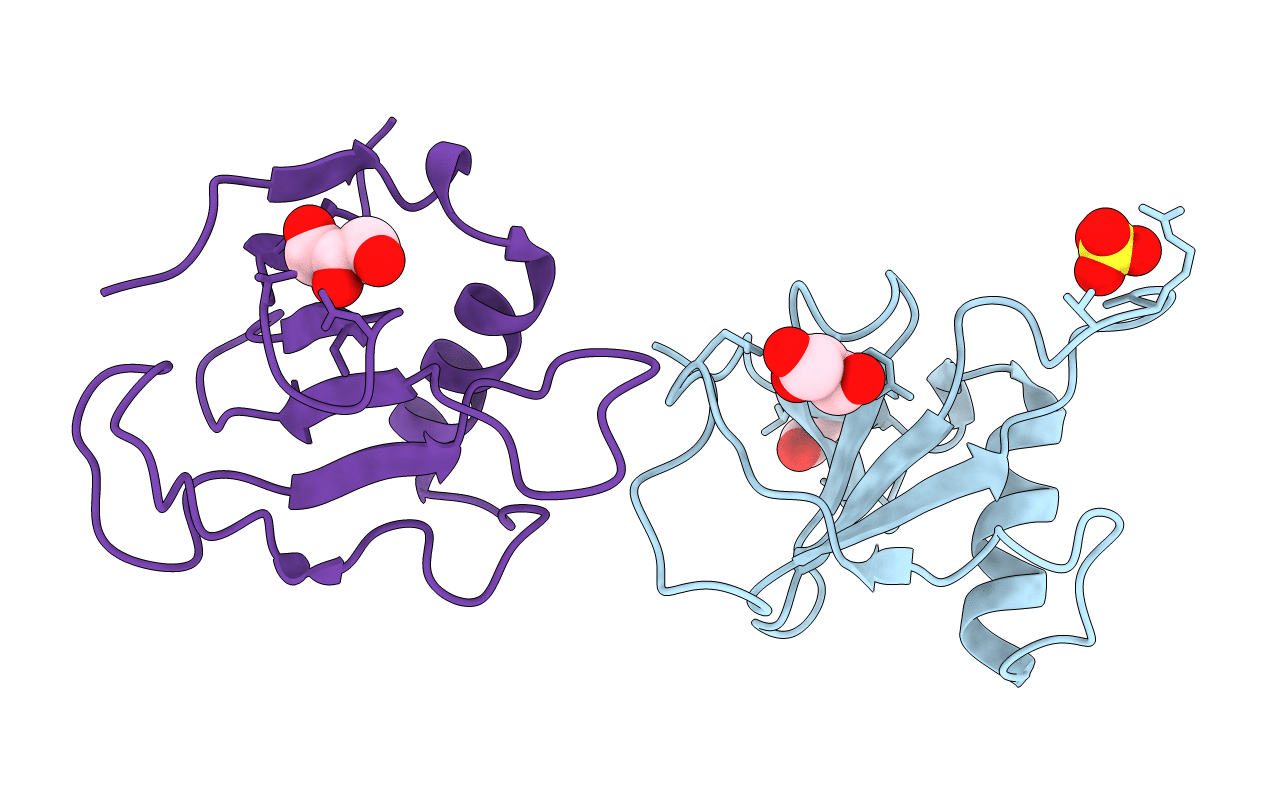
CRYSTAL STRUCTURE ANALYSIS OF A RIBONUCLEASE FROM STREPTOMYCES AUREOFACIENS AT ATOMIC RESOLUTION (1.0 A)
Biological Source:
Source Organism:
Host Organism:
Method Details:
Experimental Method:
Resolution:
1.00 Å
R-Value Observed:
0.11
Space Group:
P 21 21 21
Macromolecular Entities
Structures with similar UniProt ID
Protein Blast
Polymer Type:polypeptide(L)
Molecule:GUANYL-SPECIFIC RIBONUCLEASE SA
Gene (Uniprot):rnaSA
Chain IDs:A, B
Chain Length:96
Number of Molecules:2
Biological Source:Streptomyces aureofaciens
Primary Citation
Atomic resolution data reveal flexibility in the structure of RNase Sa.
Acta Crystallogr.,Sect.D 58 1307 1313 (2002)
PMID: 12136142 DOI: 10.1107/S0907444902010090

Abstact

Ribonuclease from Streptomyces aureofaciens, the bacterial source for the industrial production of chlorotetracycline, is a guanylate endoribonuclease (RNase Sa; EC 3.1.27.3) which hydrolyses the phosphodiester bonds of single-stranded RNA at the 3'-side of guanosine nucleotides with high specificity. The structure of the enzyme was previously refined at atomic resolution (1.2 A) using room-temperature data. Here, the RNase Sa structure refined against 1.0 A data collected at cryogenic temperature is reported. There are two surface loops in molecule A and one in molecule B for which two main-chain conformations are modelled: these loops contain active-site residues. The separation for most of the corresponding main-chain atoms in the two conformations is about 0.8 A, with a maximum of 2.5 A. The two regions of dual conformation represent the most important differences in comparison with the structure determined at room temperature, where the corresponding loops have one conformation only but the largest degree of anisotropy. The flexibility of the loops observed in the structure of RNase Sa is directly linked to the need for the active site to interact productively with substrates and/or inhibitors.

Legend

Protein

Chemical

Disease

Primary Citation of related structures
Feedback Form
Name
Email
Institute
Feedback