1LAA image
Deposition Date 1992-06-24
Release Date 1993-01-15
Last Version Date 2024-11-20
Entry Detail
PDB ID:
1LAA
Title:
X-RAY STRUCTURE OF GLU 53 HUMAN LYSOZYME
Biological Source:
Source Organism:
Homo sapiens (Taxon ID: 9606)
Method Details:
Experimental Method:
Resolution:
1.77 Å
R-Value Work:
0.17
R-Value Observed:
0.17
Space Group:
P 21 21 21
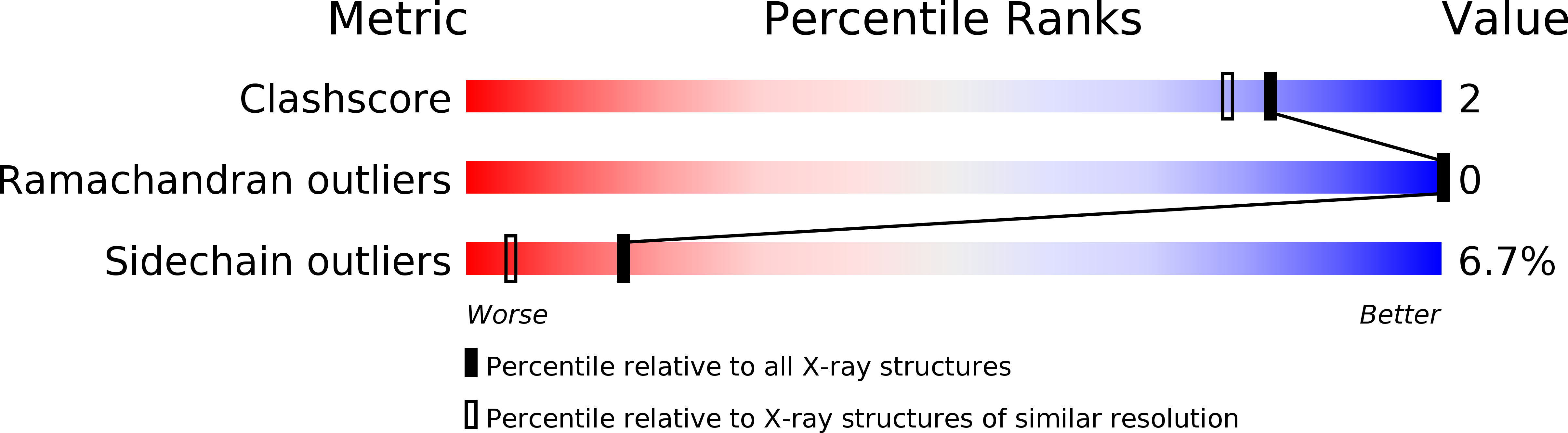
Macromolecular Entities
Structures with similar UniProt ID
Protein Blast
Polymer Type:polypeptide(L)
Molecule:HUMAN LYSOZYME
Gene (Uniprot):LYZ
Chain IDs:A
Chain Length:130
Number of Molecules:1
Biological Source:Homo sapiens
Primary Citation
X-ray structure of Glu 53 human lysozyme.
Protein Sci. 1 1447 1453 (1992)
PMID: 1363898

Abstact

The three-dimensional structure of a modified human lysozyme (HL), Glu 53 HL, in which Asp 53 was replaced by Glu, has been determined at 1.77 A resolution by X-ray analysis. The backbone structure of Glu 53 HL is essentially the same as the structure of wild-type HL. The root mean square difference for the superposition of equivalent C alpha atoms is 0.141 A. Except for the Glu 53 residue, the structure of the active site region is largely conserved between Glu 53 HL and wild-type HL. However, the hydrogen bond network differs because of the small shift or rotation of side chain groups. The carboxyl group of Glu 53 points to the carboxyl group of Glu 35 with a distance of 4.7 A between the nearest carboxyl oxygen atoms. A water molecule links these carboxyl groups by a hydrogen bond bridge. The active site structure explains well the fact that the binding ability for substrates does not significantly differ between Glu 53 HL and wild-type HL. On the other hand, the positional and orientational change of the carboxyl group of the residue 53 caused by the mutation is considered to be responsible for the low catalytic activity (ca. 1%) of Glu 53 HL. The requirement of precise positioning for the carboxyl group suggests the possibility that the Glu 53 residue contributes more than a simple electrostatic stabilization of the intermediate in the catalysis reaction.

Legend

Protein

Chemical

Disease

Primary Citation of related structures
Feedback Form
Name
Email
Institute
Feedback