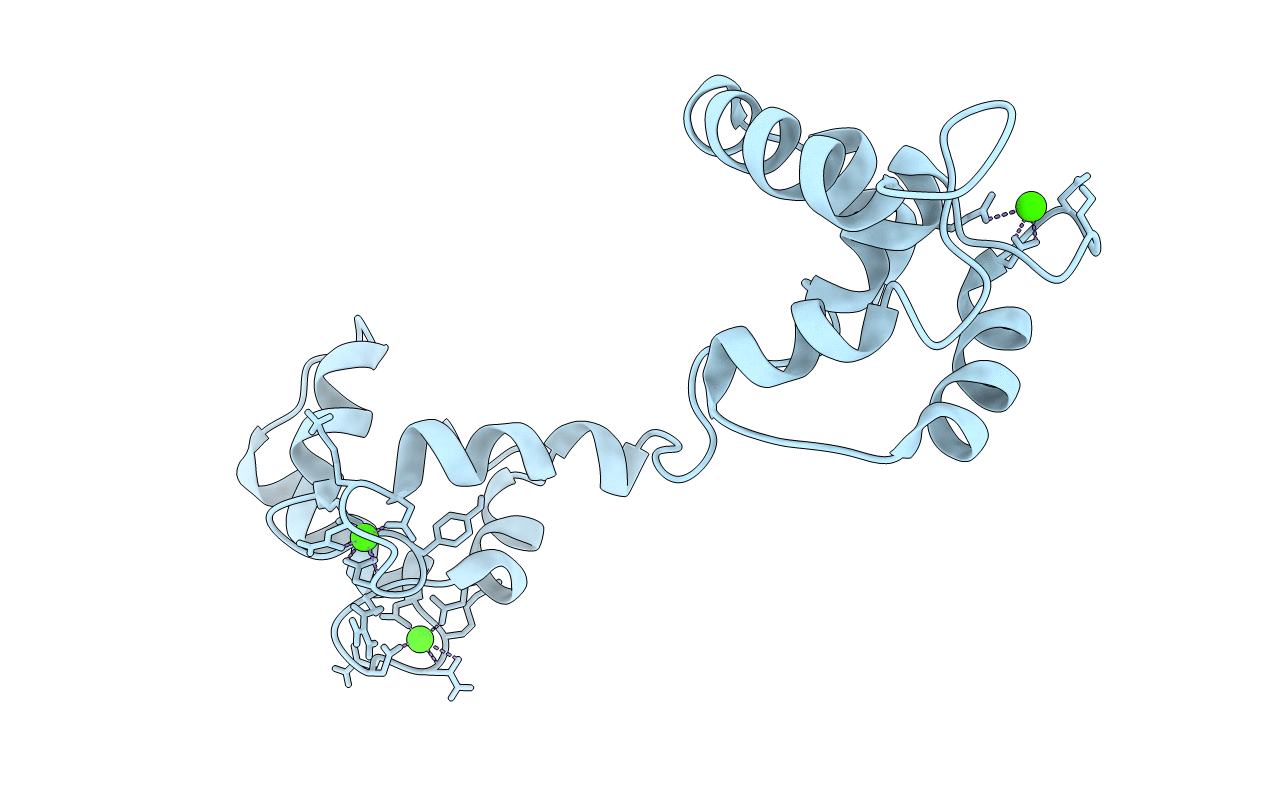
1LA0 image
Deposition Date 2002-03-27
Release Date 2002-12-11
Last Version Date 2024-05-22
Entry Detail
PDB ID:
1LA0
Title:
Solution Structure of Calcium Saturated Cardiac Troponin C in the Troponin C-Troponin I Complex
Biological Source:
Source Organism:
Gallus gallus (Taxon ID: 9031)
Method Details:
Experimental Method:
Conformers Submitted:
1

Macromolecular Entities
Structures with similar UniProt ID
Protein Blast
Polymer Type:polypeptide(L)
Molecule:Troponin C, slow skeletal and cardiac muscles
Gene (Uniprot):TNNC1
Chain IDs:A
Chain Length:161
Number of Molecules:1
Biological Source:Gallus gallus
Ligand Molecules
Primary Citation
Solution Structure of Calcium-Saturated Cardiac Troponin C bound to cardiac Troponin I.
J.Biol.Chem. 277 38565 38570 (2002)
PMID: 12147696 DOI: 10.1074/jbc.M205306200

Abstact

Cardiac troponin C (TnC) is composed of two globular domains connected by a flexible linker. In solution, linker flexibility results in an ill defined orientation of the two globular domains relative to one another. We have previously shown a decrease in linker flexibility in response to cardiac troponin I (cTnI) binding. To investigate the relative orientation of calcium-saturated TnC domains when bound to cTnI, (1)H-(15)N residual dipolar couplings were measured in two different alignment media. Similarity in alignment tensor orientation for the two TnC domains supports restriction of domain motion in the presence of cTnI. The relative spatial orientation of TnC domains bound to TnI was calculated from measured residual dipolar couplings and long-range distance restraints utilizing a rigid body molecular dynamics protocol. The relative domain orientation is such that hydrophobic pockets face each other, forming a latch to constrain separate helical segments of TnI. We have utilized this structure to successfully explain the observed functional consequences of linker region deletion mutants. Together, these studies suggest that, although linker plasticity is important, the ability of TnC to function in muscle contraction can be correlated with a preferred domain orientation and interdomain distance.

Legend

Protein

Chemical

Disease

Primary Citation of related structures
Feedback Form
Name
Email
Institute
Feedback