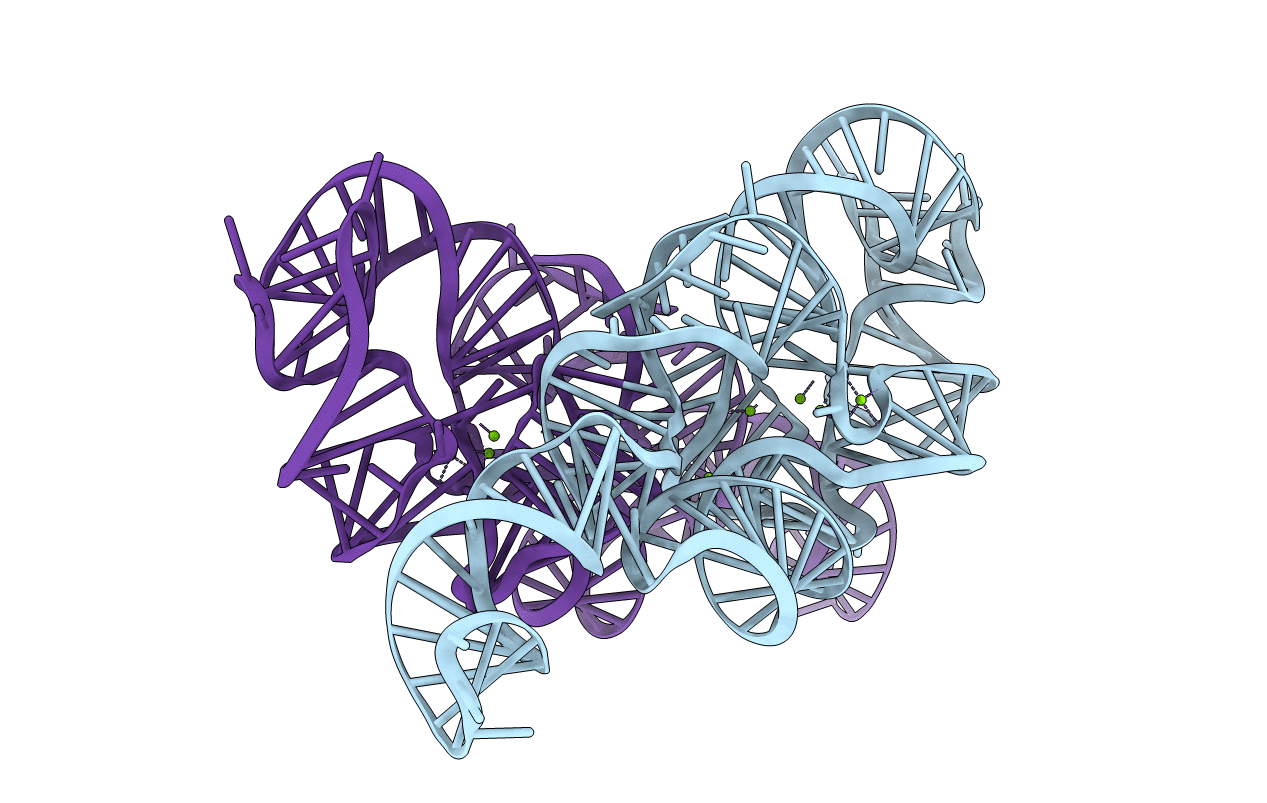
1L8V image
Deposition Date 2002-03-21
Release Date 2002-08-23
Last Version Date 2023-08-16
Entry Detail
PDB ID:
1L8V
Keywords:
Title:
Crystal Structure of a Mutant (C109G,G212C) P4-P6 Domain of the Group I Intron from Tetrahymena Thermophilia
Biological Source:
Source Organism:
Method Details:
Experimental Method:
Resolution:
2.80 Å
R-Value Free:
0.29
R-Value Work:
0.29
R-Value Observed:
0.29
Space Group:
P 21 21 21

Macromolecular Entities
Polymer Type:polyribonucleotide
Molecule:P4-P6 RNA ribozyme domain
Mutagens:C109G/G212C
Chain IDs:A, B
Chain Length:157
Number of Molecules:2
Biological Source:
Ligand Molecules
Primary Citation
Specificity of RNA-RNA Helix Recognition
Proc.Natl.Acad.Sci.USA 99 11676 11681 (2002)
PMID: 12189204 DOI: 10.1073/pnas.182221799

Abstact

Functional RNAs often form compact structures characterized by closely packed helices. Crystallographic analysis of several large RNAs revealed a prevalent interaction in which unpaired adenosine residues dock into the minor groove of a receptor helix. This A-minor motif, potentially the most important element responsible for global RNA architecture, has also been suggested to contribute to the fidelity of protein synthesis by discriminating against near-cognate tRNAs on the ribosome. The specificity of A-minor interactions is fundamental to RNA tertiary structure formation, as well as to their proposed role in translational accuracy. To investigate A-minor motif specificity, we analyzed mutations in an A-minor interaction within the Tetrahymena group I self-splicing intron. Thermodynamic and x-ray crystallographic results show that the A-minor interaction strongly prefers canonical base pairs over base mismatches in the receptor helix, enabling RNA interhelical packing through specific recognition of Watson-Crick minor groove geometry.

Legend

Protein

Chemical

Disease

Primary Citation of related structures
Feedback Form
Name
Email
Institute
Feedback