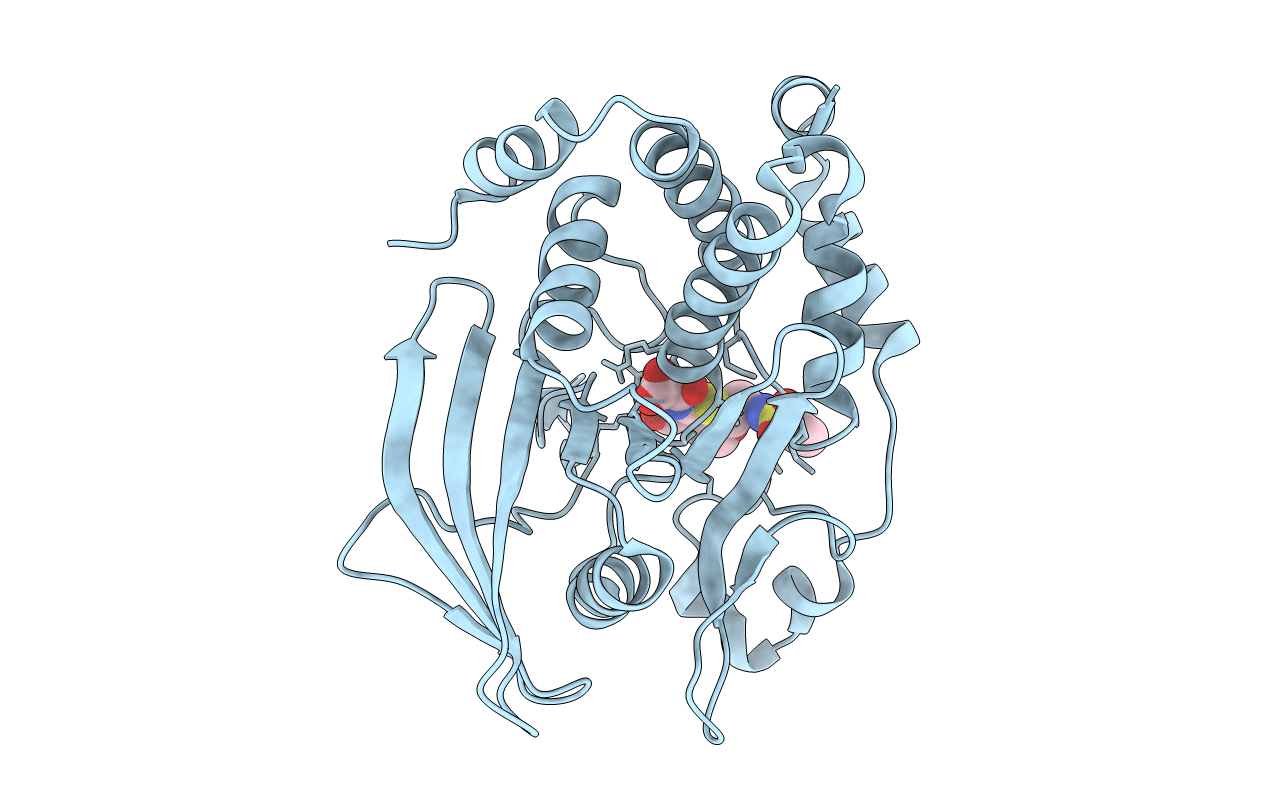
1L8G image
Deposition Date 2002-03-20
Release Date 2002-05-08
Last Version Date 2024-02-14
Entry Detail
PDB ID:
1L8G
Keywords:
Title:
Crystal structure of PTP1B complexed with 7-(1,1-Dioxo-1H-benzo[d]isothiazol-3-yloxymethyl)-2-(oxalyl-amino)-4,7-dihydro-5H-thieno[2,3-c]pyran-3-carboxylic acid
Biological Source:
Source Organism:
Homo sapiens (Taxon ID: 9606)
Host Organism:
Method Details:
Experimental Method:
Resolution:
2.50 Å
R-Value Free:
0.27
R-Value Work:
0.18
R-Value Observed:
0.18
Space Group:
P 31 2 1

Macromolecular Entities
Structures with similar UniProt ID
Protein Blast
Polymer Type:polypeptide(L)
Molecule:PROTEIN-TYROSINE PHOSPHATASE, NON-RECEPTOR TYPE 1
Gene (Uniprot):PTPN1
Chain IDs:A
Chain Length:321
Number of Molecules:1
Biological Source:Homo sapiens
Ligand Molecules
Primary Citation
Steric hindrance as a basis for structure-based design of selective inhibitors of protein-tyrosine phosphatases.
Biochemistry 40 14812 14820 (2001)
PMID: 11732900 DOI: 10.1021/bi011389l

Abstact

Utilizing structure-based design, we have previously demonstrated that it is possible to obtain selective inhibitors of protein-tyrosine phosphatase 1B (PTP1B). A basic nitrogen was introduced into a general PTP inhibitor to form a salt bridge to Asp48 in PTP1B and simultaneously cause repulsion in PTPs containing an asparagine in the equivalent position [Iversen, L. F., et al. (2000) J. Biol. Chem. 275, 10300-10307]. Further, we have recently demonstrated that Gly259 in PTP1B forms the bottom of a gateway that allows easy access to the active site for a broad range of substrates, while bulky residues in the same position in other PTPs cause steric hindrance and reduced substrate recognition capacity [Peters, G. H., et al. (2000) J. Biol. Chem. 275, 18201-18209]. The current study was undertaken to investigate the feasibility of structure-based design, utilizing these differences in accessibility to the active site among various PTPs. We show that a general, low-molecular weight PTP inhibitor can be developed into a highly selective inhibitor for PTP1B and TC-PTP by introducing a substituent, which is designed to address the region around residues 258 and 259. Detailed enzyme kinetic analysis with a set of wild-type and mutant PTPs, X-ray protein crystallography, and molecular modeling studies confirmed that selectivity for PTP1B and TC-PTP was achieved due to steric hindrance imposed by bulky position 259 residues in other PTPs.

Legend

Protein

Chemical

Disease

Primary Citation of related structures
Feedback Form
Name
Email
Institute
Feedback