1L6E image
Deposition Date 2002-03-08
Release Date 2002-04-03
Last Version Date 2024-05-22
Entry Detail
PDB ID:
1L6E
Keywords:
Title:
Solution structure of the docking and dimerization domain of protein kinase A II-alpha (RIIalpha D/D). Alternatively called the N-terminal dimerization domain of the regulatory subunit of protein kinase A.
Biological Source:
Source Organism(s):
Mus musculus (Taxon ID: 10090)
Expression System(s):
Method Details:
Experimental Method:
Conformers Calculated:
49
Conformers Submitted:
24
Selection Criteria:
structures with the least restraint violations,structures with the lowest energy
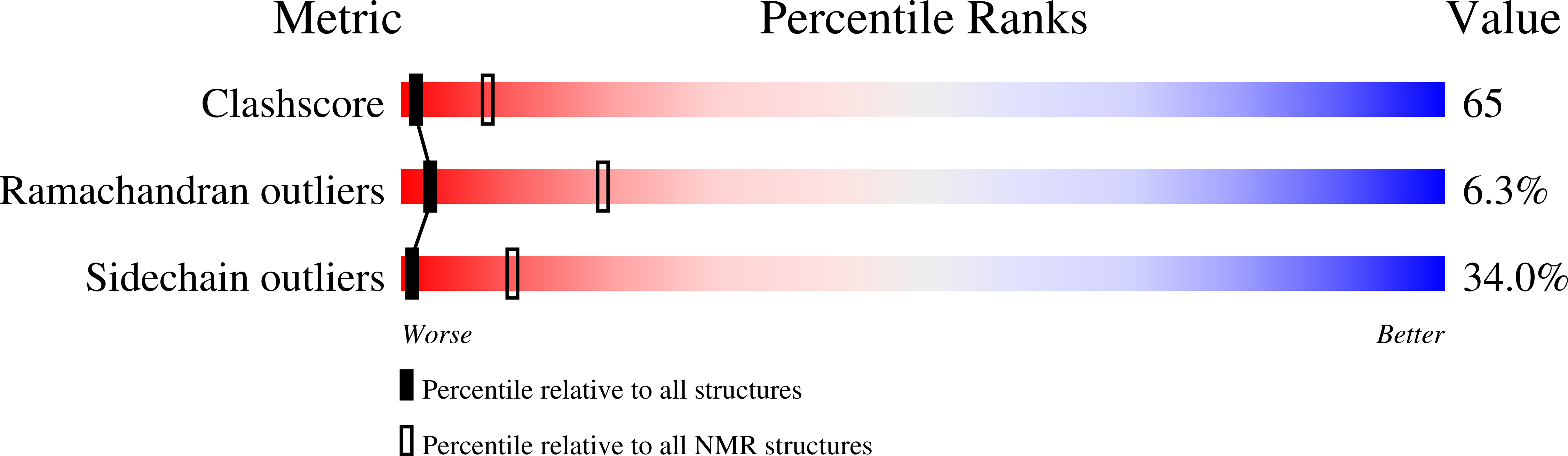
Macromolecular Entities
Structures with similar UniProt ID
Protein Blast
Polymer Type:polypeptide(L)
Molecule:cAMP-dependent protein kinase Type II-alpha regulatory chain
Gene (Uniprot):Prkar2a
Chain IDs:A, B
Chain Length:46
Number of Molecules:2
Biological Source:Mus musculus
Ligand Molecules
Primary Citation
Electrostatic properties of the structure of the docking and dimerization domain of protein kinase A IIalpha
Eur.J.Biochem. 269 2040 2051 (2002)
PMID: 11985580 DOI: 10.1046/j.1432-1033.2002.02852.x

Abstact

The structure of the N-terminal docking and dimerization domain of the type IIalpha regulatory subunit (RIIalpha D/D) of protein kinase A (PKA) forms a noncovalent stand-alone X-type four-helix bundle structural motif, consisting of two helix-loop-helix monomers. RIIalpha D/D possesses a strong hydrophobic core and two distinct, exposed faces. A hydrophobic face with a groove is the site of protein-protein interactions necessary for subcellular localization. A highly charged face, opposite to the former, may be involved in regulation of protein-protein interactions as a result of changes in phosphorylation state of the regulatory subunit. Although recent studies have addressed the hydrophobic character of packing of RIIalpha D/D and revealed the function of the hydrophobic face as the binding site to A-kinase anchoring proteins (AKAPs), little attention has been paid to the charges involved in structure and function. To examine the electrostatic character of the structure of RIIalpha D/D we have predicted mean apparent pKa values, based on Poisson-Boltzmann electrostatic calculations, using an ensemble of calculated dimer structures. We propose that the helix promoting sequence Glu34-X-X-X-Arg38 stabilizes the second helix of each monomer, through the formation of a (i, i +4) side chain salt bridge. We show that a weak inter-helical hydrogen bond between Tyr35-Glu19 of each monomer contributes to tertiary packing and may be responsible for discriminating from alternative quaternary packing of the two monomers. We also show that an inter-monomer hydrogen bond between Asp30-Arg40 contributes to quaternary packing. We propose that the charged face comprising of Asp27-Asp30-Glu34-Arg38-Arg40-Glu41-Arg43-Arg44 may be necessary to provide flexibility or stability in the region between the C-terminus and the interdomain/autoinhibitory sequence of RIIalpha, depending on the activation state of PKA. We also discuss the structural requirements necessary for the formation of a stacked (rather than intertwined) dimer, which has consequences for the orientation of the functionally important and distinct faces.

Legend

Protein

Chemical

Disease

Primary Citation of related structures
Feedback Form
Name
Email
Institute
Feedback