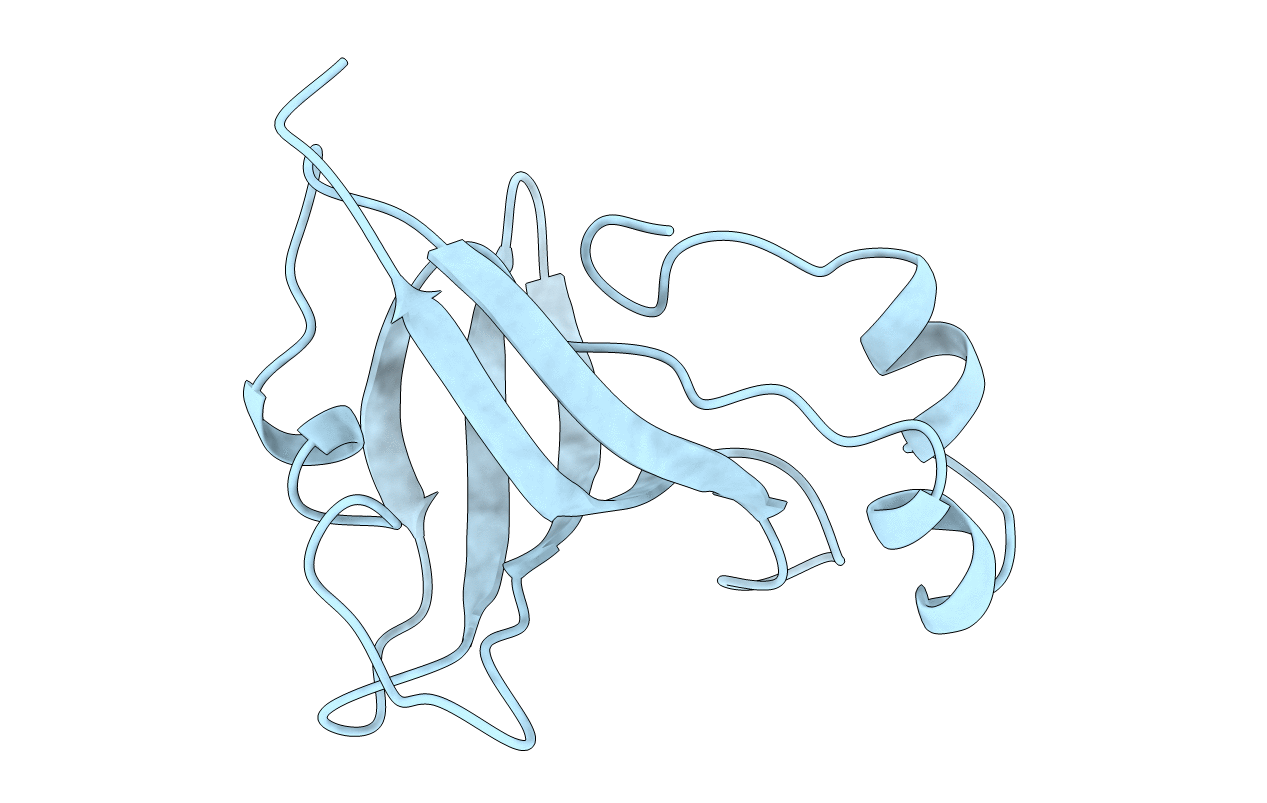
1KRS image
Deposition Date 1995-06-09
Release Date 1995-09-15
Last Version Date 2024-05-22
Entry Detail
PDB ID:
1KRS
Title:
SOLUTION STRUCTURE OF THE ANTICODON BINDING DOMAIN OF ESCHERICHIA COLI LYSYL-TRNA SYNTHETASE AND STUDIES OF ITS INTERACTIONS WITH TRNA-LYS
Biological Source:
Source Organism:
Escherichia coli (Taxon ID: 562)
Host Organism:
Method Details:
Experimental Method:
Conformers Submitted:
1
Macromolecular Entities
Structures with similar UniProt ID
Protein Blast
Polymer Type:polypeptide(L)
Molecule:LYSYL-TRNA SYNTHETASE (PRODUCT OF LYSS GENE)
Gene (Uniprot):lysS
Chain IDs:A
Chain Length:120
Number of Molecules:1
Biological Source:Escherichia coli
Ligand Molecules
Primary Citation
Solution structure of the anticodon-binding domain of Escherichia coli lysyl-tRNA synthetase and studies of its interaction with tRNA(Lys).
J.Mol.Biol. 253 100 113 (1995)
PMID: 7473706 DOI: 10.1006/jmbi.1995.0539

Abstact

A protein domain corresponding to residues 31 to 149 of the E. coli Lysyl-tRNA synthetase species corresponding to the lysS gene was expressed and 15N-labelled. 1H and 15N NMR resonance assignments for this domain were obtained by two-dimensional and three-dimensional homonuclear and heteronuclear spectroscopy. Using distance geometry and simulated annealing, a three-dimensional structure could be calculated using 701 NOE and 86 dihedral angle restraints. It is composed of a five-stranded antiparallel beta-barrel capped by three alpha-helices at its ends. This structure closely resembles that of the N-terminal domain of the other E. coli lysyl-tRNA synthetase species expressed from the lysU gene and is highly homologous to the fold observed for the corresponding region of aspartyl-tRNA synthetase. It is shown that the isolated N-terminal fragment of lysyl-tRNA synthetase can interact with tRNA(Lys) as well as with poly (U), which mimics the anticodon sequence. Amino acid residues involved in these interactions were identified and, in the case of poly-U, a number of specific protein-RNA contacts were characterized. Specific recognition of tRNA(Lys) involves a cluster of four structurally well-defined aromatic residues, anchored on the beta-strands, and basic residues located on the surrounding loops. This organization is reminiscent of other RNA binding proteins, such as the U1A small nuclear ribonucleoprotein.

Legend

Protein

Chemical

Disease

Primary Citation of related structures
Feedback Form
Name
Email
Institute
Feedback