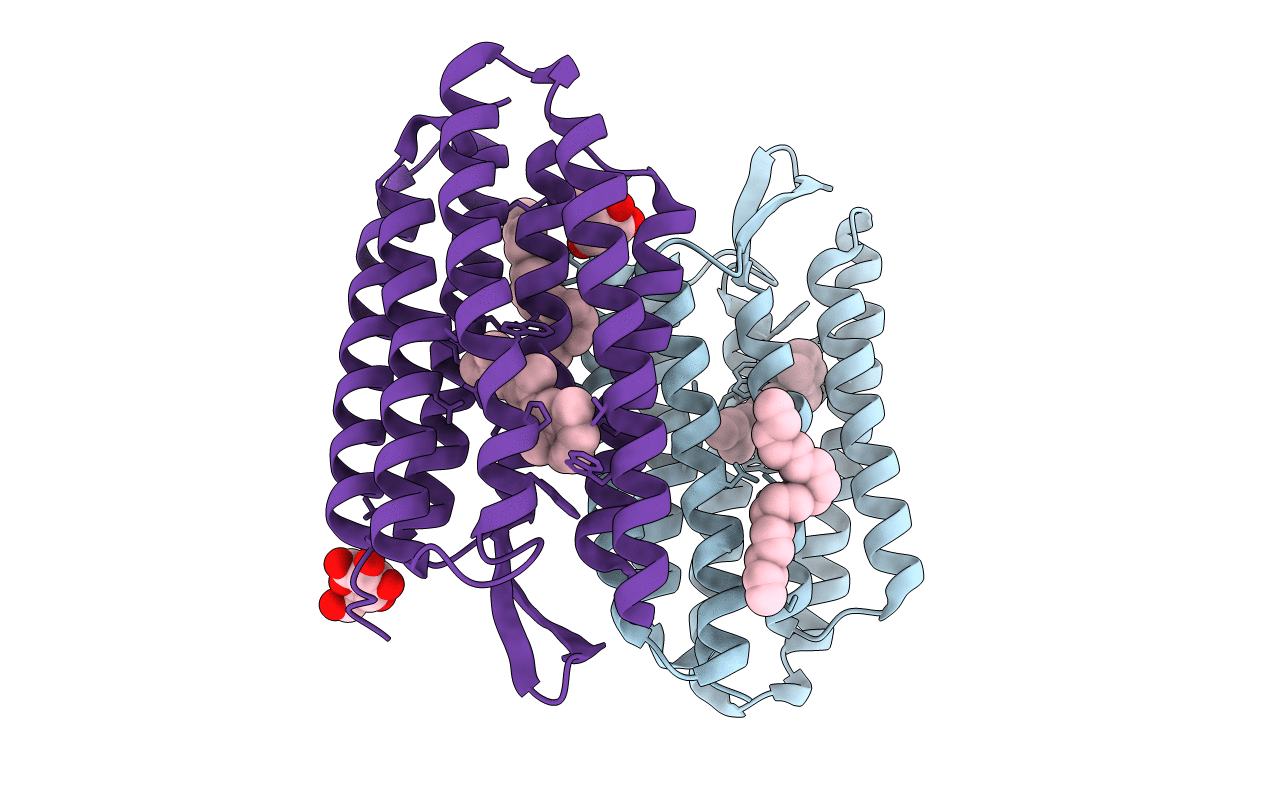
1KME image
Deposition Date 2001-12-14
Release Date 2002-02-13
Last Version Date 2024-11-20
Entry Detail
PDB ID:
1KME
Title:
CRYSTAL STRUCTURE OF BACTERIORHODOPSIN CRYSTALLIZED FROM BICELLES
Biological Source:
Source Organism(s):
Method Details:
Experimental Method:
Resolution:
2.00 Å
R-Value Free:
0.27
R-Value Work:
0.26
R-Value Observed:
0.26
Space Group:
P 1 21 1

Macromolecular Entities
Structures with similar UniProt ID
Protein Blast
Polymer Type:polypeptide(L)
Molecule:Bacteriorhodopsin
Gene (Uniprot):bop
Chain IDs:A, B
Chain Length:231
Number of Molecules:2
Biological Source:Halobacterium salinarum
Primary Citation
Bicelle crystallization: a new method for crystallizing membrane proteins yields a monomeric bacteriorhodopsin structure.
J.Mol.Biol. 316 1 6 (2002)
PMID: 11829498 DOI: 10.1006/jmbi.2001.5295

Abstact

Obtaining crystals of membrane proteins that diffract to high resolution remains a major stumbling block in structure determination. Here we present a new method for crystallizing membrane proteins from a bicelle forming lipid/detergent mixture. The method is flexible and simple to use. As a test case, bacteriorhodopsin (bR) from Halobacterium salinarum was crystallized from a bicellar solution, yielding a new bR crystal form. The crystals belong to space group P2(1) with unit cell dimensions of a=45.0 A, b=108.9 A, c=55.9 A, beta=113.58 degrees and a dimeric asymmetric unit. The structure was solved by molecular replacement and refined at 2.0 A resolution. In all previous bR structures the protein is organized as a parallel trimer, but in the crystals grown from bicelles, the individual bR subunits are arranged in an antiparallel fashion.

Legend

Protein

Chemical

Disease

Primary Citation of related structures
Feedback Form
Name
Email
Institute
Feedback