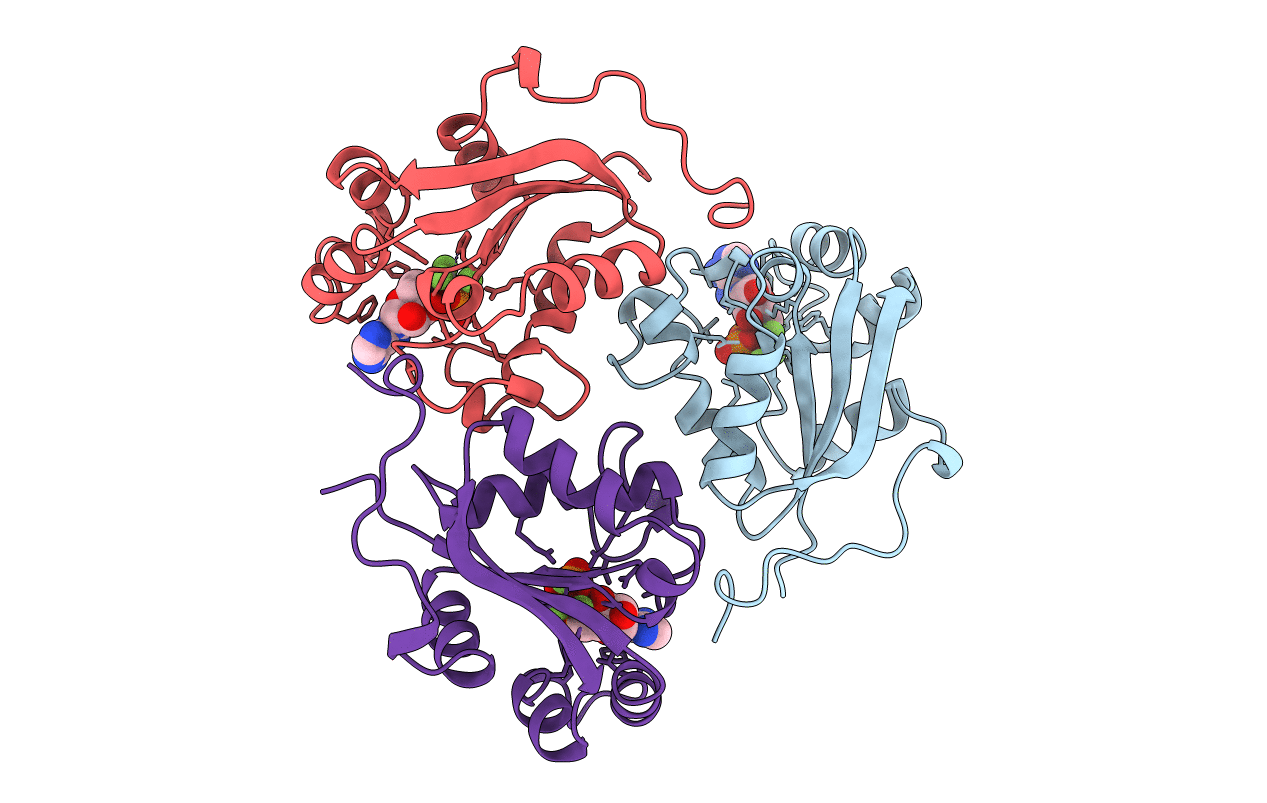
1KDN image
Deposition Date 1996-09-10
Release Date 1997-04-21
Last Version Date 2024-02-07
Entry Detail
PDB ID:
1KDN
Title:
STRUCTURE OF NUCLEOSIDE DIPHOSPHATE KINASE
Biological Source:
Source Organism:
Host Organism:
Method Details:
Experimental Method:
Resolution:
2.00 Å
R-Value Free:
0.17
R-Value Work:
0.17
R-Value Observed:
0.17
Space Group:
P 31 2 1

Macromolecular Entities
Structures with similar UniProt ID
Protein Blast
Polymer Type:polypeptide(L)
Molecule:NUCLEOSIDE DIPHOSPHATE KINASE
Gene (Uniprot):ndkC-1, ndkC-2
Chain IDs:A, B, C
Chain Length:155
Number of Molecules:3
Biological Source:Dictyostelium discoideum
Primary Citation
AlF3 mimics the transition state of protein phosphorylation in the crystal structure of nucleoside diphosphate kinase and MgADP.
Proc.Natl.Acad.Sci.USA 94 3579 3583 (1997)
PMID: 9108019 DOI: 10.1073/pnas.94.8.3579

Abstact

Nucleoside diphosphate kinase reversibly transfers the gamma-phosphate of ATP onto its active site histidine. We have investigated the transition state of histidine phosphorylation with the high-resolution crystal structures of the enzyme from Dictyostelium discoideum with MgADP and either aluminium or beryllium fluoride. The bound aluminium fluoride species is the neutral species AlF3 and not the more common AlF4-. AlF3 forms a trigonal bipyramid that makes it an accurate analog of the transition state of the gamma-phosphate of ATP undergoing transfer to the catalytic histidine. Its axial ligands are a histidine nitrogen and a beta-phosphate oxygen. Beryllium fluoride also binds at the same position and with the same ligands but in a tetrahedral geometry resembling the Michaelis complex rather than the transition state. The two x-ray structures show explicit enzyme-substrate interactions that discriminate between the ground and the transition states of the reaction. They also illustrate the partially dissociative geometry of the transition state of phosphoryl transfer and demonstrate the potential applications of metallofluorides for the study of kinase mechanisms.

Legend

Protein

Chemical

Disease

Primary Citation of related structures
Feedback Form
Name
Email
Institute
Feedback