1KDH image
Deposition Date 2001-11-13
Release Date 2002-05-13
Last Version Date 2023-08-16
Entry Detail
PDB ID:
1KDH
Keywords:
Title:
Binary Complex of Murine Terminal Deoxynucleotidyl Transferase with a Primer Single Stranded DNA
Biological Source:
Source Organism(s):
Mus musculus (Taxon ID: 10090)
Expression System(s):
Method Details:
Experimental Method:
Resolution:
3.00 Å
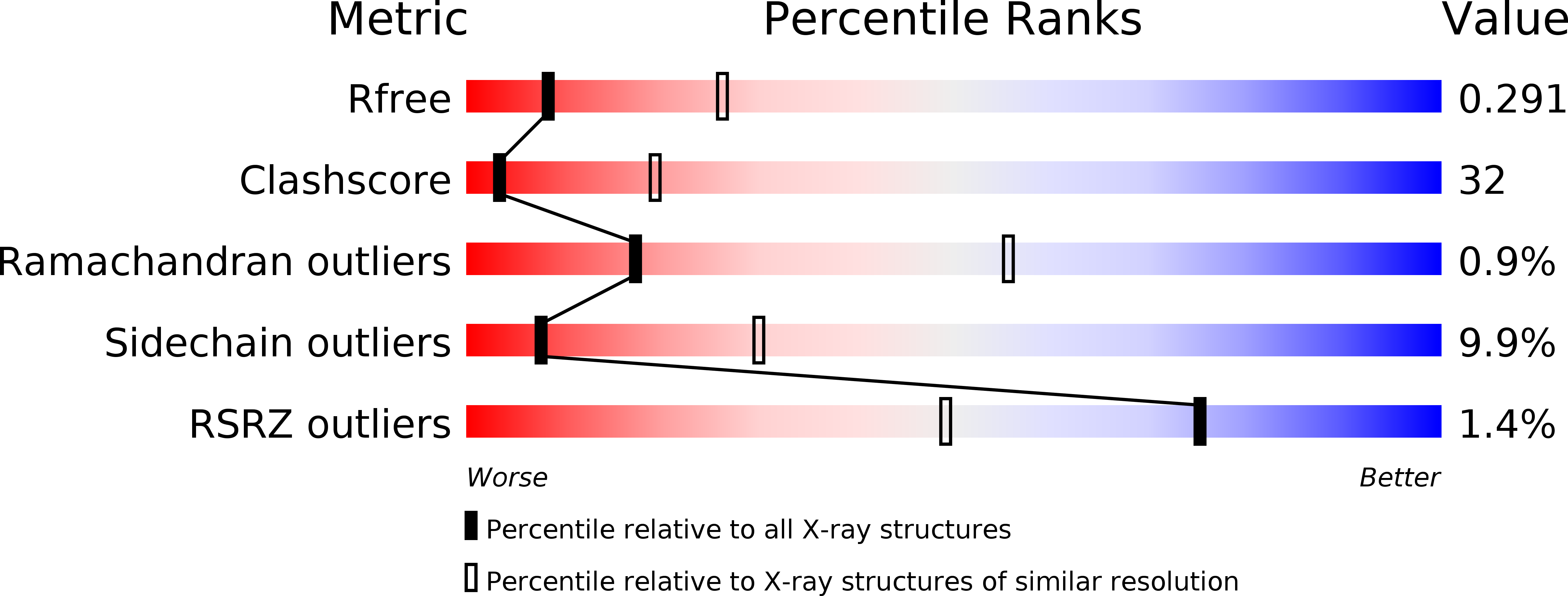
R-Value Free:
0.29
R-Value Work:
0.23
R-Value Observed:
0.24
Space Group:
P 21 21 21
Macromolecular Entities
Structures with similar UniProt ID
Protein Blast
Polymer Type:polypeptide(L)
Molecule:Terminal deoxynucleotidyltransferase short isoform
Chain IDs:B (auth: A)
Chain Length:363
Number of Molecules:1
Biological Source:Mus musculus
Modified Residue
Compound ID Chain ID Parent Comp ID Details 2D Image
BRU A DU ?
Primary Citation
Crystal structures of a template-independent DNA polymerase: murine terminal deoxynucleotidyltransferase.
EMBO J. 21 427 439 (2002)
PMID: 11823435 DOI: 10.1093/emboj/21.3.427

Abstact

The crystal structure of the catalytic core of murine terminal deoxynucleotidyltransferase (TdT) at 2.35 A resolution reveals a typical DNA polymerase beta-like fold locked in a closed form. In addition, the structures of two different binary complexes, one with an oligonucleotide primer and the other with an incoming ddATP-Co(2+) complex, show that the substrates and the two divalent ions in the catalytic site are positioned in TdT in a manner similar to that described for the human DNA polymerase beta ternary complex, suggesting a common two metal ions mechanism of nucleotidyl transfer in these two proteins. The inability of TdT to accommodate a template strand can be explained by steric hindrance at the catalytic site caused by a long lariat-like loop, which is absent in DNA polymerase beta. However, displacement of this discriminating loop would be sufficient to unmask a number of evolutionarily conserved residues, which could then interact with a template DNA strand. The present structure can be used to model the recently discovered human polymerase mu, with which it shares 43% sequence identity.

Legend

Protein

Chemical

Disease

Primary Citation of related structures
Feedback Form
Name
Email
Institute
Feedback