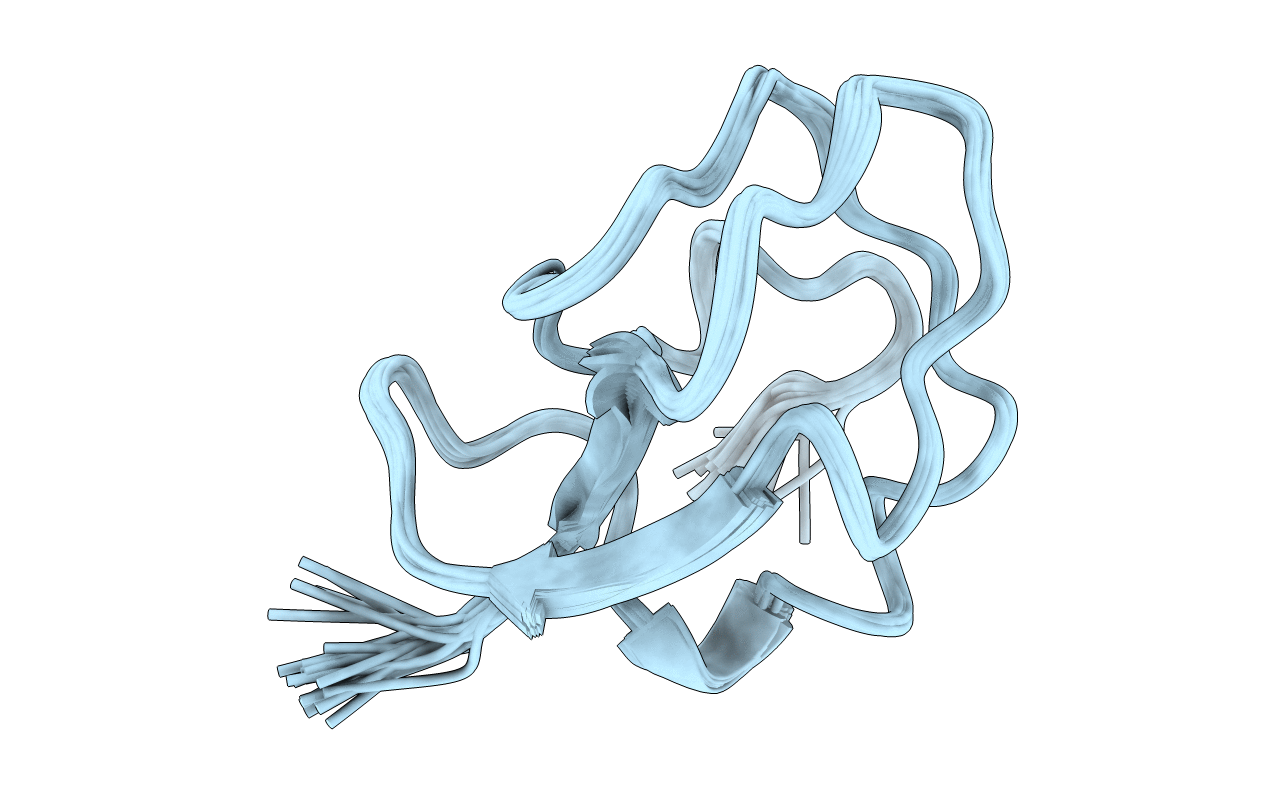
1KDE image
Deposition Date 1996-07-08
Release Date 1997-04-21
Last Version Date 2024-05-22
Entry Detail
PDB ID:
1KDE
Title:
NORTH-ATLANTIC OCEAN POUT ANTIFREEZE PROTEIN TYPE III ISOFORM HPLC12 MUTANT, NMR, 22 STRUCTURES
Biological Source:
Source Organism:
Host Organism:
Method Details:
Experimental Method:
Conformers Calculated:
50
Conformers Submitted:
22
Selection Criteria:
X-PLOR ENERGIES
Macromolecular Entities
Structures with similar UniProt ID
Protein Blast
Polymer Type:polypeptide(L)
Molecule:ANTIFREEZE PROTEIN TYPE III ISOFORM HPLC12 MUTANT
Mutagens:INS(M0), P64A, P65A, INS(K66, D67, E68, L69)
Chain IDs:A
Chain Length:70
Number of Molecules:1
Biological Source:Macrozoarces americanus
Ligand Molecules
Primary Citation
Refined solution structure of type III antifreeze protein: hydrophobic groups may be involved in the energetics of the protein-ice interaction.
Structure 4 1325 1337 (1996)
PMID: 8939756 DOI: 10.1016/S0969-2126(96)00140-2

Abstact

BACKGROUND Antifreeze proteins are found in certain fish inhabiting polar sea water. These proteins depress the freezing points of blood and body fluids below that of the surrounding sea water by binding to and inhibiting the growth of seed ice crystals. The proteins are believed to bind irreversibly to growing ice crystals in such a way as to change the curvature of the ice-water interface, leading to freezing point depression, but the mechanism of high-affinity ice binding is not yet fully understood. RESULTS The solution structure of the type III antifreeze protein was determined by multidimensional NMR spectroscopy. Twenty-two structures converged and display a root mean square difference from the mean of 0.26 A for backbone atoms and 0.62 A for all non-hydrogen atoms. The protein exhibits a compact fold with a relatively large hydrophobic core, several short and irregular beta sheets and one helical turn. The ice-binding site, which encompasses parts of the C-terminal sheet and a loop, is planar and relatively nonpolar. The site is further characterized by the low solvent accessibilities and the specific spatial arrangement of the polar side-chain atoms of the putative ice-binding residues Gln9, Asn14, Thr15, Thr18 and Gln44. CONCLUSIONS In agreement with the adsorption-inhibition mechanism of action, interatomic distances between active polar protein residues match the spacing of water molecules in the prism planes (¿10&1macr;0¿) of the hexagonal ice crystal. The particular side-chain conformations, however, limit the number and strength of possible proten-ice hydrogen bonds. This suggests that other entropic and enthalpic contributions, such as those arising from hydrophobic groups, could play a role in the high-affinity protein-ice adsorption.

Legend

Protein

Chemical

Disease

Primary Citation of related structures
Feedback Form
Name
Email
Institute
Feedback