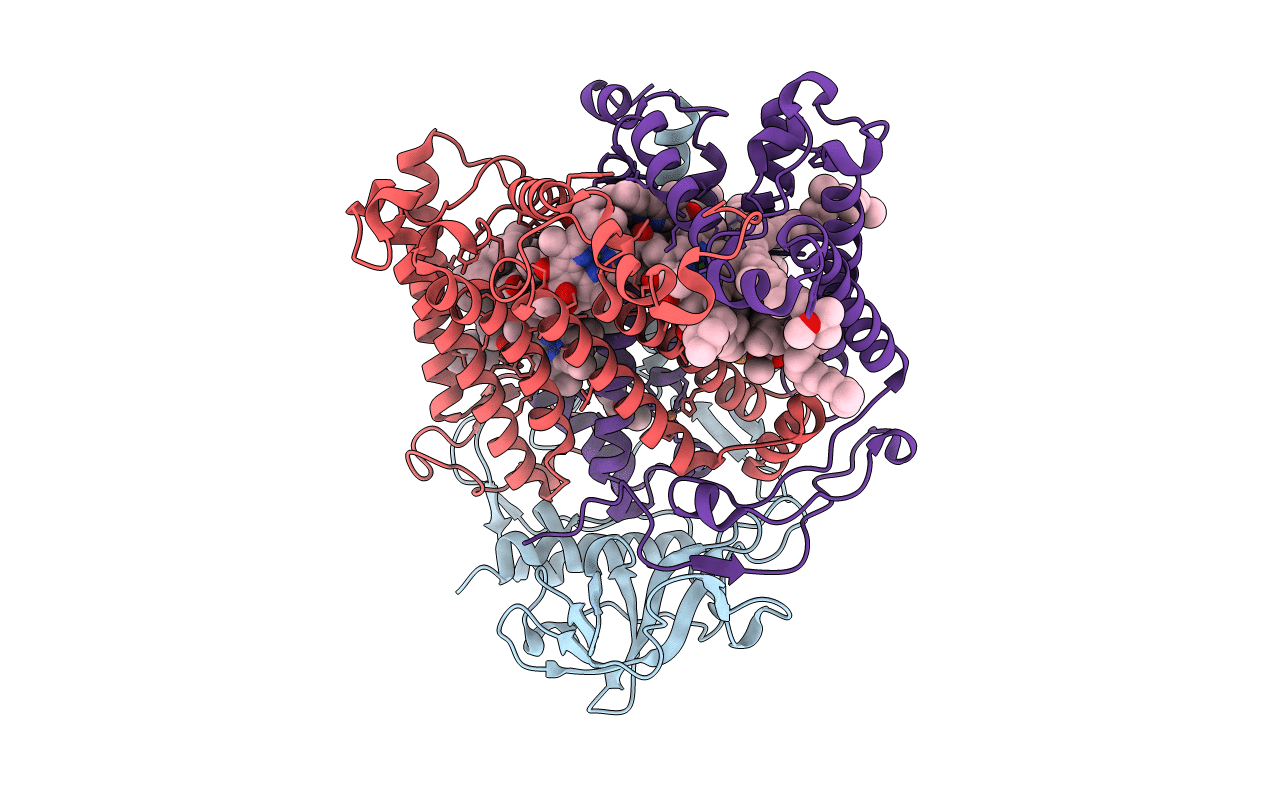
1KBY image
Deposition Date 2001-11-07
Release Date 2002-11-13
Last Version Date 2024-02-07
Entry Detail
PDB ID:
1KBY
Keywords:
Title:
Structure of Photosynthetic Reaction Center with bacteriochlorophyll-bacteriopheophytin heterodimer
Biological Source:
Source Organism:
Method Details:
Experimental Method:
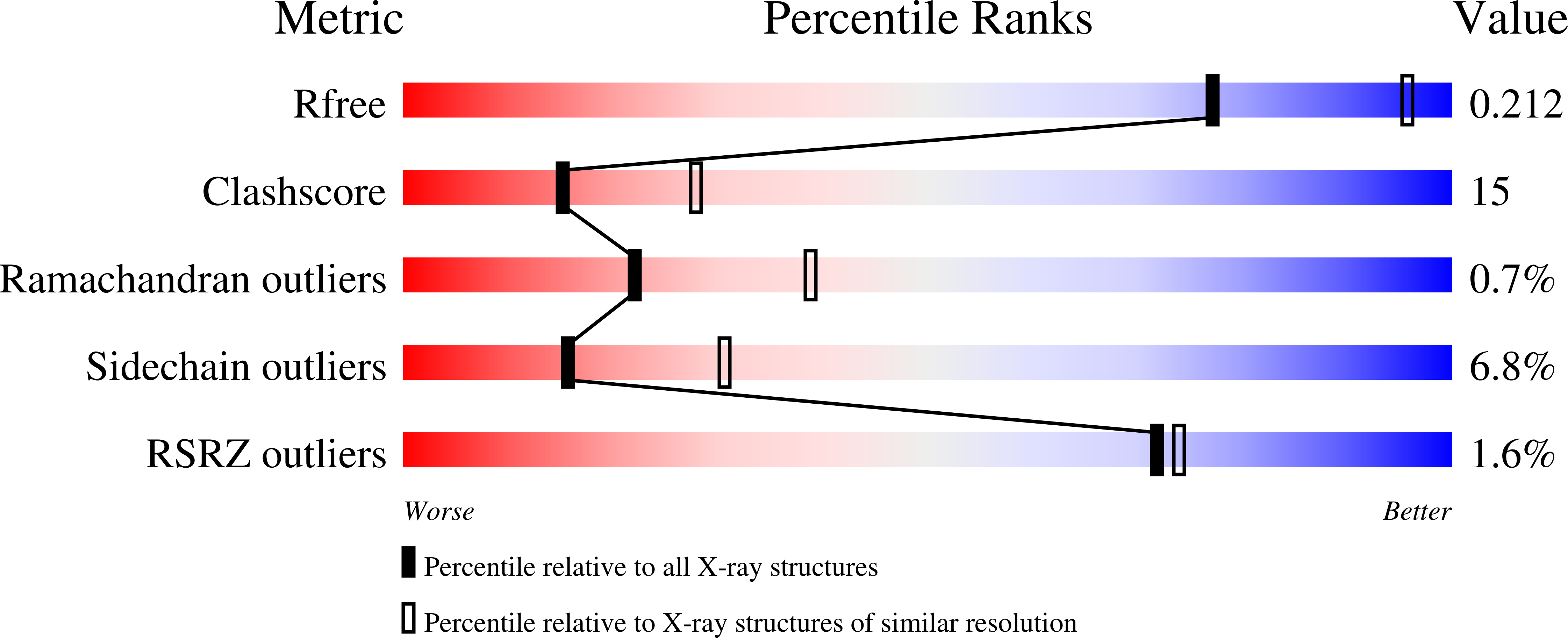
Resolution:
2.50 Å
R-Value Free:
0.22
R-Value Work:
0.19
R-Value Observed:
0.19
Space Group:
P 31 2 1
Macromolecular Entities
Structures with similar UniProt ID
Protein Blast
Polymer Type:polypeptide(L)
Molecule:PHOTOSYNTHETIC REACTION CENTER PROTEIN H CHAIN
Chain IDs:C (auth: H)
Chain Length:260
Number of Molecules:1
Biological Source:Rhodobacter sphaeroides
Structures with similar UniProt ID
Protein Blast
Polymer Type:polypeptide(L)
Molecule:PHOTOSYNTHETIC REACTION CENTER PROTEIN L CHAIN
Chain IDs:A (auth: L)
Chain Length:281
Number of Molecules:1
Biological Source:Rhodobacter sphaeroides
Structures with similar UniProt ID
Protein Blast
Polymer Type:polypeptide(L)
Molecule:PHOTOSYNTHETIC REACTION CENTER PROTEIN M CHAIN
Mutagens:H202L
Chain IDs:B (auth: M)
Chain Length:307
Number of Molecules:1
Biological Source:Rhodobacter sphaeroides
Primary Citation
The structure of the heterodimer reaction center from Rhodobacter sphaeroides at 2.55 a resolution.
Photosynth.Res. 74 87 93 (2002)
PMID: 16228547 DOI: 10.1023/A:1020882402389

Abstact

Crystals have been obtained of reaction centers of the heterodimer mutant that has significantly different properties than wild type due to the primary donor being formed from both a bacteriochlorophyll and bacteriopheophytin rather than two bacteriochlorophylls as found for wild type. The crystals belong to the trigonal space group P3(1)21 and the structure has been refined to a resolution limit of 2.55 A with an R factor of 19.0%. The electron density maps confirm that a primary donor does indeed contain a bacteriopheophytin due to the His to Leu substitution at M202 that coordinates the corresponding bacteriochlorophyll in wild-type. Other structural changes compared to wild type are relatively minor with the relative orientation and positioning of the two tetrapyrroles forming the primary donor being unchanged within the error. Compared to wild type, the only significant alterations are small shifts of residues M196 to M206, a rotation of the side chain of Ile M206, and the loss of a bound water molecule that in wild-type is hydrogen-bonded to both His M202 and the bacteriochlorophyll monomer on the active branch. Since hydrogen-bonding interactions strongly influence the energies of tetrapyrroles, the loss of the water molecule should result in changes in the energies of the bacteriochlorophyll monomer that contributes to the observed functional differences with wild-type.

Legend

Protein

Chemical

Disease

Primary Citation of related structures
Feedback Form
Name
Email
Institute
Feedback