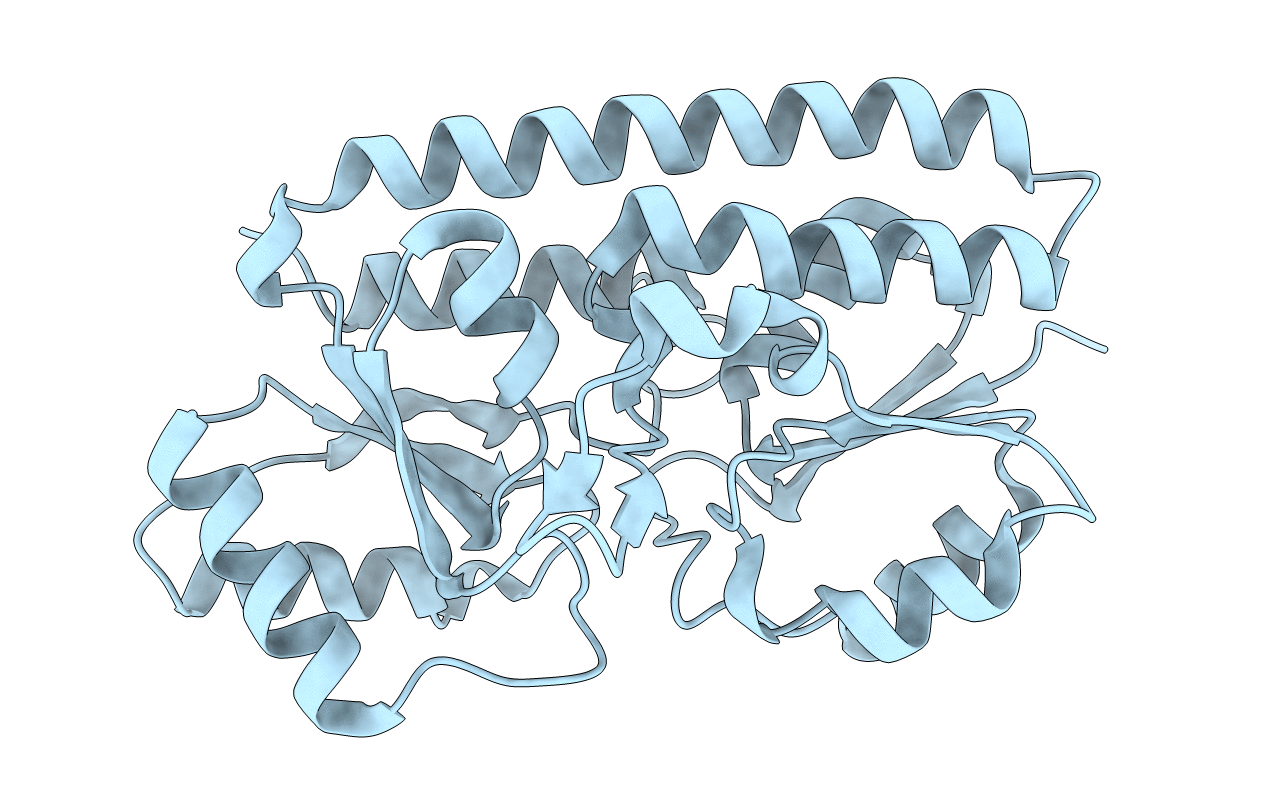
1K0F image
Deposition Date 2001-09-19
Release Date 2002-04-10
Last Version Date 2023-08-16
Entry Detail
PDB ID:
1K0F
Title:
Crystal structure of Zn(II)-free T. pallidum TroA
Biological Source:
Source Organism:
Host Organism:
Method Details:
Experimental Method:
Resolution:
2.50 Å
R-Value Free:
0.25
R-Value Work:
0.20
Space Group:
C 1 2 1

Macromolecular Entities
Structures with similar UniProt ID
Protein Blast
Polymer Type:polypeptide(L)
Molecule:Periplasmic zinc-binding protein troA
Gene (Uniprot):troA
Chain IDs:A
Chain Length:277
Number of Molecules:1
Biological Source:Treponema pallidum
Primary Citation
The crystal structure of Zn(II)-free Treponema pallidum TroA, a periplasmic metal-binding protein, reveals a closed conformation.
J.Bacteriol. 184 2300 2304 (2002)
PMID: 11914363 DOI: 10.1128/JB.184.8.2300-2304.2002

Abstact

We previously demonstrated that Treponema pallidum TroA is a periplasmic metal-binding protein (MBP) with a distinctive alpha-helical backbone. To better understand the mechanisms of metal binding and release by TroA, we determined the crystal structure of the apoprotein at a resolution of 2.5 A and compared it to that of the Zn(II)-bound form (Protein Data Bank accession code 1toa). apo-TroA shows a conformation even more closed than that of its Zn(II)-bound counterpart due to a 4 degrees tilt of the C-terminal domain (residues 190 through 308) about an axis parallel to the poorly flexible backbone helix. This domain tilting pushes two loops (residues 248 through 253 and 277 through 286) towards the metal-binding site by more than 1 A, resulting in an unfavorable interaction of I251 with D66. To avoid this contact, D66 shifts towards H68, one of the four Zn(II)-coordinating residues. The approach of this negative charge coincides with the flipping of the imidazole side chain of H68, resulting in the formation of a new hydrogen bond. The conformational change of H68, along with a slight rearrangement of D279, a C-terminal domain Zn(II)-coordinating residue, distorts the metal-binding site geometry, presumably causing the release of the bound metal ion. Ligand binding and release by TroA, and presumably by other members of the MBP cluster, differs from the "Venus flytrap" mechanism utilized by bacterial nonmetal solute-binding receptors.

Legend

Protein

Chemical

Disease

Primary Citation of related structures
Feedback Form
Name
Email
Institute
Feedback