1JRN image
Deposition Date 2001-08-14
Release Date 2002-06-28
Last Version Date 2024-02-07
Entry Detail
PDB ID:
1JRN
Keywords:
Title:
Orthorhombic form of Oxytricha telomeric DNA at 2.0A
Biological Source:
Source Organism:
Method Details:
Experimental Method:
Resolution:
2.00 Å
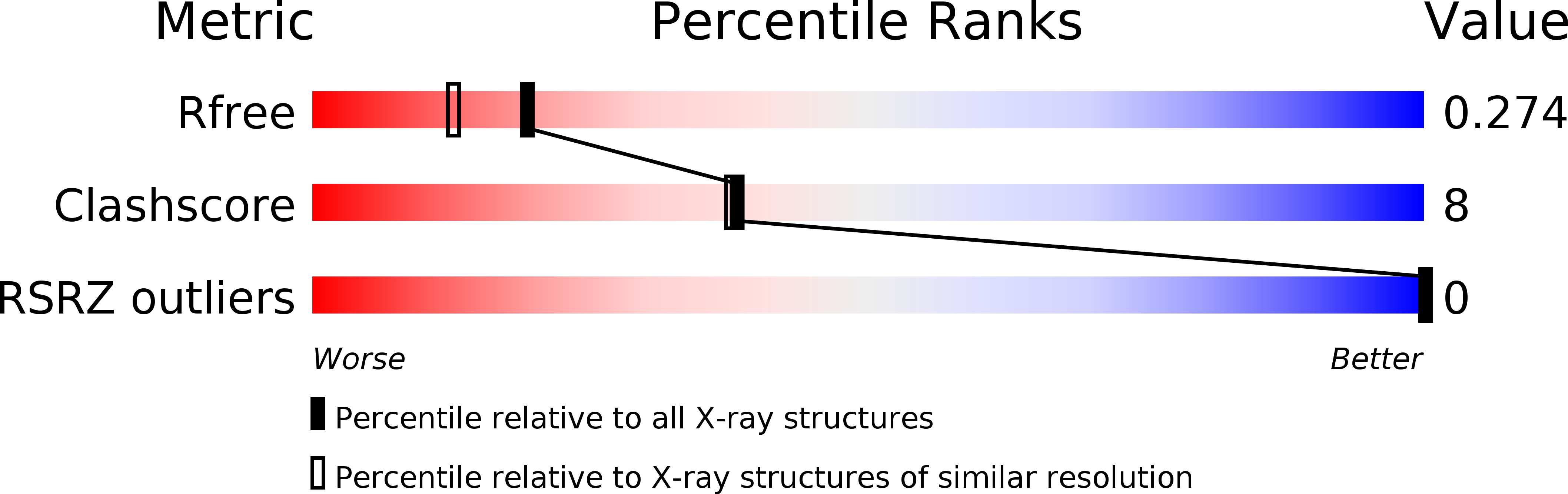
R-Value Free:
0.27
R-Value Work:
0.21
R-Value Observed:
0.26
Space Group:
P 21 21 21
Macromolecular Entities
Polymer Type:polydeoxyribonucleotide
Molecule:5'-D(*GP*GP*GP*GP*TP*TP*TP*TP*GP*GP*GP*G)-3'
Chain IDs:A, B, C, D
Chain Length:12
Number of Molecules:4
Biological Source:
Ligand Molecules
Primary Citation
Crystal structure of the potassium form of an Oxytricha nova G-quadruplex.
J.Mol.Biol. 320 189 200 (2002)
PMID: 12079378 DOI: 10.1016/S0022-2836(02)00428-X

Abstact

The crystal structures of the potassium-containing quadruplex formed from the Oxytricha nova sequence d(GGGGTTTTGGGG) are reported, in two space groups, the orthorhombic P2(1)2(1)2(1) and the trigonal P3(2)21, which diffract to 2.0 A and 1.49 A, respectively. The orthorhombic form contains two independent quadruplexes in the asymmetric unit, and the trigonal form contains one. All three of these quadruplexes adopt an identical fold, with two strands forming an antiparallel diagonal arrangement. This is identical with that observed previously in NMR studies of the native sodium and potassium forms, and a crystallographic analysis of it complexed with an O. nova protein. The present analysis demonstrates that the native structure is the same in solution and in the crystalline state and, moreover, that the nature of the counter-ion does not affect the overall fold of this quadruplex. The analysis corrects an earlier crystallographic study of this quadruplex. The conformation of the tetra-thymine loop is described in detail, which involves the third thymine base folding back to interact with the first thymine base. The water networks in the grooves and loops are described and, in particular, the ability of water molecules to form a continuous spine of hydration in the narrow groove is detailed. Each quadruplex has five potassium ions organised in a linear channel, with square antiprismatic coordination to each ion from oxygen atoms.

Legend

Protein

Chemical

Disease

Primary Citation of related structures
Feedback Form
Name
Email
Institute
Feedback