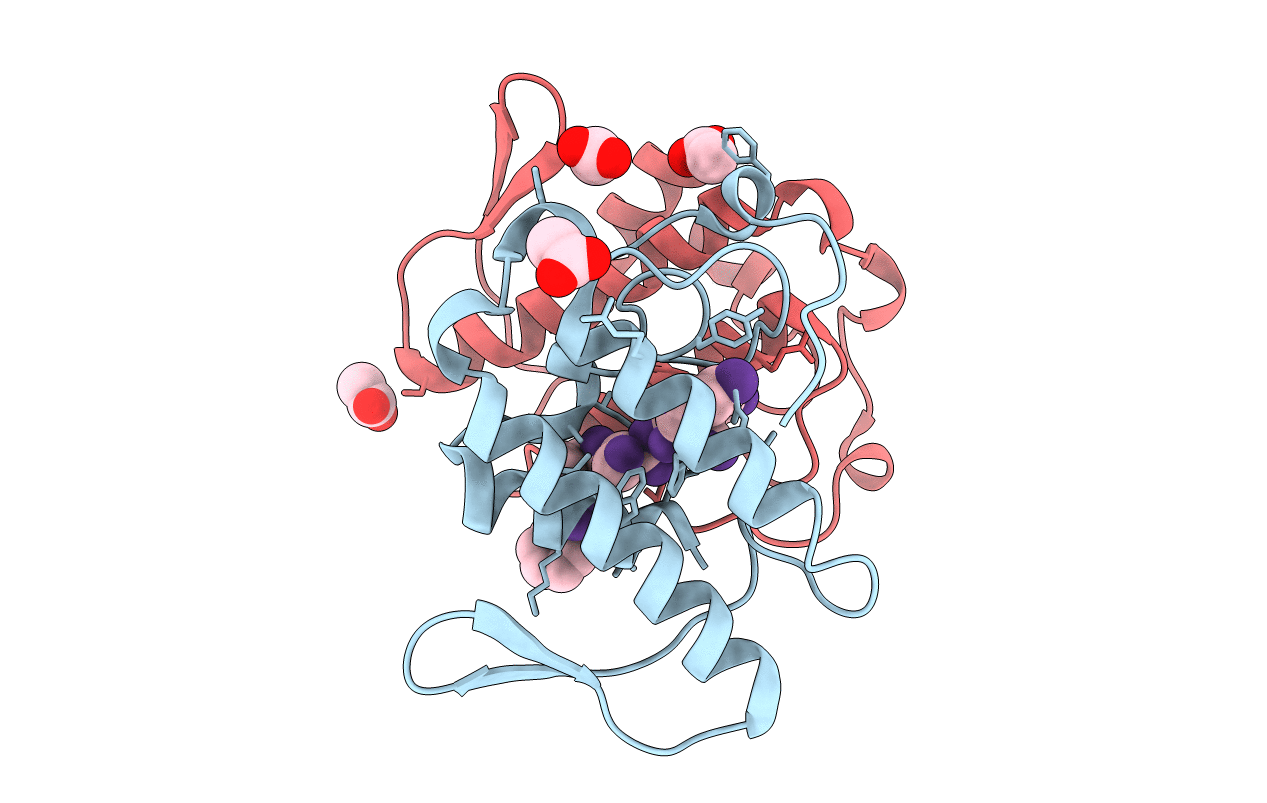
1JQ9 image
Deposition Date 2001-08-04
Release Date 2002-11-06
Last Version Date 2024-10-09
Entry Detail
PDB ID:
1JQ9
Title:
Crystal structure of a complex formed between phospholipase A2 from Daboia russelli pulchella and a designed pentapeptide Phe-Leu-Ser-Tyr-Lys at 1.8 resolution
Biological Source:
Source Organism:
Method Details:
Experimental Method:
Resolution:
1.80 Å
R-Value Free:
0.22
R-Value Work:
0.20
R-Value Observed:
0.20
Space Group:
C 2 2 21

Macromolecular Entities
Structures with similar UniProt ID
Protein Blast
Polymer Type:polypeptide(L)
Molecule:Phospholipase A2
Chain IDs:A, B
Chain Length:121
Number of Molecules:2
Biological Source:Daboia russellii pulchella
Polymer Type:polypeptide(L)
Molecule:Peptide inhibitor
Chain IDs:C (auth: P)
Chain Length:5
Number of Molecules:1
Biological Source:
Ligand Molecules
Primary Citation
Crystal Structure of a Complex Formed between a Snake Venom Phospholipase A2 and a Potent Peptide Inhibitor Phe-Leu-Ser-Tyr-Lys at 1.8 A Resolution
J.BIOL.CHEM. 277 41079 41085 (2002)
PMID: 12186870 DOI: 10.1074/jbc.M206130200

Abstact

Phospholipase A(2) is an important enzyme involved in the production of prostaglandins and their related compounds causing inflammatory disorders. Among the several peptides tested, the peptide Phe-Leu-Ser-Tyr-Lys (FLSYK) showed the highest inhibition. The dissociation constant (K(d)) for this peptide was calculated to be 3.57 +/- 0.05 x 10(-9) m. In order to further improve the degree of inhibition of phospholipase A(2), a complex between Russells viper snake venom phospholipase A(2) and a peptide inhibitor FLSYK was crystallized, and its structure was determined by crystallographic methods and refined to an R-factor of 0.205 at 1.8 A resolution. The structure contains two crystallographically independent molecules of phospholipase A(2) (molecules A and B) and a peptide molecule specifically bound to molecule A only. The two molecules formed an asymmetric dimer. The dimerization caused a modification in the binding site of molecule A. The overall conformations of molecules A and B were found to be generally similar except three regions i.e. the Trp-31-containing loop (residues 25-34), the beta-wing consisting of two antiparallel beta-strands (residues 74-85) and the C-terminal region (residues 119-133). Out of the above three, the most striking difference pertains to the conformation of Trp-31 in the two molecules. The orientation of Trp-31 in molecule A was suitable for the binding of FLSYK, while it disallowed the binding of peptide to molecule B. The structure of the complex clearly shows that the peptide is so placed in the binding site of molecule A that the side chain of its lysine residue interacted extensively with the enzyme and formed several hydrogen bonds in addition to a strong electrostatic interaction with critical Asp-49. The C-terminal carboxylic group of the peptide interacted with the catalytic residue His-48.

Legend

Protein

Chemical

Disease

Primary Citation of related structures
Feedback Form
Name
Email
Institute
Feedback