1JKX image
Deposition Date 2001-07-13
Release Date 2001-11-30
Last Version Date 2024-03-13
Entry Detail
PDB ID:
1JKX
Keywords:
Title:
Unexpected formation of an epoxide-derived multisubstrate adduct inhibitor on the active site of GAR transformylase
Biological Source:
Source Organism:
Escherichia coli (Taxon ID: 562)
Host Organism:
Method Details:
Experimental Method:
Resolution:
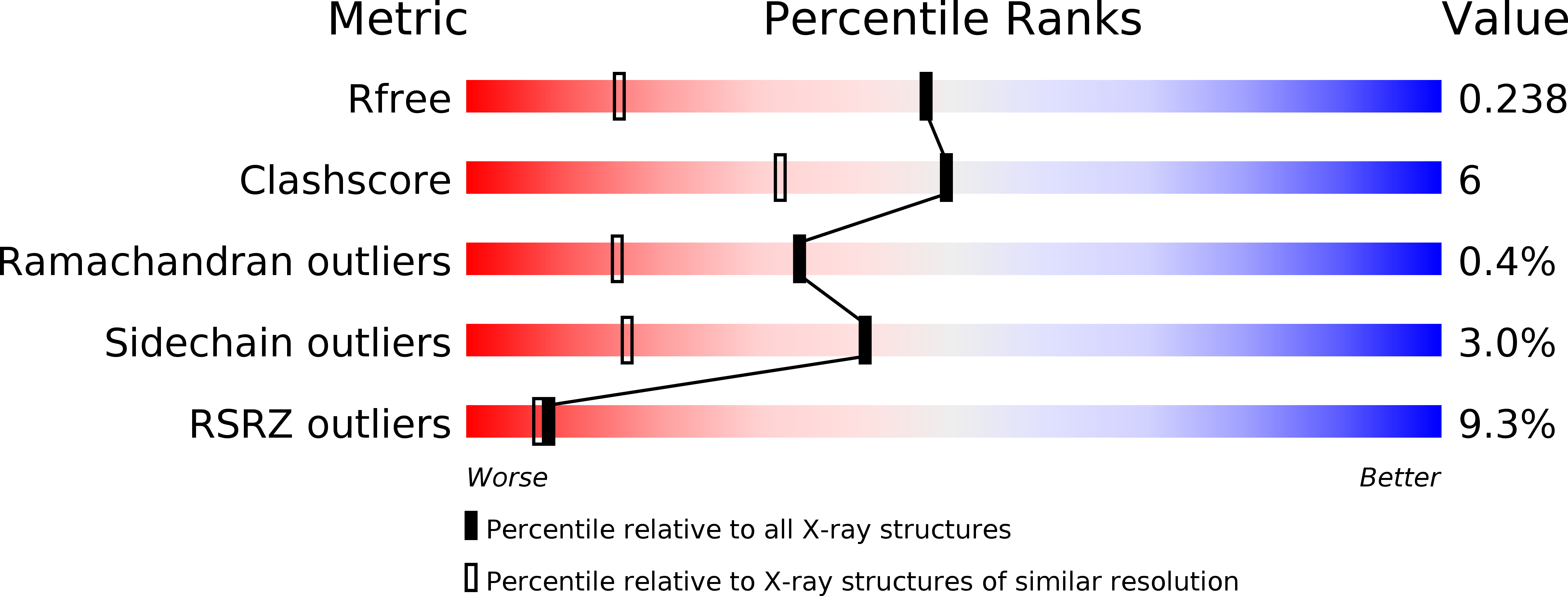
1.60 Å
R-Value Free:
0.24
R-Value Work:
0.22
R-Value Observed:
0.22
Space Group:
P 1
Macromolecular Entities
Structures with similar UniProt ID
Protein Blast
Polymer Type:polypeptide(L)
Molecule:PHOSPHORIBOSYLGLYCINAMIDE FORMYLTRANSFERASE
Gene (Uniprot):purN
Chain IDs:A, B, C, D
Chain Length:212
Number of Molecules:4
Biological Source:Escherichia coli
Ligand Molecules
Primary Citation
Unexpected formation of an epoxide-derived multisubstrate adduct inhibitor on the active site of GAR transformylase.
Biochemistry 40 13538 13547 (2001)
PMID: 11695901 DOI: 10.1021/bi011482+

Abstact

Multisubstrate adduct inhibitors (MAI) of glycinamide ribonucleotide transformylase (GAR Tfase), which incorporate key features of the folate cofactor and the beta-GAR substrate, typically exhibit K(i)'s in the picomolar range. However, these compounds have reduced bioavailability due to the incorporation of a negatively charged phosphate moiety that prevents effective cellular uptake. Thus, a folate analogue that is capable of adduct formation with the substrate on the enzyme active site could lead to a potent GAR Tfase inhibitor that takes advantage of the cellular folate transport systems. We synthesized a dibromide folate analogue, 10-bromo-10-bromomethyl-5,8,10-trideazafolic acid, that was an intermediate designed to assemble with the substrate beta-GAR on the enzyme active site. We have now determined the crystal structure of the Escherichia coli GAR Tfase/MAI complex at 1.6 A resolution to ascertain the nature and mechanism of its time-dependent inhibition. The high-resolution crystal structure clearly revealed the existence of a covalent adduct between the substrate beta-GAR and the folate analogue (K(i) = 20 microM). However, the electron density map surprisingly indicated a C10 hydroxyl in the adduct rather than a bromide and suggested that the multisubstrate adduct is not formed directly from the dibromide but proceeds via an epoxide. Subsequently, we demonstrated the in situ conversion of the dibromide to the epoxide. Moreover, synthesis of the authentic epoxide confirmed that its inhibitory, time-dependent, and cytotoxic properties are comparable to those of the dibromide. Further, inhibition was strongest when the dibromide or epoxide is preincubated with both enzyme and substrate, indicating that inhibition occurs via the enzyme-dependent formation of the multisubstrate adduct. Thus, the crystal structure revealed the successful formation of an enzyme-assembled multisubstrate adduct and highlighted a potential application for epoxides, and perhaps aziridines, in the design of efficacious GAR Tfase inhibitors.

Legend

Protein

Chemical

Disease

Primary Citation of related structures
Feedback Form
Name
Email
Institute
Feedback