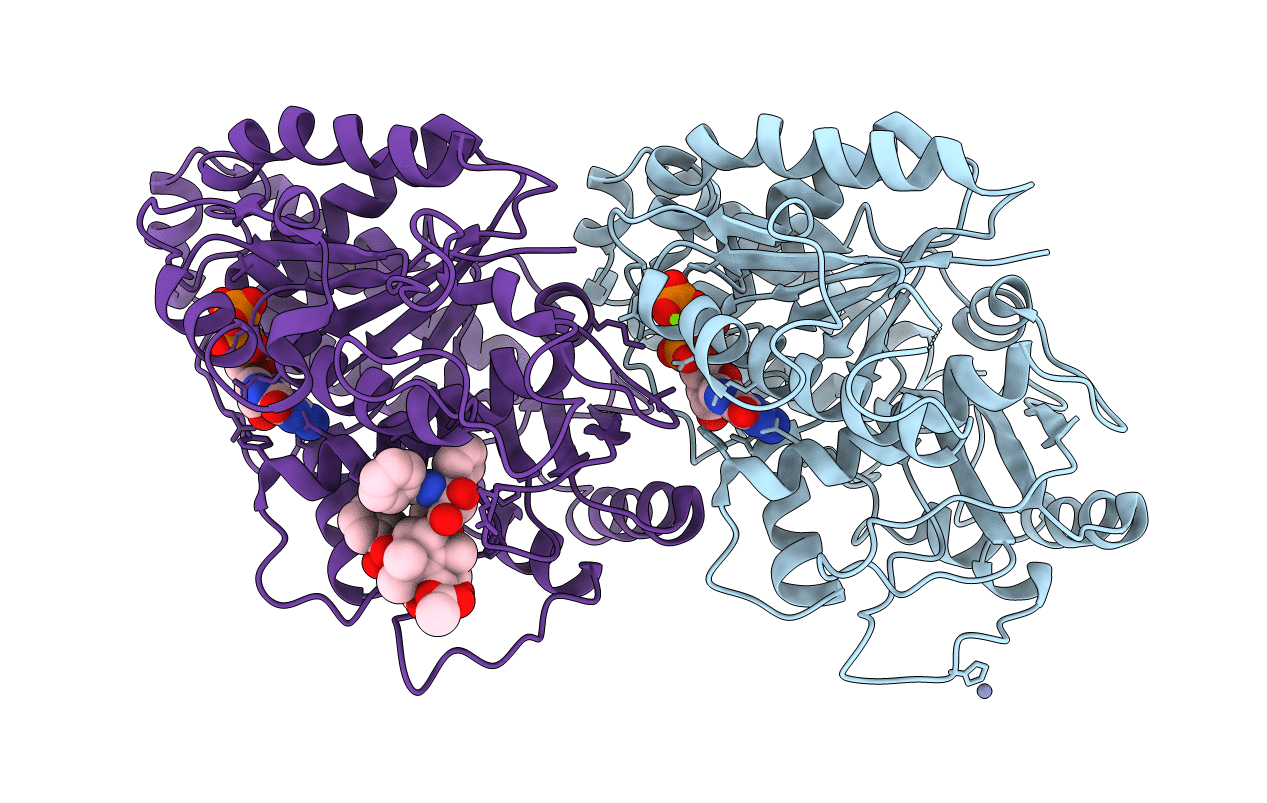
1JFF image
Deposition Date 2001-06-20
Release Date 2001-09-19
Last Version Date 2023-08-16
Entry Detail
PDB ID:
1JFF
Title:
Refined structure of alpha-beta tubulin from zinc-induced sheets stabilized with taxol
Biological Source:
Source Organism:
Bos taurus (Taxon ID: 9913)
Method Details:
Experimental Method:
Resolution:
3.50 Å
R-Value Free:
0.29
R-Value Work:
0.23
Space Group:
P 1 21 1

Macromolecular Entities
Structures with similar UniProt ID
Protein Blast
Polymer Type:polypeptide(L)
Molecule:tubulin alpha chain
Chain IDs:A
Chain Length:451
Number of Molecules:1
Biological Source:Bos taurus
Structures with similar UniProt ID
Protein Blast
Polymer Type:polypeptide(L)
Molecule:tubulin beta chain
Chain IDs:B
Chain Length:445
Number of Molecules:1
Biological Source:Bos taurus
Primary Citation
Refined structure of alpha beta-tubulin at 3.5 A resolution.
J.Mol.Biol. 313 1045 1057 (2001)
PMID: 11700061 DOI: 10.1006/jmbi.2001.5077

Abstact

We present a refined model of the alpha beta-tubulin dimer to 3.5 A resolution. An improved experimental density for the zinc-induced tubulin sheets was obtained by adding 114 electron diffraction patterns at 40-60 degrees tilt and increasing the completeness of structure factor amplitudes to 84.7 %. The refined structure was obtained using maximum-likelihood including phase information from experimental images, and simulated annealing Cartesian refinement to an R-factor of 23.2 and free R-factor of 29.7. The current model includes residues alpha:2-34, alpha:61-439, beta:2-437, one molecule of GTP, one of GDP, and one of taxol, as well as one magnesium ion at the non-exchangeable nucleotide site, and one putative zinc ion near the M-loop in the alpha-tubulin subunit. The acidic C-terminal tails could not be traced accurately, neither could the N-terminal loop including residues 35-60 in the alpha-subunit. There are no major changes in the overall fold of tubulin with respect to the previous structure, testifying to the quality of the initial experimental phases. The overall geometry of the model is, however, greatly improved, and the position of side-chains, especially those of exposed polar/charged groups, is much better defined. Three short protein sequence frame shifts were detected with respect to the non-refined structure. In light of the new model we discuss details of the tubulin structure such as nucleotide and taxol binding sites, lateral contacts in zinc-sheets, and the significance of the location of highly conserved residues.

Legend

Protein

Chemical

Disease

Primary Citation of related structures
Feedback Form
Name
Email
Institute
Feedback