1JD7 image
Deposition Date 2001-06-13
Release Date 2002-09-18
Last Version Date 2024-10-23
Entry Detail
PDB ID:
1JD7
Keywords:
Title:
CRYSTAL STRUCTURE ANALYSIS OF THE MUTANT K300R OF PSEUDOALTEROMONAS HALOPLANCTIS ALPHA-AMYLASE
Biological Source:
Source Organism:
Host Organism:
Method Details:
Experimental Method:
Resolution:
2.25 Å
R-Value Free:
0.21
R-Value Work:
0.17
Space Group:
C 2 2 21
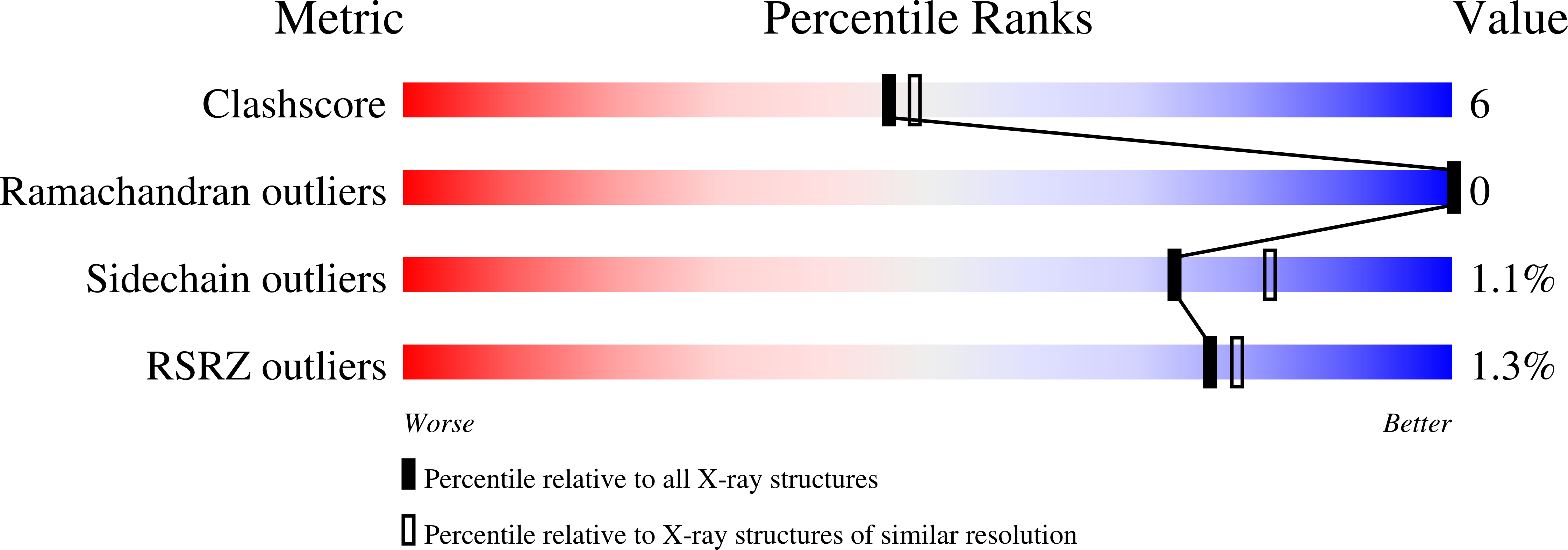
Macromolecular Entities
Structures with similar UniProt ID
Protein Blast
Polymer Type:polypeptide(L)
Molecule:ALPHA-AMYLASE
Gene (Uniprot):amy
Mutagens:K300R
Chain IDs:A
Chain Length:453
Number of Molecules:1
Biological Source:Pseudoalteromonas haloplanktis
Primary Citation
Structural basis of alpha-amylase activation by chloride
PROTEIN SCI. 11 1435 1441 (2002)
PMID: 12021442 DOI: 10.1110/ps.0202602

Abstact

To further investigate the mechanism and function of allosteric activation by chloride in some alpha-amylases, the structure of the bacterial alpha-amylase from the psychrophilic micro-organism Pseudoalteromonas haloplanktis in complex with nitrate has been solved at 2.1 A degrees, as well as the structure of the mutants Lys300Gln (2.5 A degrees ) and Lys300Arg (2.25 A degrees ). Nitrate binds strongly to alpha-amylase but is a weak activator. Mutation of the critical chloride ligand Lys300 into Gln results in a chloride-independent enzyme, whereas the mutation into Arg mimics the binding site as is found in animal alpha-amylases with, however, a lower affinity for chloride. These structures reveal that the triangular conformation of the chloride ligands and the nearly equatorial coordination allow the perfect accommodation of planar trigonal monovalent anions such as NO3-, explaining their unusual strong binding. It is also shown that a localized negative charge such as that of Cl-, rather than a delocalized charge as in the case of nitrate, is essential for maximal activation. The chloride-free mutant Lys300Gln indicates that chloride is not mandatory for the catalytic mechanism but strongly increases the reactivity at the active site. Disappearance of the putative catalytic water molecule in this weakly active mutant supports the view that chloride helps to polarize the hydrolytic water molecule and enhances the rate of the second step in the catalytic reaction.

Legend

Protein

Chemical

Disease

Primary Citation of related structures
Feedback Form
Name
Email
Institute
Feedback