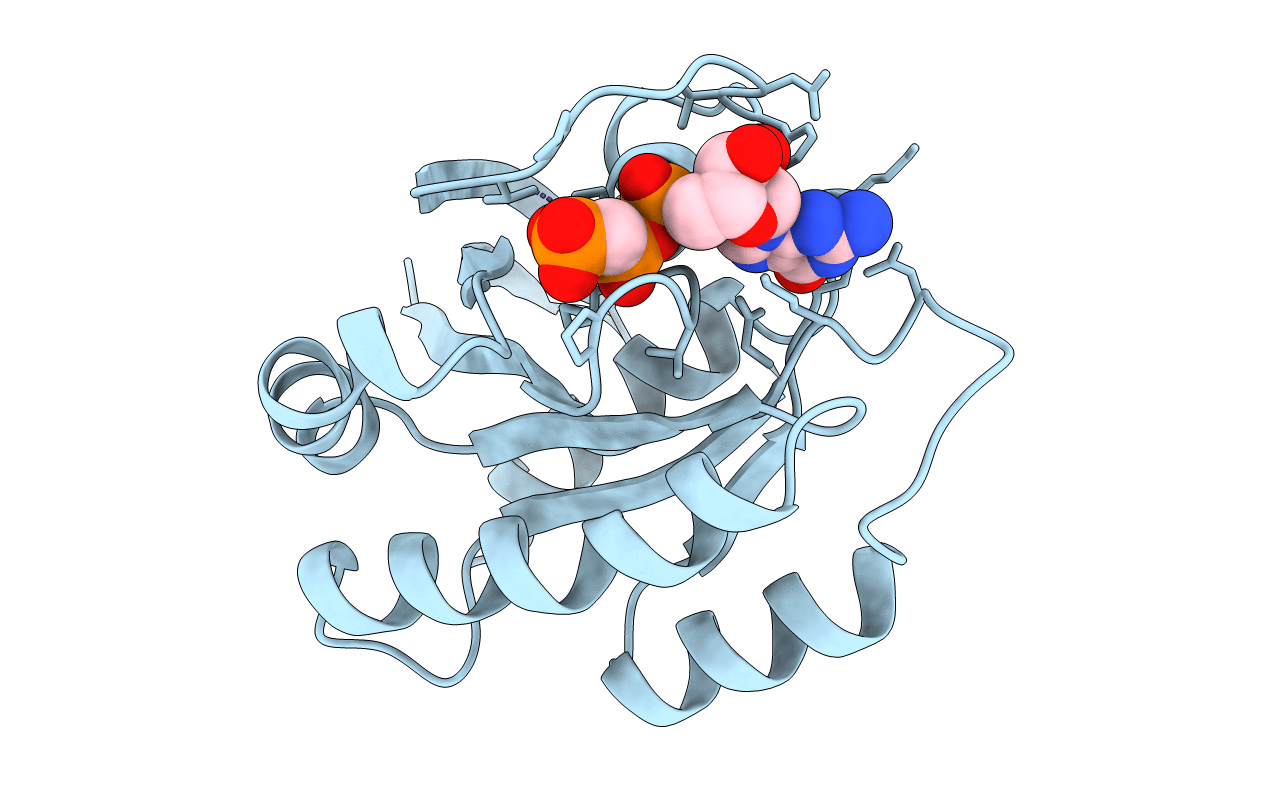
1JAH image
Deposition Date 1996-12-15
Release Date 1997-07-23
Last Version Date 2024-04-03
Entry Detail
PDB ID:
1JAH
Keywords:
Title:
H-RAS P21 PROTEIN MUTANT G12P, COMPLEXED WITH GUANOSINE-5'-[BETA,GAMMA-METHYLENE] TRIPHOSPHATE AND MAGNESIUM
Biological Source:
Source Organism:
Homo sapiens (Taxon ID: 9606)
Host Organism:
Method Details:
Experimental Method:
Resolution:
1.80 Å
R-Value Free:
0.29
R-Value Work:
0.22
R-Value Observed:
0.22
Space Group:
P 32 2 1

Macromolecular Entities
Structures with similar UniProt ID
Protein Blast
Polymer Type:polypeptide(L)
Molecule:C-HA-RAS
Gene (Uniprot):HRAS
Mutagens:G12P
Chain IDs:A
Chain Length:166
Number of Molecules:1
Biological Source:Homo sapiens
Primary Citation
The role of the metal ion in the p21ras catalysed GTP-hydrolysis: Mn2+ versus Mg2+.
J.Mol.Biol. 266 847 856 (1997)
PMID: 9102473 DOI: 10.1006/jmbi.1996.0814

Abstact

GTP and ATP hydrolysing proteins have an absolute requirement for a divalent cation, which is usually Mg2+, as a cofactor in the enzymatic reaction. Other phosphoryl transfer enzymes employ more than one divalent ion for the enzymatic reaction. It is shown here for p21ras, a well studied example of GTP hydrolysing proteins, that the GTP-hydrolysis rate is significantly faster if Mg2+ is replaced by Mn2+, both in the presence or absence of its GTPase-activating protein Ras-GAP. This effect is not due to a different stoichiometry of metal ion binding, since one metal ion is sufficient for full enzymatic activity. To determine the role of the metal ion, the crystal structure of p21(G12P). GppCp complexed with Mn2+ was determined and shown to be very similar to the corresponding p21(G12P). GppCp.Mg2+ structure. Especially the coordination sphere around the metal ions is very similar, and no second metal ion binding site could be detected, consistent with the assumption that one metal ion is sufficient for GTP hydrolysis. In order to explain the biochemical differences, we analysed the GTPase reaction mechanism with a linear free energy relationships approach. The result suggests that the reaction mechanism is not changed with Mn2+ but that the transition metal ion Mn2+ shifts the pKa of the gamma-phosphate by almost half a unit and increases the reaction rate due to an increase in the basicity of GTP acting as the general base. This suggests that the intrinsic GTPase reaction could be an attractive target for anti-cancer drug design. By using Rap1A and Ran, we show that the acceleration of the GTPase by Mn2+ appears to be a general phenomenon of GTP-binding proteins.

Legend

Protein

Chemical

Disease

Primary Citation of related structures
Feedback Form
Name
Email
Institute
Feedback