1J4N image
Deposition Date 2001-10-19
Release Date 2002-03-27
Last Version Date 2023-12-27
Entry Detail
PDB ID:
1J4N
Title:
Crystal Structure of the AQP1 water channel
Biological Source:
Source Organism:
Bos taurus (Taxon ID: 9913)
Method Details:
Experimental Method:
Resolution:
2.20 Å
R-Value Free:
0.30
R-Value Work:
0.26
Space Group:
I 4 2 2
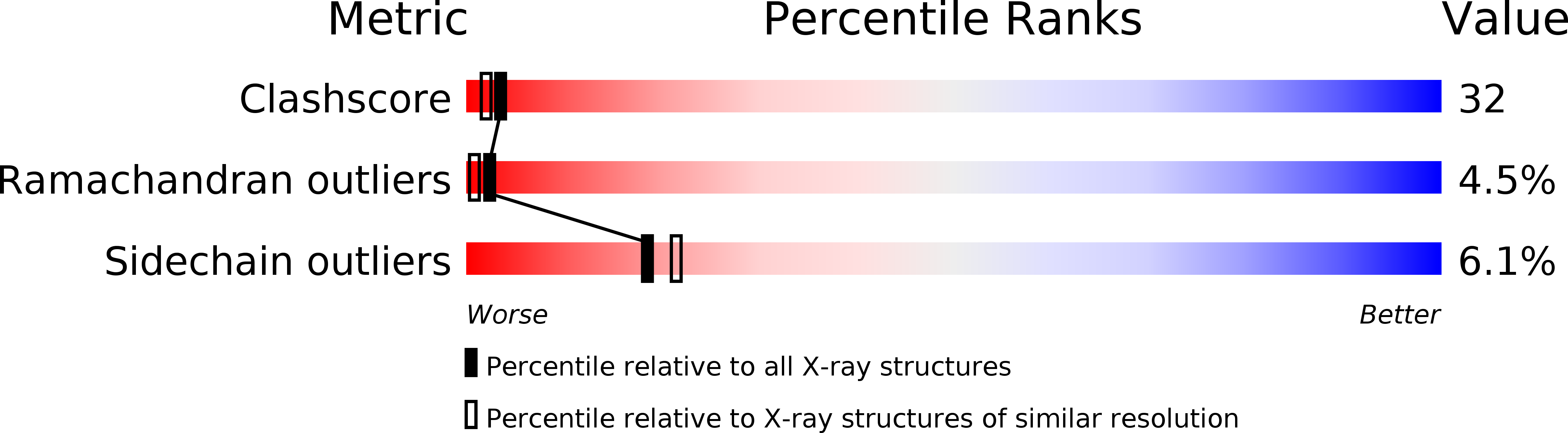
Macromolecular Entities
Structures with similar UniProt ID
Protein Blast
Polymer Type:polypeptide(L)
Molecule:AQUAPORIN 1
Gene (Uniprot):AQP1
Chain IDs:A
Chain Length:271
Number of Molecules:1
Biological Source:Bos taurus
Ligand Molecules
Primary Citation
Structural basis of water-specific transport through the AQP1 water channel.
Nature 414 872 878 (2001)
PMID: 11780053 DOI: 10.1038/414872a

Abstact

Water channels facilitate the rapid transport of water across cell membranes in response to osmotic gradients. These channels are believed to be involved in many physiological processes that include renal water conservation, neuro-homeostasis, digestion, regulation of body temperature and reproduction. Members of the water channel superfamily have been found in a range of cell types from bacteria to human. In mammals, there are currently 10 families of water channels, referred to as aquaporins (AQP): AQP0-AQP9. Here we report the structure of the aquaporin 1 (AQP1) water channel to 2.2 A resolution. The channel consists of three topological elements, an extracellular and a cytoplasmic vestibule connected by an extended narrow pore or selectivity filter. Within the selectivity filter, four bound waters are localized along three hydrophilic nodes, which punctuate an otherwise extremely hydrophobic pore segment. This unusual combination of a long hydrophobic pore and a minimal number of solute binding sites facilitates rapid water transport. Residues of the constriction region, in particular histidine 182, which is conserved among all known water-specific channels, are critical in establishing water specificity. Our analysis of the AQP1 pore also indicates that the transport of protons through this channel is highly energetically unfavourable.

Legend

Protein

Chemical

Disease

Primary Citation of related structures
Feedback Form
Name
Email
Institute
Feedback