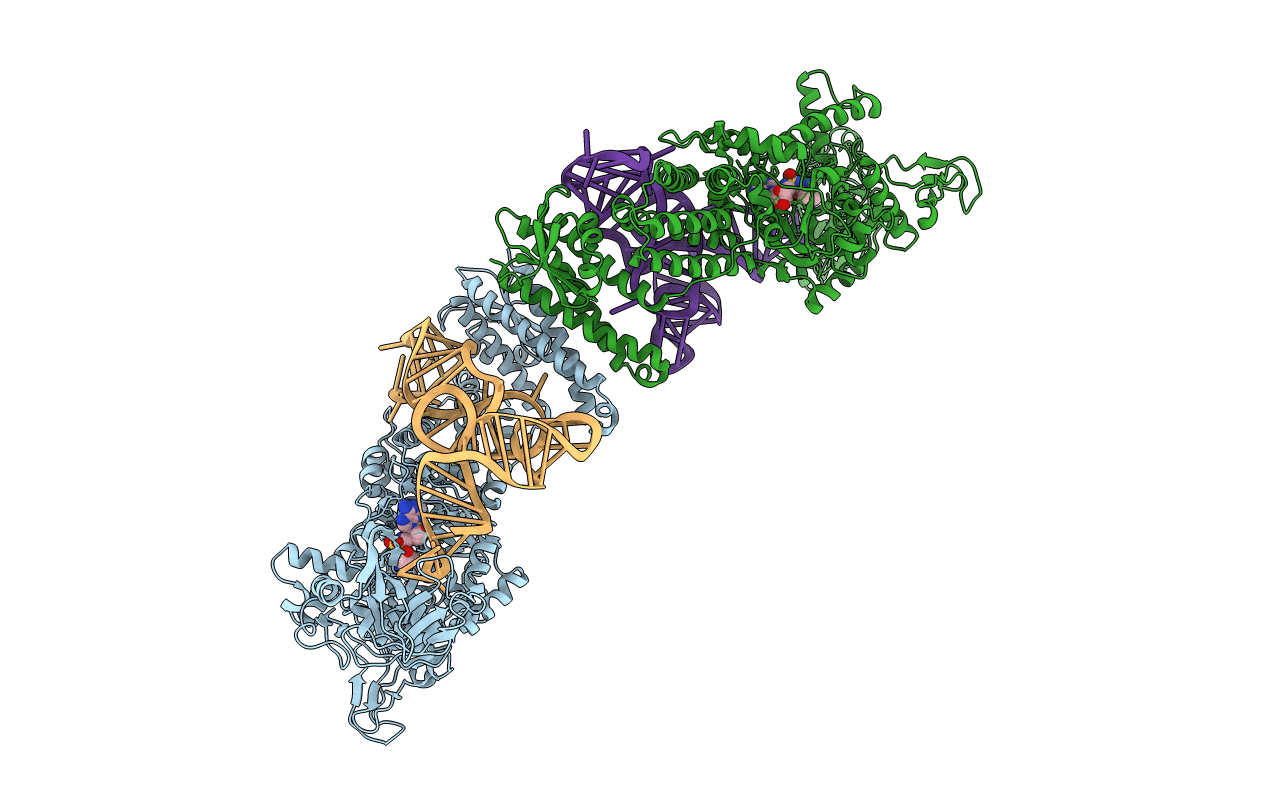
1IVS image
Deposition Date 2002-03-29
Release Date 2003-02-11
Last Version Date 2023-12-27
Entry Detail
PDB ID:
1IVS
Keywords:
Title:
CRYSTAL STRUCTURE OF THERMUS THERMOPHILUS VALYL-TRNA SYNTHETASE COMPLEXED WITH TRNA(VAL) AND VALYL-ADENYLATE ANALOGUE
Biological Source:
Source Organism:
Host Organism:
Method Details:
Experimental Method:
Resolution:
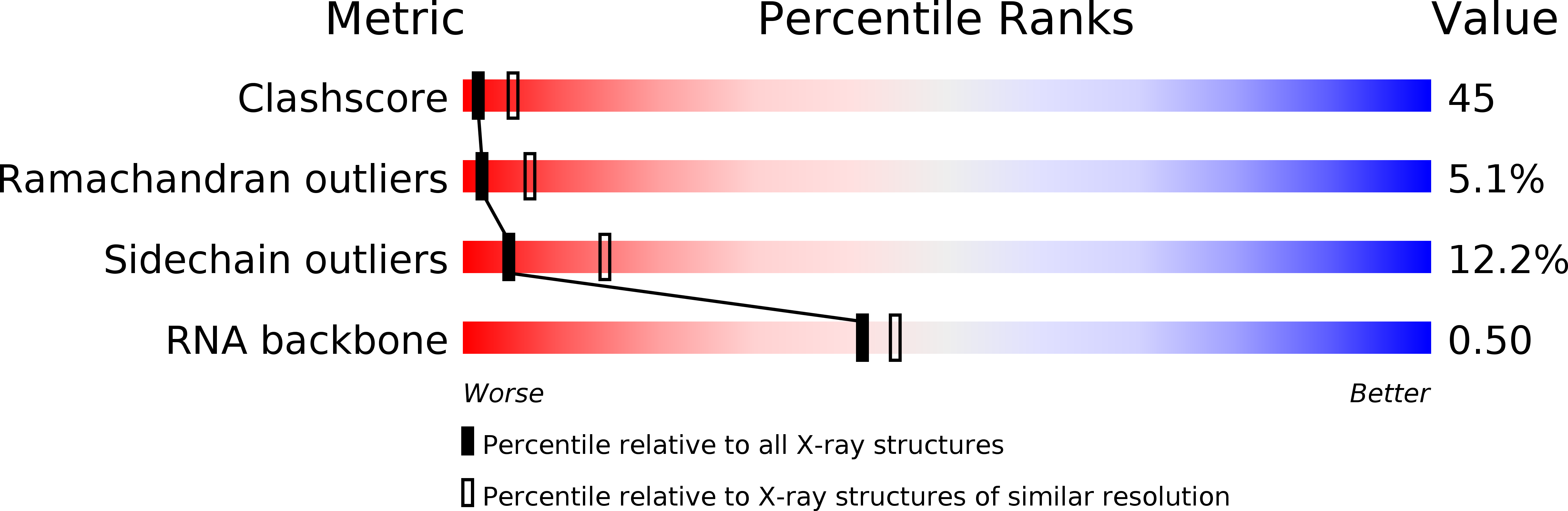
2.90 Å
R-Value Free:
0.28
R-Value Work:
0.24
R-Value Observed:
0.24
Space Group:
P 42 21 2
Macromolecular Entities
Structures with similar UniProt ID
Protein Blast
Polymer Type:polypeptide(L)
Molecule:Valyl-tRNA synthetase
Gene (Uniprot):valS
Chain IDs:C (auth: A), D (auth: B)
Chain Length:862
Number of Molecules:2
Biological Source:Thermus thermophilus
Ligand Molecules
Primary Citation
Mechanism of molecular interactions for tRNA(Val) recognition by valyl-tRNA synthetase
RNA 9 100 111 (2003)
PMID: 12554880 DOI: 10.1261/rna.2760703

Abstact

The molecular interactions between valyl-tRNA synthetase (ValRS) and tRNA(Val), with the C34-A35-C36 anticodon, from Thermus thermophilus were studied by crystallographic analysis and structure-based mutagenesis. In the ValRS-bound structure of tRNA(Val), the successive A35-C36 residues (the major identity elements) of tRNA(Val) are base-stacked upon each other, and fit into a pocket on the alpha-helix bundle domain of ValRS. Hydrogen bonds are formed between ValRS and A35-C36 of tRNA(Val) in a base-specific manner. The C-terminal coiled-coil domain of ValRS interacts electrostatically with A20 and hydrophobically with the G19*C56 tertiary base pair. The loss of these interactions by the deletion of the coiled-coil domain of ValRS increased the K(M) value for tRNA(Val) 28-fold and decreased the k(cat) value 19-fold in the aminoacylation. The tRNA(Val) K(M) and k(cat) values were increased 21-fold and decreased 32-fold, respectively, by the disruption of the G18*U55 and G19*C56 tertiary base pairs, which associate the D- and T-loops for the formation of the L-shaped tRNA structure. Therefore, the coiled-coil domain of ValRS is likely to stabilize the L-shaped tRNA structure during the aminoacylation reaction.

Legend

Protein

Chemical

Disease

Primary Citation of related structures
Feedback Form
Name
Email
Institute
Feedback