1IQW image
Deposition Date 2001-08-10
Release Date 2002-01-23
Last Version Date 2024-10-30
Entry Detail
PDB ID:
1IQW
Keywords:
Title:
CRYSTAL STRUCTURE OF THE FAB FRAGMENT OF THE MOUSE ANTI-HUMAN FAS ANTIBODY HFE7A
Biological Source:
Source Organism:
Mus musculus (Taxon ID: 10090)
Method Details:
Experimental Method:
Resolution:
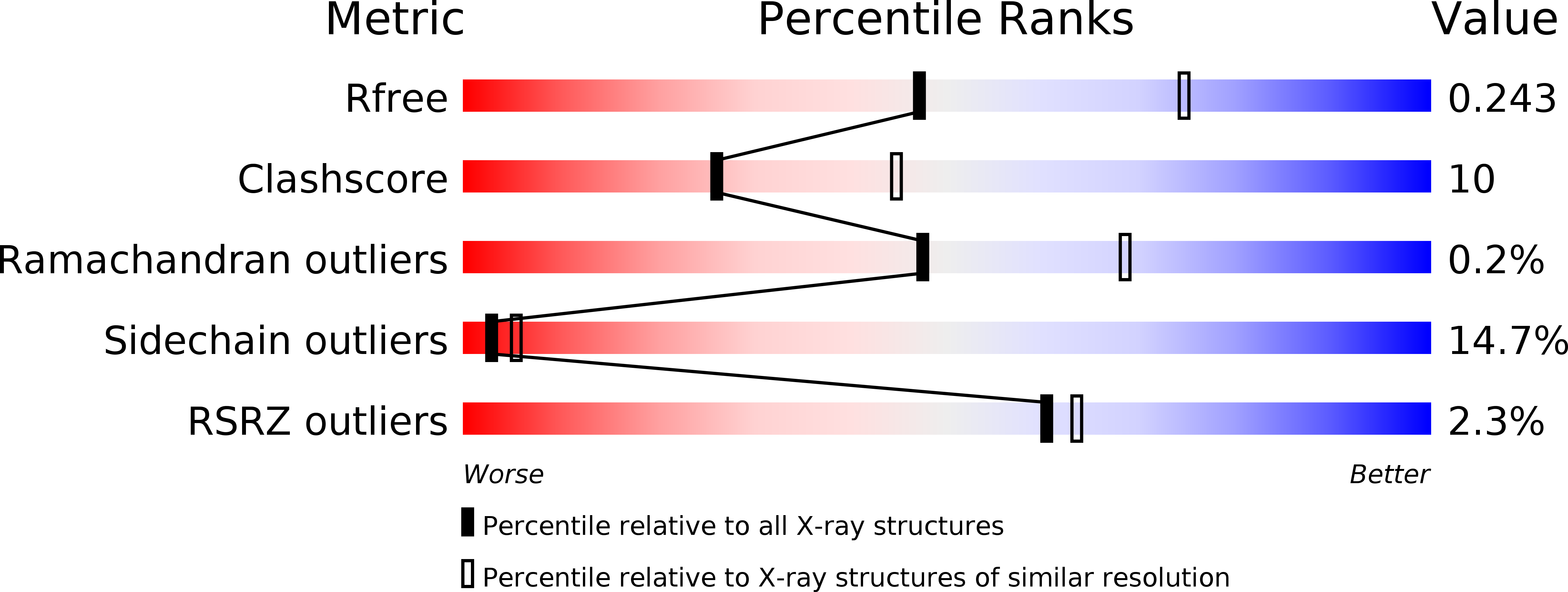
2.50 Å
R-Value Free:
0.24
R-Value Work:
0.16
Space Group:
P 21 21 21
Macromolecular Entities
Polymer Type:polypeptide(L)
Molecule:ANTIBODY M-HFE7A, HEAVY CHAIN
Chain IDs:B (auth: H)
Chain Length:230
Number of Molecules:1
Biological Source:Mus musculus
Polymer Type:polypeptide(L)
Molecule:ANTIBODY M-HFE7A, LIGHT CHAIN
Chain IDs:A (auth: L)
Chain Length:218
Number of Molecules:1
Biological Source:Mus musculus
Primary Citation

Abstact

Binding of Fas ligand to Fas induces apoptosis. The Fas-Fas ligand system plays important roles in many biological processes, including the elimination of autoreactive lymphoid cells. The mouse anti-human Fas monoclonal antibody HFE7A (m-HFE7A), which induces apoptosis, has been humanized based on a structure predicted by homology modeling. A version of humanized HFE7A is currently under development for the treatment of autoimmune diseases such as rheumatoid arthritis. For a deeper understanding of the protein engineering aspect of antibody humanization, for which information on the three-dimensional structure is essential, we determined the crystal structure of the m-HFE7A antigen-binding fragment (Fab) by X-ray crystallography at 2.5 A resolution. The main-chain conformation of the five loops in the six complementarity-determining regions (CDRs) was correctly predicted with root-mean-square deviations of 0.30-1.04 A based on a comparison of the crystal structure with the predicted structure. The CDR-H3 conformation of the crystal structure, which was not classified as one of the canonical structures, was completely different from that of the predicted structure but adopted the conformation which followed the "H3-rules." The results of charge distribution analysis of the antigen-binding site suggest that electrostatic interactions may be important for its binding to Fas.

Legend

Protein

Chemical

Disease

Primary Citation of related structures
Feedback Form
Name
Email
Institute
Feedback