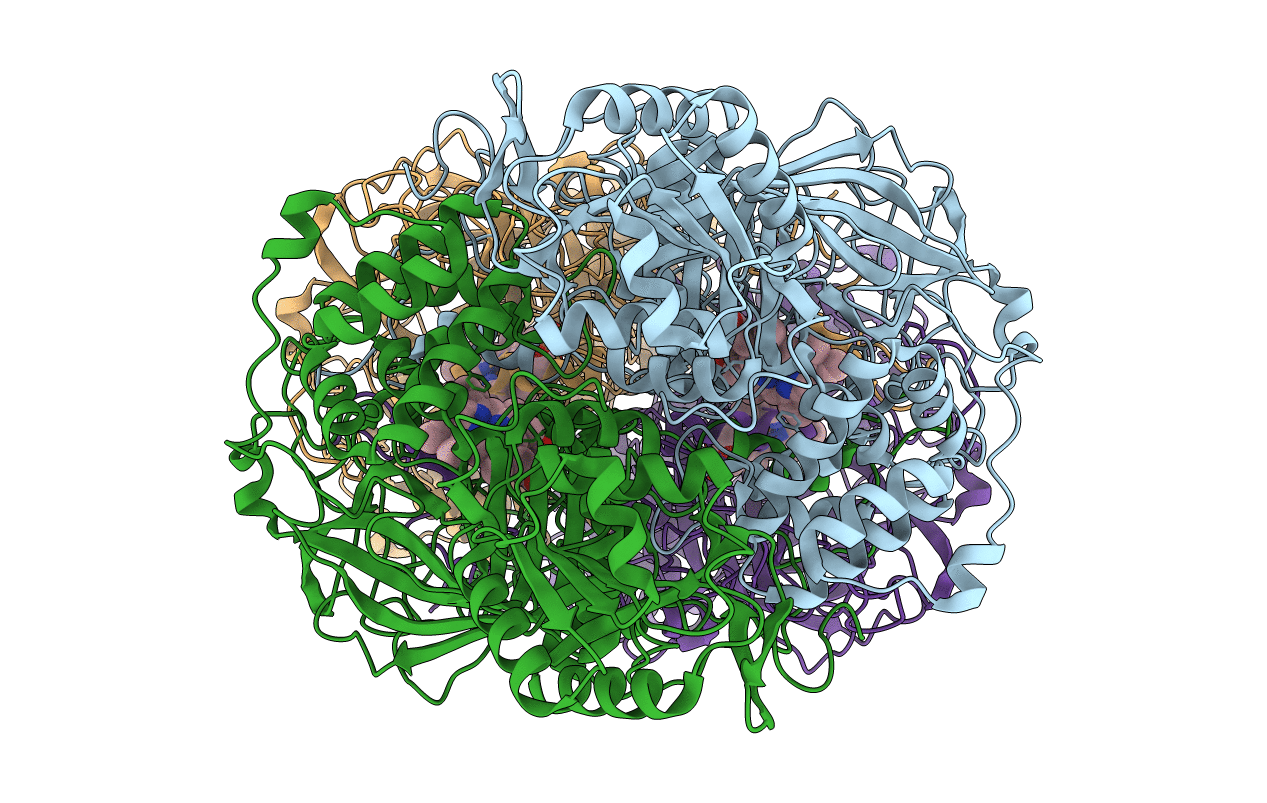
1IPH image
Deposition Date 1995-12-31
Release Date 1997-09-04
Last Version Date 2023-09-27
Entry Detail
PDB ID:
1IPH
Keywords:
Title:
STRUCTURE OF CATALASE HPII FROM ESCHERICHIA COLI
Biological Source:
Source Organism:
Escherichia coli (Taxon ID: 562)
Method Details:
Experimental Method:
Resolution:
2.80 Å
R-Value Work:
0.20
R-Value Observed:
0.20
Space Group:
P 1 21 1

Macromolecular Entities
Structures with similar UniProt ID
Protein Blast
Polymer Type:polypeptide(L)
Molecule:CATALASE HPII
Gene (Uniprot):katE
Chain IDs:A, B, C, D
Chain Length:753
Number of Molecules:4
Biological Source:Escherichia coli
Ligand Molecules
Primary Citation

Abstact

BACKGROUND Catalase is a ubiquitous enzyme present in both the prokaryotic and eukaryotic cells of aerobic organisms. It serves, in part, to protect the cell from the toxic effects of small peroxides. Escherichia coli produces two catalases, HPI and HPII, that are quite distinct from other catalases in physical structure and catalytic properties. HPII, studied in this work, is encoded by the katE gene, and has been characterized as an oligomeric, monofunctional catalase containing one cis-heme d prosthetic group per subunit of 753 residues. RESULTS The crystal structure of catalase HPII from E. coli has been determined to 2.8 A resolution. The asymmetric unit of the crystal contains a whole molecule, which is a tetramer with accurate 222 point group symmetry. In the model built, that includes residues 27-753 and one heme group per monomer, strict non-crystallographic symmetry has been maintained. The crystallographic agreement R-factor is 20.1% for 58,477 reflections in the resolution shell 8.0-2.8 A. CONCLUSIONS Despite differences in size and chemical properties, which were suggestive of a unique catalase, the deduced structure of HPII is related to the structure of catalase from Penicillium vitale, whose sequence is not yet known. In particular, both molecules have an additional C-terminal domain that is absent in the bovine catalase. This extra domain contains a Rossmann fold but no bound nucleotides have been detected, and its physiological role is unknown. In HPII, the heme group is modified to a heme d and inverted with respect to the orientation determined in all previously reported heme catalases. HPII is the largest catalase for which the structure has been determined to almost atomic resolution.

Legend

Protein

Chemical

Disease

Primary Citation of related structures
Feedback Form
Name
Email
Institute
Feedback