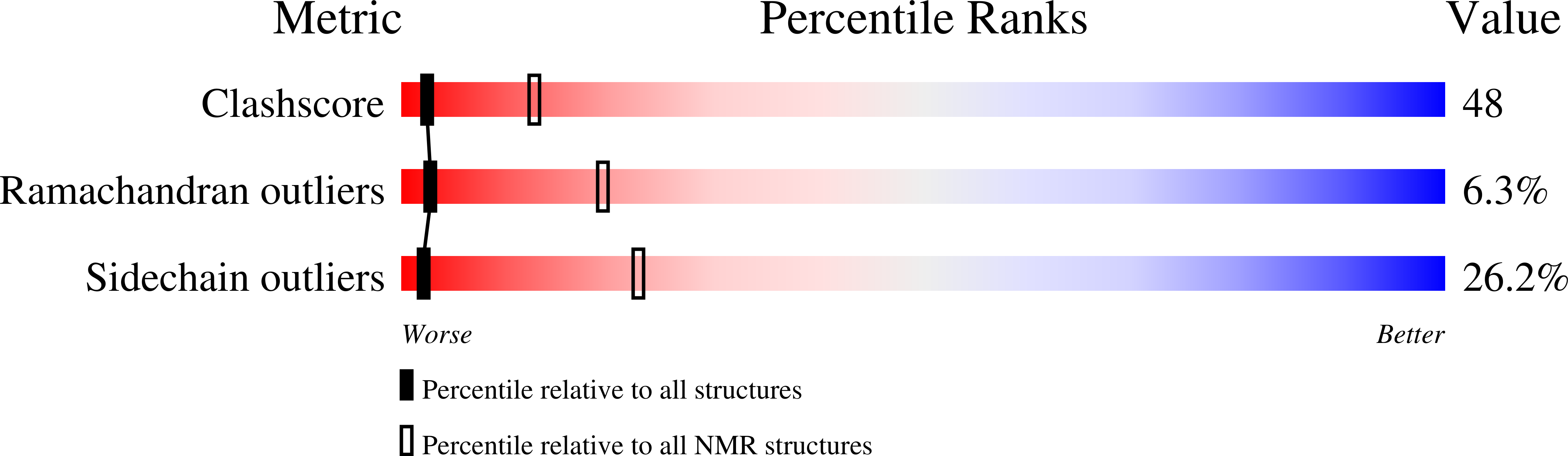
1IOH image
Deposition Date 1998-08-13
Release Date 1999-01-13
Last Version Date 2024-10-30
Entry Detail
PDB ID:
1IOH
Title:
INSULIN MUTANT A8 HIS,(B1, B10, B16, B27)GLU, DES-B30, NMR, 26 STRUCTURES
Biological Source:
Source Organism:
Homo sapiens (Taxon ID: 9606)
Method Details:
Experimental Method:
Conformers Calculated:
100
Conformers Submitted:
26
Macromolecular Entities
Structures with similar UniProt ID
Protein Blast
Polymer Type:polypeptide(L)
Molecule:PROTEIN (INSULIN PRECURSOR)
Gene (Uniprot):INS
Mutagens:T8H
Chain IDs:A
Chain Length:21
Number of Molecules:1
Biological Source:Homo sapiens
Structures with similar UniProt ID
Protein Blast
Polymer Type:polypeptide(L)
Molecule:PROTEIN (INSULIN PRECURSOR)
Gene (Uniprot):INS
Mutagens:F1E, H10E, Y16E, T27E
Chain IDs:B
Chain Length:29
Number of Molecules:1
Biological Source:Homo sapiens
Ligand Molecules
Primary Citation
The relationship between insulin bioactivity and structure in the NH2-terminal A-chain helix.
J.Mol.Biol. 284 477 488 (1998)
PMID: 9813131 DOI: 10.1006/jmbi.1998.2175

Abstact

Studies of naturally occuring and chemically modified insulins have established that the NH2-terminal helix of the A-chain is important in conferring affinity in insulin-receptor interactions. Nevertheless, the three-dimensional structural basis for these observations has not previously been studied in detail. To correlate structure and function in this region of the molecule, we have used the solution structure of an engineered monomer (GluB1, GluB10, GluB16, GluB27, desB30)-insulin (4E insulin) as a template for design of A-chain mutants associated with enhanced or greatly diminished affinity for the insulin receptor. In the context of 4E insulin, the employed mutants, i.e. ThrA8-->His and ValA3-->Gly, result in species with 143% and 0.1% biological activity, respectively, relative to human insulin. The high-resolution NMR studies reveal two well-defined structures each resembling the template. However, significant structural differences are evident notably in residues A2-A8 and their immediate environment. In comparison with the template structure, the A8His mutation enhances the helical character of residues A2-A8. This structural change leads to additional exposure of a hydrophobic patch mainly consisting of species invariant residues. In contrast, the A3Gly mutation leads to stretching and disruption of the A2-A8 helix and changes both the dimensions and the access to the hydrophobic patch exposed in the more active insulins. We conclude that the mutations induce small, yet decisive structural changes that either mediate or inhibit the subtle conformational adjustments involved in the presentation of this part of the insulin pharmacophore to the receptor.

Legend

Protein

Chemical

Disease

Primary Citation of related structures
Feedback Form
Name
Email
Institute
Feedback