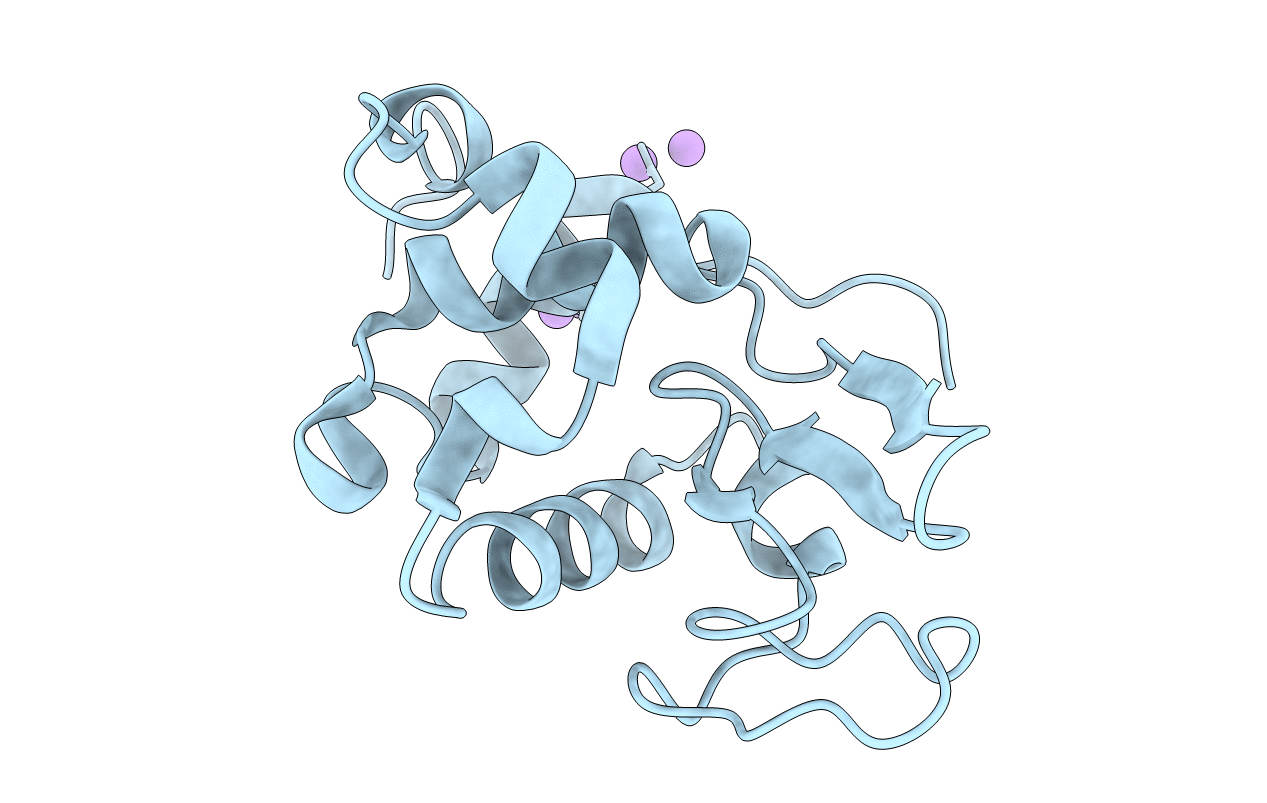
1IOC image
Deposition Date 2001-02-27
Release Date 2002-10-09
Last Version Date 2024-10-23
Entry Detail
PDB ID:
1IOC
Keywords:
Title:
CRYSTAL STRUCTURE OF MUTANT HUMAN LYSOZYME, EAEA-I56T
Biological Source:
Source Organism:
Homo sapiens (Taxon ID: 9606)
Host Organism:
Method Details:
Experimental Method:
Resolution:
2.40 Å
R-Value Work:
0.21
R-Value Observed:
0.21
Space Group:
P 61 2 2
Macromolecular Entities
Structures with similar UniProt ID
Protein Blast
Polymer Type:polypeptide(L)
Molecule:LYSOZYME C
Gene (Uniprot):LYZ
Mutagens:I56T
Chain IDs:A
Chain Length:134
Number of Molecules:1
Biological Source:Homo sapiens
Ligand Molecules
Primary Citation
Elongation in a beta-structure promotes amyloid-like fibril formation of human lysozyme.
J.Biochem. 132 655 661 (2002)
PMID: 12359083 DOI: 10.1093/oxfordjournals.jbchem.a003270

Abstact

To understand the mechanism of amyloid fibril formation of a protein, we examined wild-type and three mutant human lysozymes containing both amyloidogenic and non-amyloidogenic proteins: I56T (amyloidogenic); EAEA, which has four additional residues (Glu-Ala-Glu-Ala-) at the N-terminus located on a beta-structure; and EAEA-I56T, which is an I56T mutant of EAEA. All formed amyloid-like fibrils through an in the increase contents of alpha-helix with increasing concentration of ethanol. The order of propensity for amyloid-like fibril formation in highly concentrated ethanol solution is EAEA-I56T > EAEA > I56T > wild-type. This order is almost the reverse of the order of conformational stability of these proteins, wild-type > EAEA > I56T > EAEA-I56T. The important views in this work are as follows. (i) Artificially modified proteins formed amyloid fibrils in vitro. This means that amyloid formation is a generic property of polypeptide chains. (ii) The amyloidogenic mutation Ile56 to Thr caused the destabilization and promoted fibril formation in the wild-type and EAEA human lysozymes, indicating that instability facilitates amyloid formation. (iii) The mutant protein EAEA human lysozyme had higher propensity for fibril formation than the amyloidogenic mutant protein, indicating that amyloid formation is controlled not only by stability but also by other factors. In this case, appending polypeptide chains to a beta-structure accelerated amyloid formation.

Legend

Protein

Chemical

Disease

Primary Citation of related structures
Feedback Form
Name
Email
Institute
Feedback