Planned Maintenance: Some services may turn out to be unavailable from 15th January, 2026 to 16th January, 2026. We apologize for the inconvenience!

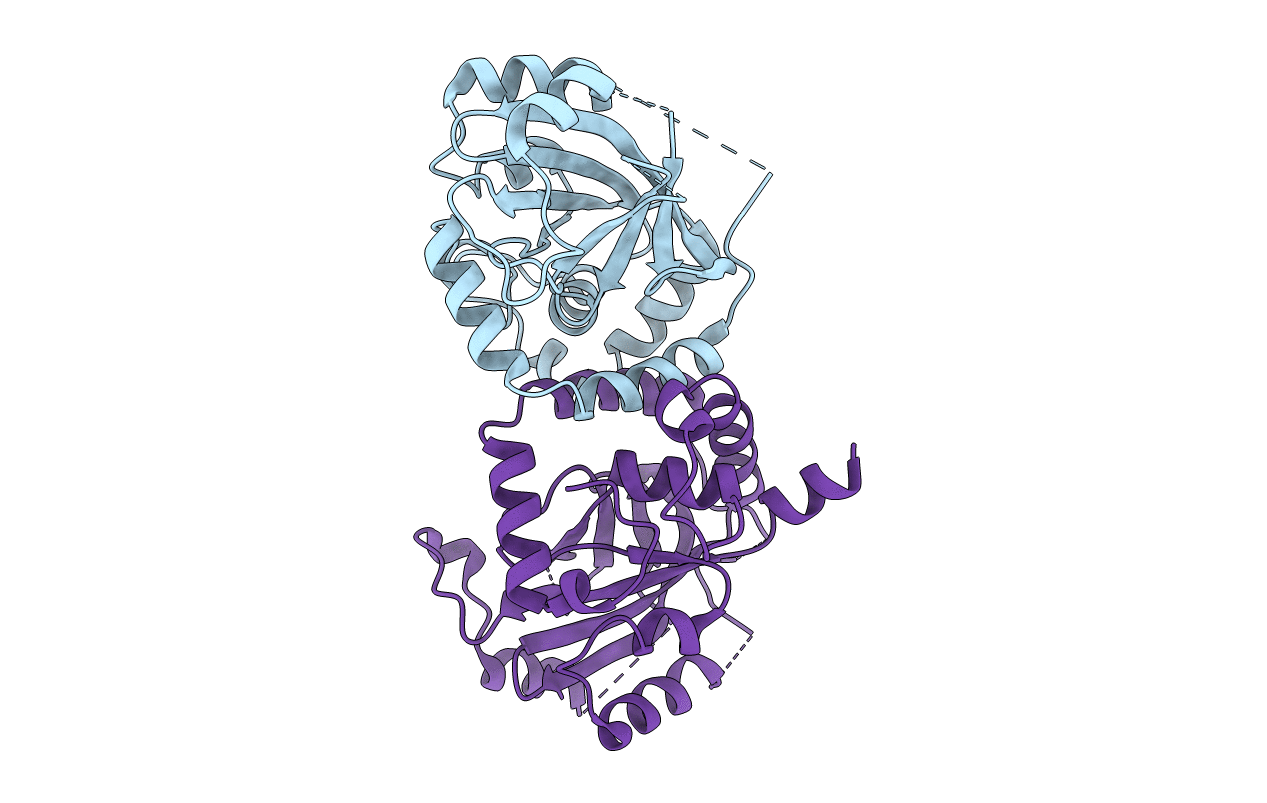
1ID4 image
Deposition Date 2001-04-03
Release Date 2001-06-06
Last Version Date 2024-02-07
Entry Detail
PDB ID:
1ID4
Keywords:
Title:
CRYSTAL STRUCTURE OF THE CATALYTIC SITE MUTANT (H157Q) OF THE HUMAN CYTOMEGALOVIRUS PROTEASE
Biological Source:
Source Organism(s):
Expression System(s):
Method Details:
Experimental Method:
Resolution:
2.20 Å
R-Value Free:
0.26
R-Value Work:
0.22
R-Value Observed:
0.22
Space Group:
P 41 21 2

Macromolecular Entities
Structures with similar UniProt ID
Protein Blast
Polymer Type:polypeptide(L)
Molecule:CAPSID PROTEIN P40: ASSEMBLIN PROTEASE
Gene (Uniprot):UL80
Mutagens:A143Q, H157Q
Chain IDs:A, B
Chain Length:256
Number of Molecules:2
Biological Source:Human herpesvirus 5
Primary Citation
Investigating the role of histidine 157 in the catalytic activity of human cytomegalovirus protease.
Biochemistry 40 6344 6351 (2001)
PMID: 11371196 DOI: 10.1021/bi010158b

Abstact

Herpesvirus proteases belong to a new class of serine proteases and contain a novel Ser-His-His catalytic triad, while classical serine proteases have an acidic residue as the third member. To gain a better understanding of the molecular basis for the functional role of the third-member His residue, we have carried out structural and biochemical investigations of human cytomegalovirus (HCMV) protease that bears mutations of the His157 third member. Kinetic studies showed that all the mutants have reduced catalytic activity. Structural studies revealed that a solvent molecule is hydrogen-bonded to the His63 second member and Ser134 in the H157A mutant, partly rescuing the activity of this mutant. This is confirmed by our kinetic and structural observations on the S134A/H157A double mutant, which showed further reductions in the catalytic activity. The structure of the H157A mutant is also in complex with the PMSF inhibitor. The H157E mutant has the best catalytic activity among the mutants; its structure, however, showed conformational readjustments of the His63 and Ser132 residues. The Ser132-His63 diad of HCMV protease has similar activity as the diads in classical serine proteases, whereas the contribution of the His157 third member to the catalysis is much smaller. Finally, structural comparisons revealed the presence of two conserved structural water molecules at the bottom of the S(1) pocket, suggesting a possible new direction for the design of HCMV protease inhibitors.

Legend

Protein

Chemical

Disease

Primary Citation of related structures
Feedback Form
Name
Email
Institute
Feedback