1I5N image
Deposition Date 2001-02-28
Release Date 2001-07-11
Last Version Date 2024-10-30
Entry Detail
PDB ID:
1I5N
Keywords:
Title:
Crystal structure of the P1 domain of CheA from Salmonella typhimurium
Biological Source:
Source Organism:
Host Organism:
Method Details:
Experimental Method:
Resolution:
2.14 Å
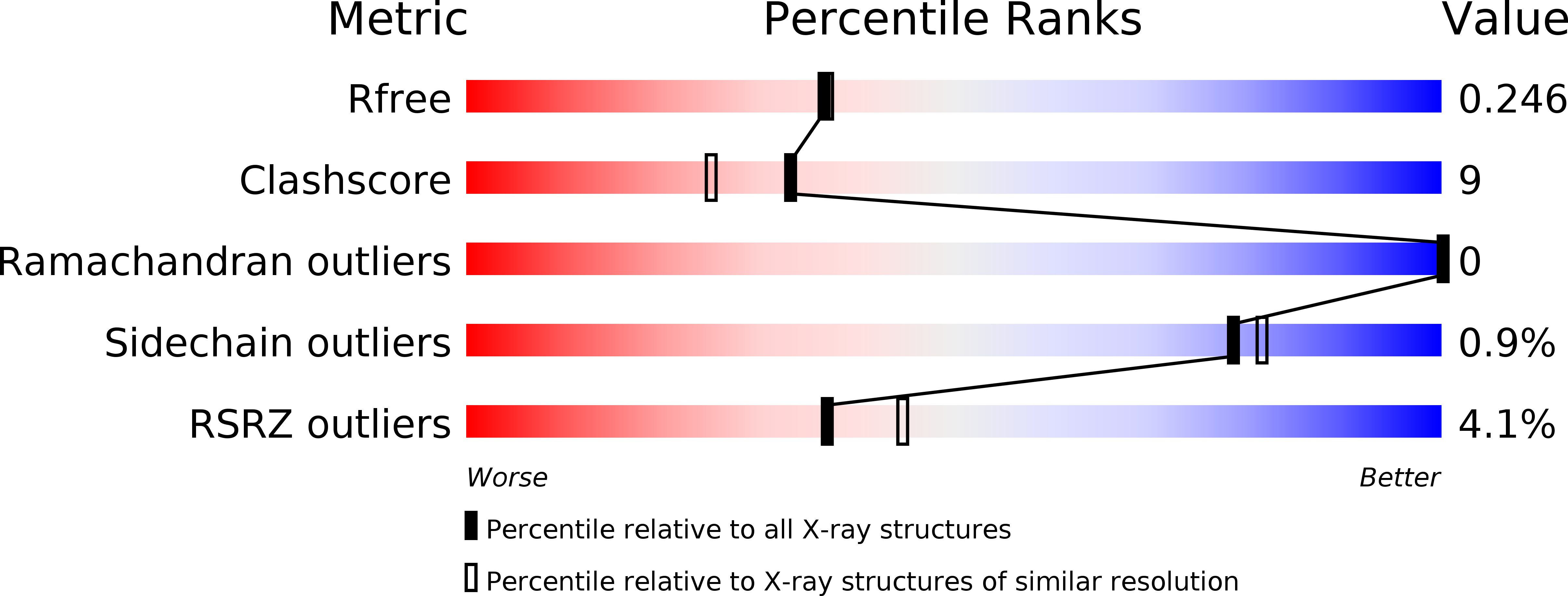
R-Value Free:
0.24
R-Value Work:
0.21
R-Value Observed:
0.21
Space Group:
P 21 21 21
Macromolecular Entities
Structures with similar UniProt ID
Protein Blast
Polymer Type:polypeptide(L)
Molecule:CHEMOTAXIS PROTEIN CHEA
Gene (Uniprot):cheA
Chain IDs:A, B, C, D
Chain Length:146
Number of Molecules:4
Biological Source:Salmonella typhimurium
Modified Residue
Compound ID Chain ID Parent Comp ID Details 2D Image
MSE A MET SELENOMETHIONINE
Ligand Molecules
Primary Citation
Crystal structure of the CheA histidine phosphotransfer domain that mediates response regulator phosphorylation in bacterial chemotaxis
J.Biol.Chem. 276 31074 31082 (2001)
PMID: 11387324 DOI: 10.1074/jbc.M101943200

Abstact

The x-ray crystal structure of the P1 or H domain of the Salmonella CheA protein has been solved at 2.1-A resolution. The structure is composed of an up-down up-down four-helix bundle that is typical of histidine phosphotransfer or HPt domains such as Escherichia coli ArcB(C) and Saccharomyces cerevisiae Ypd1. Loop regions and additional structural features distinguish all three proteins. The CheA domain has an additional C-terminal helix that lies over the surface formed by the C and D helices. The phosphoaccepting His-48 is located at a solvent-exposed position in the middle of the B helix where it is surrounded by several residues that are characteristic of other HPt domains. Mutagenesis studies indicate that conserved glutamate and lysine residues that are part of a hydrogen-bond network with His-48 are essential for the ATP-dependent phosphorylation reaction but not for the phosphotransfer reaction with CheY. These results suggest that the CheA-P1 domain may serve as a good model for understanding the general function of HPt domains in complex two-component phosphorelay systems.

Legend

Protein

Chemical

Disease

Primary Citation of related structures
Feedback Form
Name
Email
Institute
Feedback