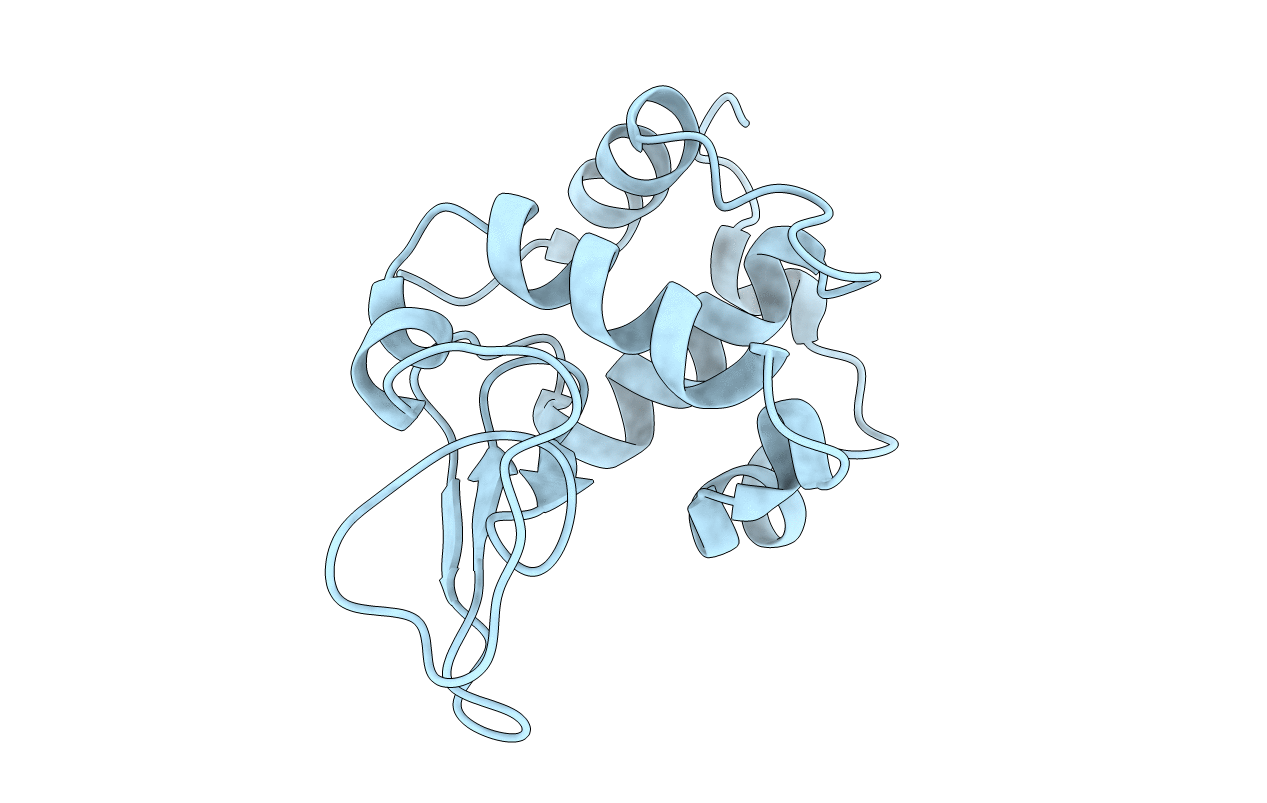
1I20 image
Deposition Date 2001-02-05
Release Date 2001-02-28
Last Version Date 2024-10-30
Entry Detail
PDB ID:
1I20
Keywords:
Title:
MUTANT HUMAN LYSOZYME (A92D)
Biological Source:
Source Organism:
Homo sapiens (Taxon ID: 9606)
Method Details:
Experimental Method:
Resolution:
1.90 Å
R-Value Work:
0.16
R-Value Observed:
0.16
Space Group:
P 21 21 21

Macromolecular Entities
Structures with similar UniProt ID
Protein Blast
Polymer Type:polypeptide(L)
Molecule:LYSOZYME C
Gene (Uniprot):LYZ
Mutagens:A92D
Chain IDs:A
Chain Length:130
Number of Molecules:1
Biological Source:Homo sapiens
Primary Citation
Structural and thermodynamic responses of mutations at a Ca2+ binding site engineered into human lysozyme.
J.Biol.Chem. 273 34310 34315 (1998)
PMID: 9852096 DOI: 10.1074/jbc.273.51.34310

Abstact

Structural determinants of Ca2+ binding sites within proteins typically comprise several acidic residues in appropriate juxtaposition. Three residues (Ala-83, Gln-86, and Ala-92) in human lysozyme are characteristically mutated to Lys, Asp, and Asp, respectively, in natural Ca2+ binding lysozymes and alpha-lactalbumins. The effects of these mutations on the stability and Ca2+ binding properties of human lysozyme were investigated using calorimetry and were interpreted with crystal structures. The double mutant, in which Glu-86 and Ala-92 were replaced with Asp, clearly showed Ca2+ binding affinity, whereas neither point mutant showed Ca2+ affinity, indicating that both residues are essential. The further mutation of Ala-83 --> Lys did not affect the Ca2+ binding of the double mutant. The point mutations Ala-83 --> Lys and Glu-86 --> Asp did not affect the stability, whereas the mutation Ala-92 --> Asp was about 1.3 kcal/mol less stable. Structural analyses showed that both Asp-86 and Lys-83 were exposed to solvent. Side chains of Asp-86 and Asp-91 were rotated in opposite directions about chi1 angle, as if to reduce the electrostatic repulsion. The charged amino acids at the Ca2+ binding site did not significantly affect stability of the protein, possibly because of the local conformational change of the side chains.

Legend

Protein

Chemical

Disease

Primary Citation of related structures
Feedback Form
Name
Email
Institute
Feedback