1I01 image
Deposition Date 2001-01-27
Release Date 2001-02-07
Last Version Date 2024-02-07
Entry Detail
PDB ID:
1I01
Keywords:
Title:
CRYSTAL STRUCTURE OF BETA-KETOACYL [ACYL CARRIER PROTEIN] REDUCTASE FROM E. COLI.
Biological Source:
Source Organism:
Escherichia coli (Taxon ID: 562)
Host Organism:
Method Details:
Experimental Method:
Resolution:
2.60 Å
R-Value Free:
0.25
R-Value Work:
0.22
R-Value Observed:
0.22
Space Group:
P 1 21 1
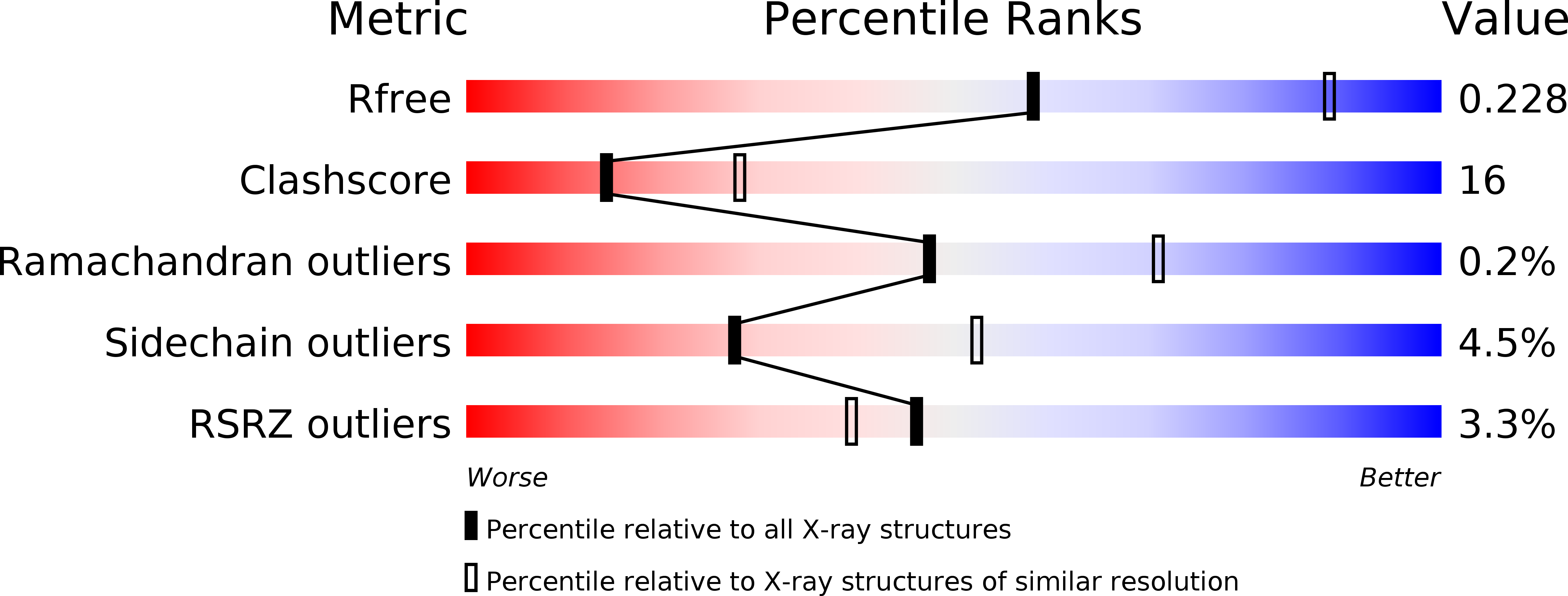
Macromolecular Entities
Structures with similar UniProt ID
Protein Blast
Polymer Type:polypeptide(L)
Molecule:BETA-KETOACYL [ACP] REDUCTASE
Gene (Uniprot):fabG
Chain IDs:A, B, C, D, E, F, G, H
Chain Length:244
Number of Molecules:8
Biological Source:Escherichia coli
Primary Citation
Structure of beta-ketoacyl-[acyl carrier protein] reductase from Escherichia coli: negative cooperativity and its structural basis.
Biochemistry 40 12772 12781 (2001)
PMID: 11669613 DOI: 10.1021/bi010737g

Abstact

The structure of beta-ketoacyl-[acyl carrier protein] reductase (FabG) from Escherichia coli was determined via the multiwavelength anomalous diffraction technique using a selenomethionine-labeled crystal containing 88 selenium sites in the asymmetric unit. The comparison of the E. coli FabG structure with the homologous Brassica napus FabG.NADP(+) binary complex reveals that cofactor binding causes a substantial conformational change in the protein. This conformational change puts all three active-site residues (Ser 138, Tyr 151, and Lys 155) into their active configurations and provides a structural mechanism for allosteric communication between the active sites in the homotetramer. FabG exhibits negative cooperative binding of NADPH, and this effect is enhanced by the presence of acyl carrier protein (ACP). NADPH binding also increases the affinity and decreases the maximum binding of ACP to FabG. Thus, unlike other members of the short-chain dehydrogenase/reductase superfamily, FabG undergoes a substantial conformational change upon cofactor binding that organizes the active-site triad and alters the affinity of the other substrate-binding sites in the tetrameric enzyme.

Legend

Protein

Chemical

Disease

Primary Citation of related structures
Feedback Form
Name
Email
Institute
Feedback