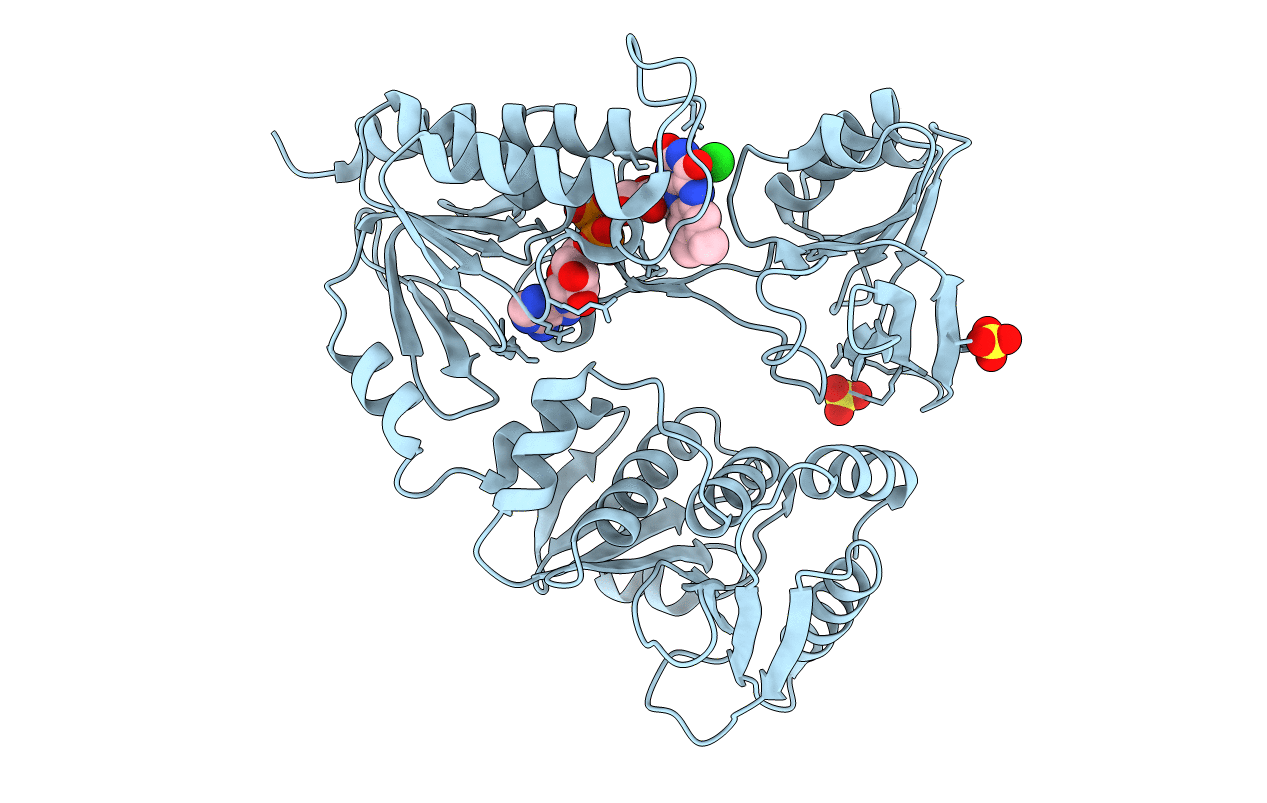
1HYU image
Deposition Date 2001-01-22
Release Date 2001-02-14
Last Version Date 2024-11-13
Entry Detail
PDB ID:
1HYU
Keywords:
Title:
CRYSTAL STRUCTURE OF INTACT AHPF
Biological Source:
Source Organism:
Host Organism:
Method Details:
Experimental Method:
Resolution:
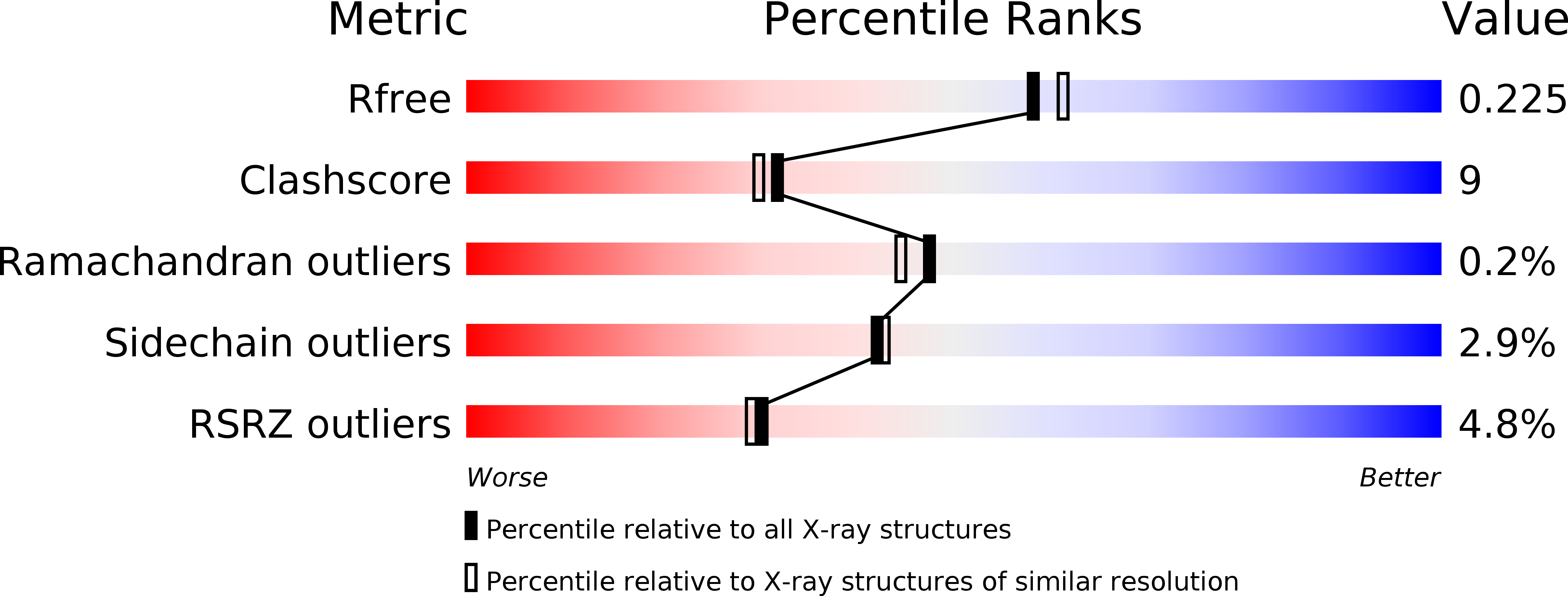
2.00 Å
R-Value Free:
0.23
R-Value Work:
0.18
R-Value Observed:
0.18
Space Group:
P 21 21 2
Macromolecular Entities
Structures with similar UniProt ID
Protein Blast
Polymer Type:polypeptide(L)
Molecule:ALKYL HYDROPEROXIDE REDUCTASE SUBUNIT F
Gene (Uniprot):ahpF
Chain IDs:A
Chain Length:521
Number of Molecules:1
Biological Source:Salmonella typhimurium
Primary Citation
Structure of intact AhpF reveals a mirrored thioredoxin-like active site and implies large domain rotations during catalysis.
Biochemistry 40 3900 3911 (2001)
PMID: 11300769 DOI: 10.1021/bi002765p

Abstact

AhpF, a homodimer of 57 kDa subunits, is a flavoenzyme which catalyzes the NADH-dependent reduction of redox-active disulfide bonds in the peroxidase AhpC, a member of the recently identified peroxiredoxin class of antioxidant enzymes. The structure of AhpF from Salmonella typhimurium at 2.0 A resolution, determined using multiwavelength anomalous dispersion, shows that the C-terminal portion of AhpF (residues 210-521) is structurally like Escherichia coli thioredoxin reductase. In addition, AhpF has an N-terminal domain (residues 1-196) formed from two contiguous thioredoxin folds, but containing just a single redox-active disulfide (Cys129-Cys132). A flexible linker (residues 197-209) connects the domains, consistent with experiments showing that the N-terminal domain acts as an appended substrate, first being reduced by the C-terminal portion of AhpF, and subsequently reducing AhpC. Modeling studies imply that an intrasubunit electron transfer accounts for the reduction of the N-terminal domain in dimeric AhpF. Furthermore, comparing the N-terminal domain with protein disulfide oxidoreductase from Pyrococcus furiosis, we describe a new class of protein disulfide oxidoreductases based on a novel mirror-image active site arrangement, with a distinct carboxylate (Glu86) being functionally equivalent to the key acid (Asp26) of E. coli thioredoxin. A final fortuitous result is that the N-terminal redox center is reduced and provides a high-resolution view of the thiol-thiolate hydrogen bond that has been predicted to stabilize the attacking thiolate in thioredoxin-like proteins.

Legend

Protein

Chemical

Disease

Primary Citation of related structures
Feedback Form
Name
Email
Institute
Feedback