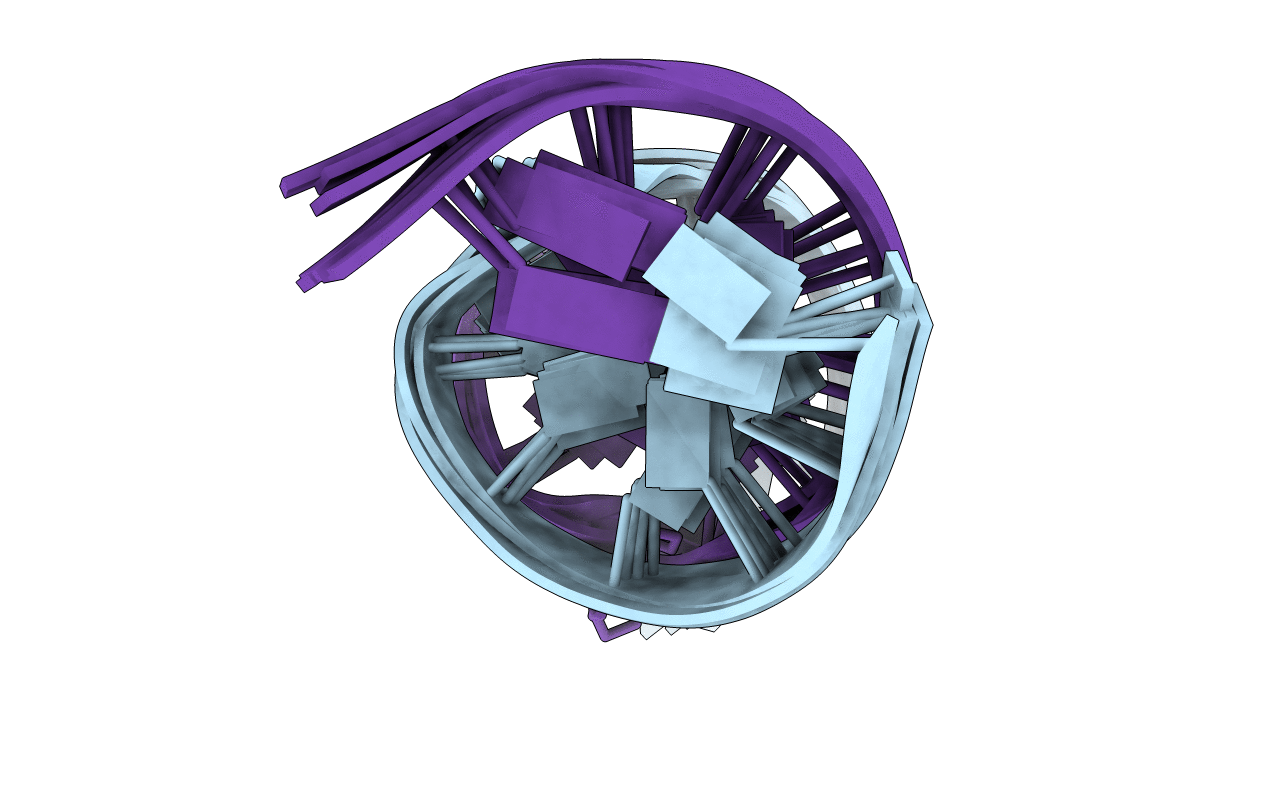
1HT4 image
Deposition Date 2000-12-28
Release Date 2001-05-02
Last Version Date 2024-05-22
Entry Detail
PDB ID:
1HT4
Keywords:
Title:
SOLUTION STRUCTURE OF A BISTRAND ABASIC SITE LESION STAGGERED IN A 3'-ORIENTATION.
Biological Source:
Source Organism:
Method Details:
Experimental Method:
Conformers Calculated:
30
Conformers Submitted:
6
Selection Criteria:
structures with the least restraint violations

Macromolecular Entities
Polymer Type:polydeoxyribonucleotide
Molecule:5'-D(*CP*GP*CP*AP*TP*GP*(3DR)P*GP*TP*AP*CP*GP*C)-3'
Chain IDs:A
Chain Length:13
Number of Molecules:1
Biological Source:
Polymer Type:polydeoxyribonucleotide
Molecule:5'-D(*GP*CP*GP*TP*AP*CP*AP*(3DR)P*AP*TP*GP*CP*G)-3'
Chain IDs:B
Chain Length:13
Number of Molecules:1
Biological Source:
Ligand Molecules
Primary Citation
NMR characterization of clustered bistrand abasic site lesions: effect of orientation on their solution structure.
J.Mol.Biol. 308 341 352 (2001)
PMID: 11327771 DOI: 10.1006/jmbi.2001.4587

Abstact

A unique characteristic of ionizing radiation and radiomimetic anticancer drugs is the induction of clustered damage: two or more DNA lesions (oxidized bases, abasic sites, or strand breaks) occurring in the same or different strands of the DNA molecule within a single turn of the helix. In spite of arising at a lower frequency than single lesions, clustered DNA damage represents an exotic challenge to the repair systems present in the cells and, in some cases, these lesions may escape detection and/or processing. To understand the structural properties of clustered DNA lesions we have prepared two oligodeoxynucleotide duplexes containing adjacent tetrahydrofuran residues (abasic site analogues), positioned one in each strand of the duplex in a 5' or 3' orientation, and determined their solution structure by NMR spectroscopy and molecular dynamics simulations. The NMR data indicate that both duplex structures are right-handed helices of high similarity outside the clustered damage site. The thermal stability of the duplexes is severely reduced by the presence of the abasic residues, especially in a 5' orientation where the melting temperature is 5 degrees C lower. The structures show remarkable differences at the lesion site where the extrahelical location of the tetrahydrofuran residues in the (AP)(2)-5'-staggered duplex contrasts with their smooth alignment along the sugar-phosphate backbone in the (AP)(2)-3'-staggered duplex.

Legend

Protein

Chemical

Disease

Primary Citation of related structures
Feedback Form
Name
Email
Institute
Feedback