1HQ6 image
Deposition Date 2000-12-14
Release Date 2001-03-21
Last Version Date 2024-11-20
Entry Detail
PDB ID:
1HQ6
Keywords:
Title:
STRUCTURE OF PYRUVOYL-DEPENDENT HISTIDINE DECARBOXYLASE AT PH 8
Biological Source:
Source Organism:
Host Organism:
Method Details:
Experimental Method:
Resolution:
2.70 Å
R-Value Free:
0.31
R-Value Work:
0.25
R-Value Observed:
0.26
Space Group:
H 3 2
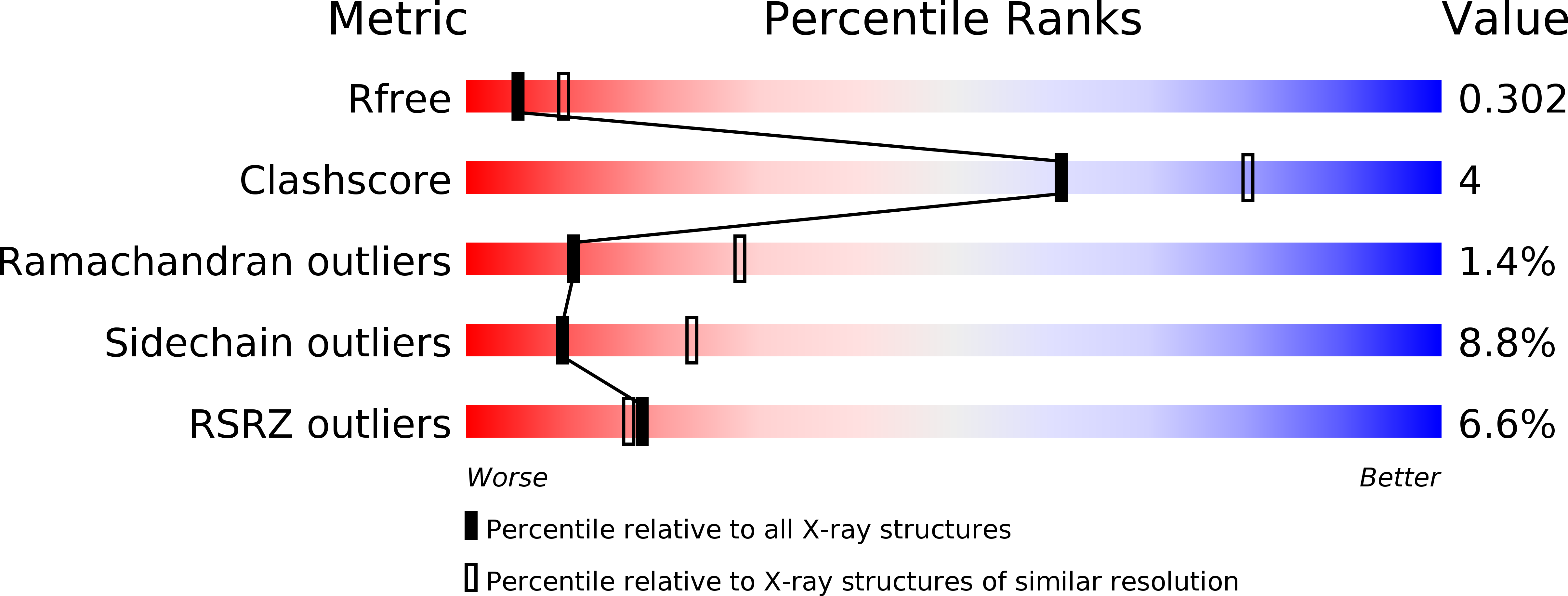
Macromolecular Entities
Structures with similar UniProt ID
Protein Blast
Polymer Type:polypeptide(L)
Molecule:HISTIDINE DECARBOXYLASE
Gene (Uniprot):hdcA
Chain IDs:A, C
Chain Length:81
Number of Molecules:2
Biological Source:Lactobacillus sp.
Structures with similar UniProt ID
Protein Blast
Polymer Type:polypeptide(L)
Molecule:HISTIDINE DECARBOXYLASE
Gene (Uniprot):hdcA
Chain IDs:B, D
Chain Length:229
Number of Molecules:2
Biological Source:Lactobacillus sp.
Primary Citation
pH-induced structural changes regulate histidine decarboxylase activity in Lactobacillus 30a.
J.Mol.Biol. 306 727 732 (2001)
PMID: 11243783 DOI: 10.1006/jmbi.2000.4430

Abstact

Histidine decarboxylase (HDC) from Lactobacillus 30a produces histamine that is essential to counter waste acids, and to optimize cell growth. The HDC trimer is active at low pH and inactive at neutral to alkaline pH. We have solved the X-ray structure of HDC at pH 8 and revealed the novel mechanism of pH regulation. At high pH helix B is unwound, destroying the substrate binding pocket. At acid pH the helix is stabilized, partly through protonation of Asp198 and Asp53 on either side of the molecular interface, acting as a proton trap. In contrast to hemoglobin regulation, pH has a large effect on the tertiary structure of HDC monomers and relatively little or no effect on quaternary structure.

Legend

Protein

Chemical

Disease

Primary Citation of related structures
Feedback Form
Name
Email
Institute
Feedback