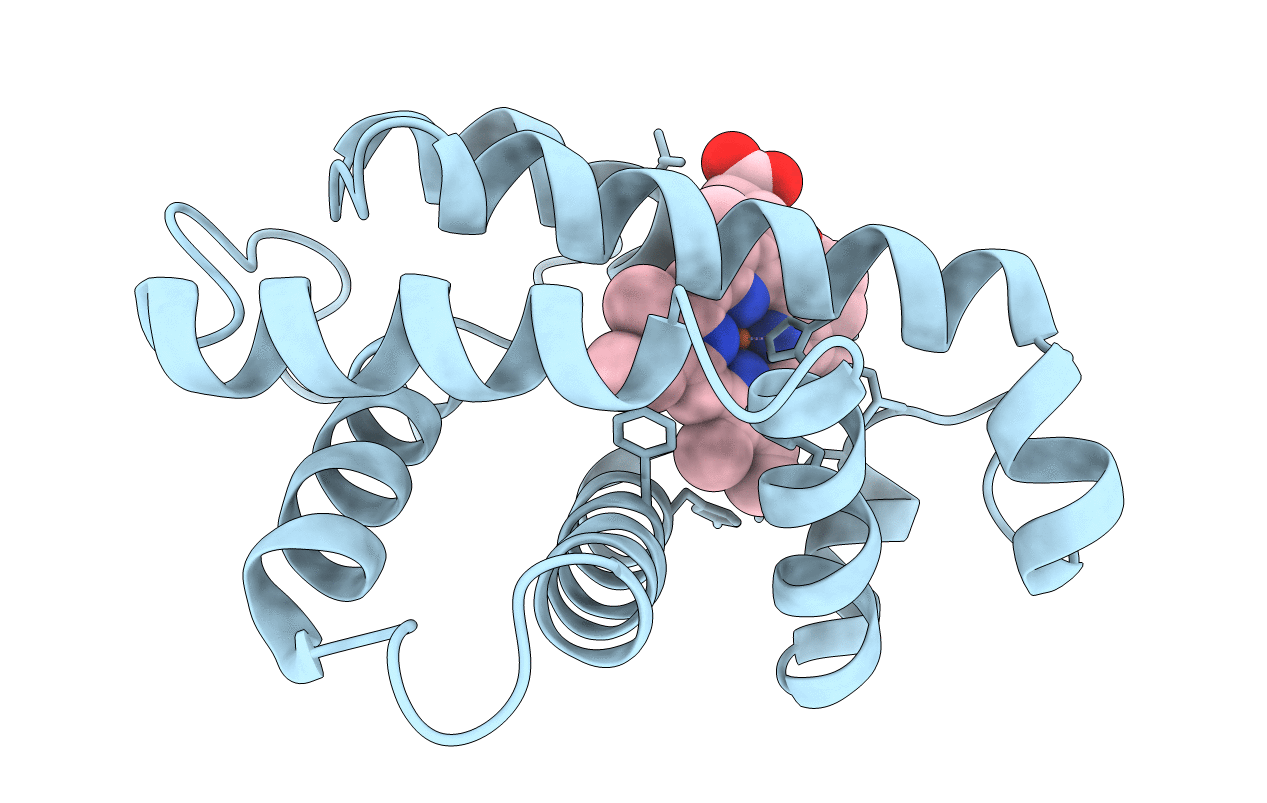
1HLB image
Deposition Date 1994-03-22
Release Date 1994-06-22
Last Version Date 2024-11-13
Entry Detail
PDB ID:
1HLB
Title:
Structural analysis of monomeric hemichrome and dimeric cyanomet hemoglobins from Caudina arenicola
Biological Source:
Source Organism:
Method Details:
Experimental Method:
Resolution:
2.50 Å
R-Value Work:
0.15
R-Value Observed:
0.15
Space Group:
P 1 21 1
Macromolecular Entities
Structures with similar UniProt ID
Protein Blast
Polymer Type:polypeptide(L)
Molecule:HEMOGLOBIN (DEOXY)
Chain IDs:A
Chain Length:158
Number of Molecules:1
Biological Source:Caudina arenicola
Ligand Molecules
Primary Citation
Structural analysis of monomeric hemichrome and dimeric cyanomet hemoglobins from Caudina arenicola.
J.Mol.Biol. 251 421 431 (1995)
PMID: 7650740 DOI: 10.1006/jmbi.1995.0445

Abstact

The X-ray structures of two hemoglobins (Hb) from the sea cucumber Caudina arenicola (an echinoderm) have been determined: a low spin, hemichrome, monomeric Hb-C chain, and a cyanomet-liganded dimeric Hb-D chain. Attempts to obtain crystal structures of the deoxy-liganded and hemichrome forms from the same chain type have not been successful. In this work, the Hb-C chain and Hb-D chain structures are compared, and differences observed in tertiary structure related to the different ligand states for hemoglobin chains from this organism. In addition to shifts of the distal histidine and E helix, differences are noted in the position of the heme group within the heme pocket, the hydrogen bonding of the heme group to the protein, and the status of the D helix. These differences are important in understanding the ligand-linked association states of these hemoglobins. The quaternary structure of the Hb-D homodimer is compared with those from two other invertebrate hemoglobins from Scapharca inaequivalvis and Urechis caupo, which also have subunit-subunit interactions that involve the E and E' helices. The dimer interactions of the Caudina and Urechis hemoglobins are quite dissimilar. However, the dimer interface observed in cyanomet Hb-D is strikingly similar to that observed for the carbonmonoxy hemoglobin dimer from the clam, Scapharca, yet many of the key amino acid residues implicated in the cooperative mechanism of the Scapharca hemoglobin are not conserved in the Caudina hemoglobins.

Legend

Protein

Chemical

Disease

Primary Citation of related structures
Feedback Form
Name
Email
Institute
Feedback