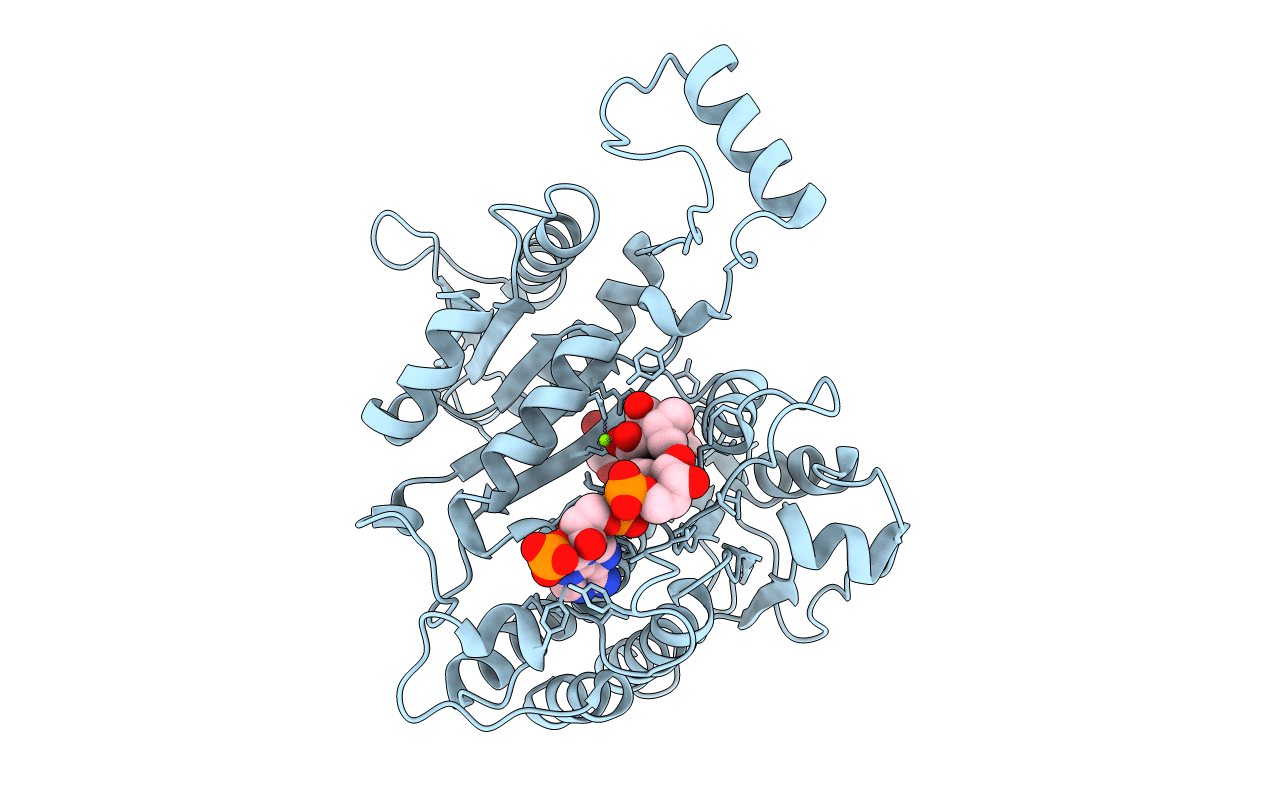
1HJ6 image
Deposition Date 2001-01-08
Release Date 2001-01-16
Last Version Date 2024-05-01
Entry Detail
PDB ID:
1HJ6
Keywords:
Title:
ISOCITRATE DEHYDROGENASE S113E MUTANT COMPLEXED WITH ISOPROPYLMALATE, NADP+ AND MAGNESIUM (FLASH-COOLED)
Biological Source:
Source Organism:
ESCHERICHIA COLI (Taxon ID: 562)
Host Organism:
Method Details:
Experimental Method:
Resolution:
2.00 Å
R-Value Free:
0.24
R-Value Work:
0.20
R-Value Observed:
0.20
Space Group:
P 43 21 2

Macromolecular Entities
Structures with similar UniProt ID
Protein Blast
Polymer Type:polypeptide(L)
Molecule:ISOCITRATE DEHYDROGENASE
Gene (Uniprot):icd
Mutagens:YES
Chain IDs:A
Chain Length:416
Number of Molecules:1
Biological Source:ESCHERICHIA COLI
Primary Citation
Structural Basis for a Change in Substrate Specificity: Crystal Structure of S113E Isocitrate Dehydrogenase in a Complex with Isopropylmalate, Mg2+ and Nadp
Biochemistry 40 4234 ? (2001)
PMID: 11284679 DOI: 10.1021/BI002533Q

Abstact

Isocitrate dehydrogenase (IDH) catalyzes the oxidative decarboxylation of isocitrate and has negligible activity toward other (R)-malate-type substrates. The S113E mutant of IDH significantly improves its ability to utilize isopropylmalate as a substrate and switches the substrate specificity (k(cat)/K(M)) from isocitrate to isopropylmalate. To understand the structural basis for this switch in substrate specificity, we have determined the crystal structure of IDH S113E in a complex with isopropylmalate, NADP, and Mg(2+) to 2.0 A resolution. On the basis of a comparison with previously determined structures, we identify distinct changes caused by the amino acid substitution and by the binding of substrates. The S113E complex exhibits alterations in global and active site conformations compared with other IDH structures that include loop and helix conformational changes near the active site. In addition, the angle of the hinge that relates the two domains was altered in this structure, which suggests that the S113E substitution and the binding of substrates act together to promote catalysis of isopropylmalate. Ligand binding results in reorientation of the active site helix that contains residues 113 through 116. E113 exhibits new interactions, including van der Waals contacts with the isopropyl group of isopropylmalate and a hydrogen bond with N115, which in turn forms a hydrogen bond with NADP. In addition, the loop and helix regions that bind NADP are altered, as is the loop that connects the NADP binding region to the active site helix, changing the relationship between substrates and enzyme. In combination, these interactions appear to provide the basis for the switch in substrate specificity.

Legend

Protein

Chemical

Disease

Primary Citation of related structures
Feedback Form
Name
Email
Institute
Feedback