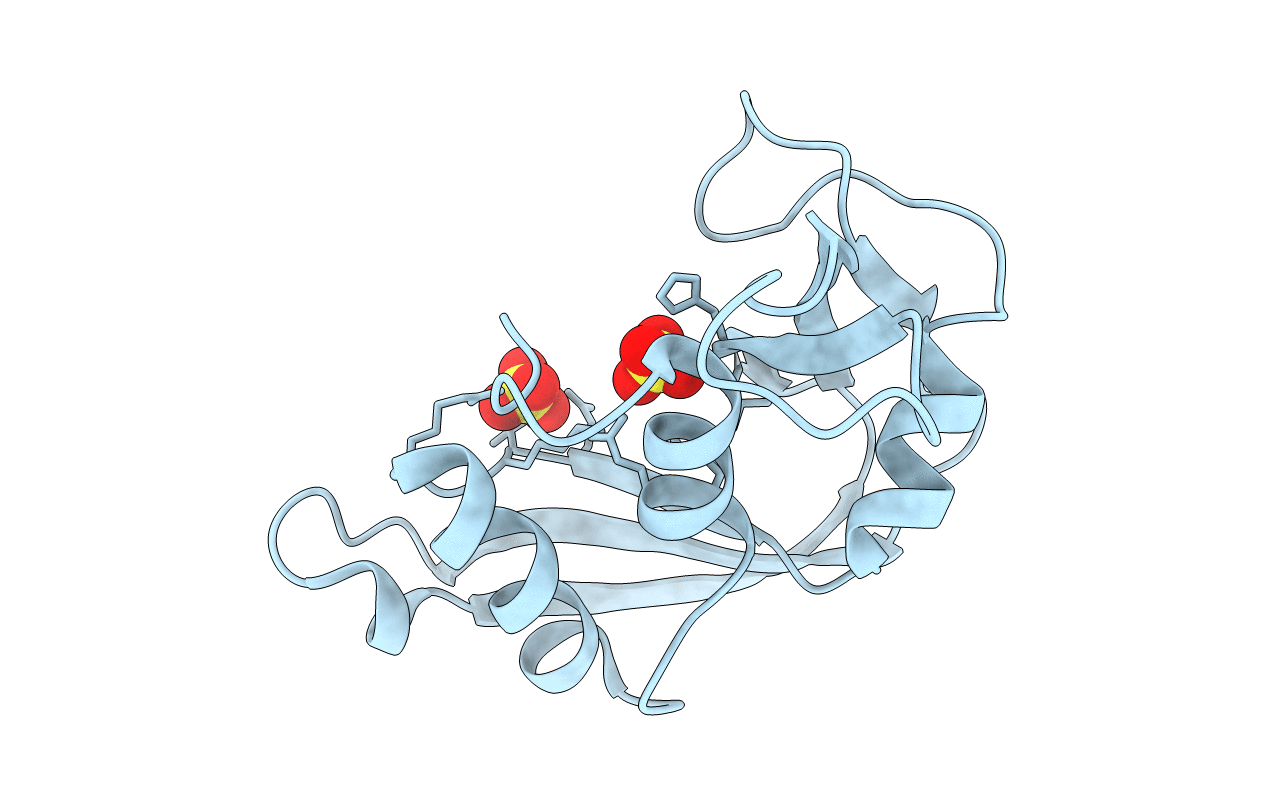
1HI2 image
Deposition Date 2001-01-02
Release Date 2001-05-31
Last Version Date 2024-11-20
Entry Detail
PDB ID:
1HI2
Keywords:
Title:
Eosinophil-derived Neurotoxin (EDN) - Sulphate Complex
Biological Source:
Source Organism:
HOMO SAPIENS (Taxon ID: 9606)
Host Organism:
Method Details:
Experimental Method:
Resolution:
1.60 Å
R-Value Free:
0.21
R-Value Work:
0.17
R-Value Observed:
0.17
Space Group:
P 21 21 21

Macromolecular Entities
Structures with similar UniProt ID
Protein Blast
Polymer Type:polypeptide(L)
Molecule:EOSINOPHIL-DERIVED NEUROTOXIN
Gene (Uniprot):RNASE2
Chain IDs:A
Chain Length:135
Number of Molecules:1
Biological Source:HOMO SAPIENS
Ligand Molecules
Primary Citation
Mapping the Ribonucleolytic Active Site of Eosinophil-Derived Neurotoxin (Edn): High Resolution Crystal Structures of Edn Complexes with Adenylic Nucleotide Inhibitors
J.Biol.Chem. 276 15009 ? (2001)
PMID: 11154698 DOI: 10.1074/JBC.M010585200

Abstact

Eosinophil-derived neurotoxin (EDN), a basic ribonuclease found in the large specific granules of eosinophils, belongs to the pancreatic RNase A family. Although its physiological function is still unclear, it has been shown that EDN is a neurotoxin capable of inducing the Gordon phenomenon in rabbits. EDN is also a potent helminthotoxin and can mediate antiviral activity of eosinophils against isolated virions of the respiratory syncytial virus. EDN is a catalytically efficient RNase sharing similar substrate specificity with pancreatic RNase A with its ribonucleolytic activity being absolutely essential for its neurotoxic, helminthotoxic, and antiviral activities. The crystal structure of recombinant human EDN in the unliganded form has been determined previously (Mosimann, S. C., Newton, D. L., Youle, R. J., and James, M. N. G. (1996) J. Mol. Biol. 260, 540-552). We have now determined high resolution (1.8 A) crystal structures for EDN in complex with adenosine-3',5'-diphosphate (3',5'-ADP), adenosine-2',5'-di-phosphate (2',5'-ADP), adenosine-5'-diphosphate (5'-ADP) as well as for a native structure in the presence of sulfate refined at 1.6 A. The inhibition constant of these mononucleotides for EDN has been determined. The structures present the first detailed picture of differences between EDN and RNase A in substrate recognition at the ribonucleolytic active site. They also provide a starting point for the design of tight-binding inhibitors, which may be used to restrain the RNase activity of EDN.

Legend

Protein

Chemical

Disease

Primary Citation of related structures
Feedback Form
Name
Email
Institute
Feedback