1HG8 image
Deposition Date 2000-12-13
Release Date 2001-11-10
Last Version Date 2024-10-16
Entry Detail
PDB ID:
1HG8
Keywords:
Title:
Endopolygalacturonase from the phytopathogenic fungus Fusarium moniliforme
Biological Source:
Source Organism:
Method Details:
Experimental Method:
Resolution:
1.73 Å
R-Value Free:
0.20
R-Value Work:
0.17
Space Group:
P 21 21 21
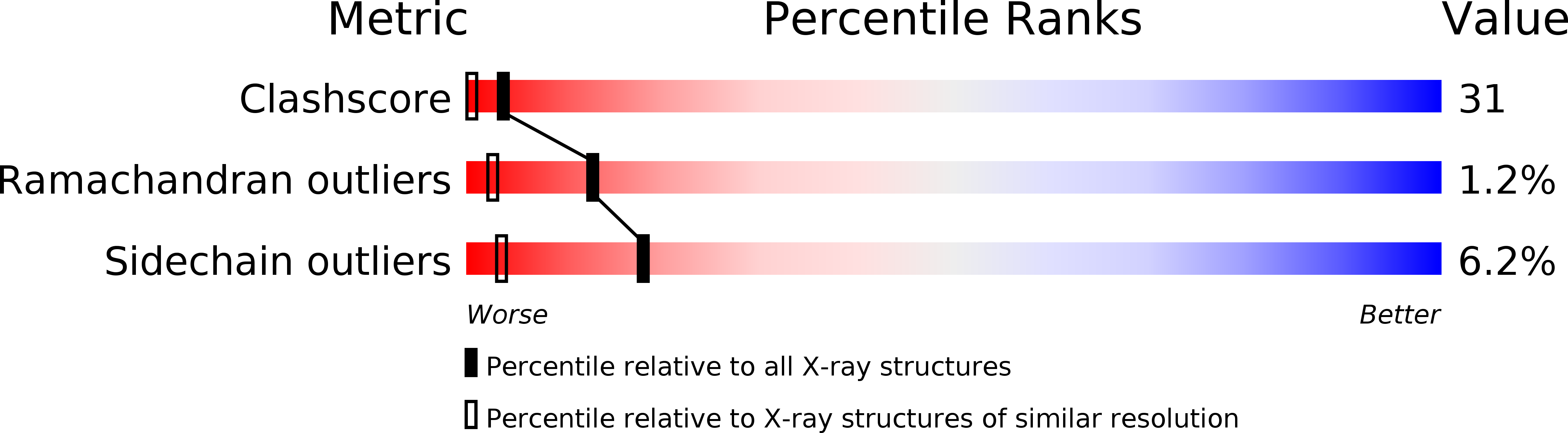
Macromolecular Entities
Structures with similar UniProt ID
Protein Blast
Polymer Type:polypeptide(L)
Molecule:ENDOPOLYGALACTURONASE
Gene (Uniprot):PGA
Chain IDs:A
Chain Length:349
Number of Molecules:1
Biological Source:FUSARIUM MONILIFORME
Modified Residue
Compound ID Chain ID Parent Comp ID Details 2D Image
ASN A ASN GLYCOSYLATION SITE
Ligand Molecules
Primary Citation
Structural Requirements of Endopolygalacturonase for the Interaction with Pgip (Polygalacturonase-Inhibiting Protein)
Proc.Natl.Acad.Sci.USA 98 13425 ? (2001)
PMID: 11687632 DOI: 10.1073/PNAS.231473698

Abstact

To invade a plant tissue, phytopathogenic fungi produce several cell wall-degrading enzymes; among them, endopolygalacturonase (PG) catalyzes the fragmentation and solubilization of homogalacturonan. Polygalacturonase-inhibiting proteins (PGIPs), found in the cell wall of many plants, counteract fungal PGs by forming specific complexes with them. We report the crystal structure at 1.73 A resolution of PG from the phytopathogenic fungus Fusarium moniliforme (FmPG). The structure of FmPG was useful to study the mode of interaction of the enzyme with PGIP-2 from Phaseolus vulgaris. Several amino acids of FmPG were mutated, and their contribution to the formation of the complex with PGIP-2 was investigated by surface plasmon resonance. The residues Lys-269 and Arg-267, located inside the active site cleft, and His-188, at the edge of the active site cleft, are critical for the formation of the complex, which is consistent with the observed competitive inhibition of the enzyme played by PGIP-2. The replacement of His-188 with a proline or the insertion of a tryptophan after position 270, variations that both occur in plant PGs, interferes with the formation of the complex. We suggest that these variations are important structural requirements of plant PGs to prevent PGIP binding.

Legend

Protein

Chemical

Disease

Primary Citation of related structures
Feedback Form
Name
Email
Institute
Feedback